

New Math: Division & Multiplication Problems
July 25, 2017
By Jack Roberts
MHSAA Executive Director
This is the second part in a series on MHSAA tournament classification, past and present, that will be published over the next two weeks. This series originally ran in this spring's edition of MHSAA benchmarks.
High school tournament classifications went viral before there was social media and most of us knew what “viral” meant.
Much as a virus infects computers today or has created epidemics of disease around the world for centuries, high school tournament classification – once introduced – tends to spread uncontrollably. Once started, it tends to keep expanding and rarely contracts.
While we are still some distance from providing every team a trophy as a result of expanding high school tournament classification across the country, there is criticism nevertheless that we are headed in that direction – a philosophy which is supposed to exist only in local youth sports for our youngest children.
Michigan could be blamed for all this. Michigan is generally accepted as the first state to provide different classifications for season-ending tournaments for different sized schools. It started a century ago. Today, every state has various classifications for its tournaments in most if not all sports. And it is a bit ironic that Michigan – creator of the classification chaos – more than most other states has kept the number of tournament classes or divisions under control.
Yes, there is evidence that tournament classifications have expanded over the years in Michigan, especially with the relatively recent introduction of tournaments in football and the late 1990s’ move from classes to divisions in most MHSAA tournaments. But the MHSAA Representative Council has held true to its word when it expanded the playoffs for football from four classes to eight divisions: this is needed because of unique factors of football, factors that exist in no other sport; and all other sports should be capped at a maximum of four classes or divisions.
Kentucky is the preeminent defender of single-class basketball. All of its 276 high schools compete for the single state championship for each gender. In Indiana, there are still open wounds from its move in 1998 from one to four classes for its 400 schools in basketball.
Multi-class tournaments have tended to increase the number of non-public school champions, which some states are trying to lower through enrollment “multipliers,” and also tend to increase the number of repeat champions, which some states are trying to affect with “success factors” which lift smaller schools into classifications for larger schools if they take home too many trophies.
While there is considerable evidence that state tournaments do as much bad as good for educational athletics, state associations persist in providing postseason tournaments because, on balance, the experiences are supposed to be good for student-athletes. And once we reach that conclusion it is just a small leap to believe that if the tournaments are good for a few, they must be better for more – which leads to creating more and more tournament classifications. One becomes two classes, then three, then four and so forth.
While the argument is that more classifications or divisions provides more students with opportunities to compete and win, it is undeniable that the experience changes as the number of tournament classifications expands. It is not possible for state associations to provide the same level of support when tournament classifications expand to multiple venues playing simultaneously. For example, there is less audio and video broadcast potential at each venue, and less media coverage to each venue. Focus is diluted and fans diminished at each championship.
No one can argue reasonably that today's two-day MHSAA Football Finals of eight championship games has the same pizazz as the one-day, four-games event conducted prior to 1990.
In some states the number of divisions has grown so much that it is difficult to see much difference between the many season-ending state championship games and a regular-season event in the same sport.
It is a balancing act. And Michigan has been studying that balance longer than any other state, and charting a steadier course than most.
Addition by Division
The shift to Divisions for MHSAA Tournament play in numerous sports has added up to a greater number of champions for teams and individuals across the state. Following are the sports currently employing a divisional format, and the procedures for determining enrollment and classification.
In 23 statewide or Lower Peninsula tournaments, schools which sponsor the sport are currently divided into nearly equal divisions. They are:
- Baseball - 4 Divisions
- Boys Bowling - 4 Divisions
- Girls Bowling - 4 Divisions
- Girls Competitive Cheer - 4 Divisions
- LP Boys Cross Country - 4 Divisions
- LP Girls Cross Country - 4 Divisions
- LP Boys Golf - 4 Divisions
- LP Girls Golf - 4 Divisions
- Ice Hockey - 3 Divisions
- Boys Lacrosse - 2 Divisions
- Girls Lacrosse - 2 Divisions
- Boys Skiing - 2 Divisions
- Girls Skiing - 2 Divisions
- LP Boys Soccer - 4 Divisions LP
- Girls Soccer - 4 Divisions
- Girls Softball - 4 Divisions
- LP Boys Swimming & Diving - 3 Divisions
- LP Girls Swimming & Diving - 3 Divisions
- LP Boys Tennis - 4 Divisions
- LP Girls Tennis - 4 Divisions
- LP Boys Track & Field - 4 Divisions
- LP Girls Track & Field - 4 Divisions
- Wrestling - 4 Divisions
Lists of schools for each division of these 23 tournaments are posted on MHSAA.com approximately April 1. Listings of schools in Upper Peninsula tournaments for their sports are also posted on MHSAA.com. The lists are based on school memberships and sports sponsorships in effect or anticipated for the following school year, as known to the MHSAA office as of a date in early March.
In football, the 256 schools which qualify for MHSAA 11-player playoffs are placed in eight equal divisions annually on Selection Sunday. Beginning in 2017, the 8-player divisions will be determined in a like manner on Selection Sunday as well, with 32 qualifying schools placed in two divisions.
Schools have the option to play in any higher division in one or more sports for a minimum of two years.
The deadlines for "opt-ups" are as follows:
- Applications for fall sports must be submitted by April 15
- Applications for winter sports must be submitted by Aug. 15
- Applications for spring sports must be submitted by Oct. 15
Subsequent to the date of these postings for these tournaments, no school will have its division raised or lowered by schools opening or closing, schools adding or dropping sports, schools exercising the option to play in a higher division, or approval or dissolution of cooperative programs.
When the same sport is conducted for boys and girls in the same season (e.g., track & field and cross country), the gender that has the most sponsoring schools controls the division breaks for both genders.
Performance: Trenton's Michael Wolsek
January 31, 2020
 Michael Wolsek
Trenton senior - Swimming
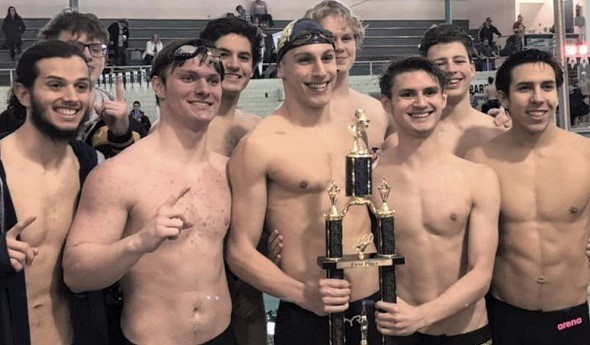
The Trenton senior standout set meet and pool records in the 200-yard freestyle (1:43.85) and 100 butterfly (50.03) at Allen Park on Saturday in helping the Trojans to the team victory at the Downriver Classic. Wolsek also was part of a meet and pool record-setting 200 medley relay (1:39.17) and meet record-breaking 400 freestyle (3:18.13) in earning the MHSAA “Performance of the Week” as Trenton claimed the Classic championship for the first time in five years.
Wolsek grew up in the pool; his father Robert was a Trenton record holder at one time and helped create the community’s youth swim lesson program, and three older siblings also starred for the Trojans. Michael holds school records in the 50 (21.52), 100 (47.60) and 200 freestyles (1:42.72), 100 butterfly (49.89), and as part of the record 400 free relay (3:17.52). All four of his individual school records also are league records, and he was also part of a league record 200 medley relay (1:39.14) as well. Wolsek finished second in the butterfly and fourth in the 200 free and swam on two scoring relays at last season’s Lower Peninsula Division 3 Finals, where Trenton finished ninth – also its current team state ranking this winter. He called his winter “just a culmination of all the great coaches I’ve had the opportunity to work with,” and obviously it’s paying off – Wolsek’s season-best fly time of 50.03 ranks first in the state by nearly a second, and his top 200 free time of 1:43.85 is eighth-fastest.
He’s part of a talented cast; among teammates, junior Spencer Boling-Hamer won the teams’ first Finals individual championship last season since 1969. Wolsek is one of three team captains and the first from his family to wear the “Helmet” – an honor bestowed on a senior annually to wear while leading the team into competition. Wolsek will continue his academic and athletic careers at Wayne State University. He carries a 3.7 GPA and is interested in majoring in kinesiology and studying exercise sciences.
Coach Jim DeRupa said: “Micheal has been a huge asset to the team. He has been focused on leading a younger group of swimmers. We have 18 new swimmers on the team this season. He shows his leadership as a captain by giving speeches at practices and meets to get the team fired up. He has helped the program significantly not only by winning events but by encouraging a team culture where everyone works hard and everyone is a part of the team. He is excited to see what the end of the season is going to bring for the team. He is focused on the current team, but is also excited to continue the sport in college.”
Performance Point: “This year, I feel like the whole team has come together in a way that I've never seen it come together,” Wolsek said. “I've had older siblings on the team, before I was in high school, and I've never seen the team come together quite like it (did) at the meet on Saturday. Everybody has been working so hard to make this team great. We're fighting for that league title this February. And the thing I take away (from Saturday) is when you're doing your swims for your teammates, the camaraderie and connection that we share, it helps. It makes it easier. I don't think I'm ever going to forget that sense of camaraderie that I felt on Saturday.”
Ready to lead: I’ve always loved taking every opportunity to be a leader on the team. I’ve been granted the opportunity this year as a senior leader to be able to not only help the freshmen and underclassmen and rookies with technique after practice, but I can also give speeches and have a more hands-on approach with my team. It’s just been absolutely awesome – the people I’ve met this year, the freshman are working so hard, and it’s probably been one of my favorite experiences just getting to meet and pass on what I’ve learned through my four years at this school to the younger guys.”
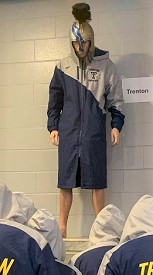 Wear ‘The Helmet’ proudly: “It’s a Trenton swim tradition. I believe it started in the 90s. Every year a senior who has the helmet passes it down to a junior who will be a senior the next year. And we have a very unique team chant that’s unlike anything else in the state of Michigan – we march out and align to a cowbell, and the person at the front of the line is wearing the Trojan helmet. … I’m so blessed to be a part of this culture. At Trenton High School, we’re very proud of our community, and our symbol, The Trojan, we’re very proud to represent that. Last year at our swim banquet, senior Donny Grocki passed it down to me … and after he gave it to me, he told me he gave it to me because he saw the work I put in and he saw the leadership that I demonstrated. When I found out I was the one who had it, I was very, very excited. It’s been my dream ever since I saw my brothers’ teams as a kid; you always see the guy wearing the Trojan helmet. I was very excited when I found out I got to represent our school like that.”
Watched and learning: “It’s definitely changed the way I think about the sport. I attribute a lot of my success to the opportunities I’ve had at home. My parents have always been extremely supportive of my swimming, and having older siblings that have all gone through the sport grants me the opportunity to be able to learn from their mistakes and to improve upon what I saw them doing. So I think the biggest thing is the culture at my house – every day I’m coming home and it’s swimming for breakfast, lunch and dinner, always swimming, and that’s definitely helped me.”
Science of speed: I’ve always been fascinated by locomotion and biomechanics, and they have a physical therapy and occupational therapy program at Wayne State which I’m looking to possibly pursue after getting my bachelor’s in kinesiology. Swimming’s been the one thing I’ve been consistently passionate about my entire life, and any of that that I can take into my professional career would just make it an absolute joy.”
– Geoff Kimmerly, Second Half editor
Past honorees
Jan. 24: Kensington Holland, Utica Ford bowling - Report
Jan. 17: Claycee West, White Pigeon basketball - Report
Jan. 10: Seth Lause, Livonia Stevenson hockey - Report
Dec. 5: Mareyohn Hrabowski, River Rouge football - Report
Nov. 28: Kathryn Ackerman, Grand Haven swimming - Report
Nov. 21: Emily Van Dyke, Southfield Christian volleyball - Report
Nov. 14: Taylor Wegener, Ida volleyball - Report
Nov. 7: Carter Solomon, Plymouth cross country - Report
Oct. 31: Jameson Goorman, Muskegon Western Michigan Christian soccer - Report
Oct. 24: Austin Plotkin, Brimley cross country - Report
Oct. 17: Jack Spamer, Brighton cross country - Report
Oct. 10: Kaylee Maat, Hudsonville volleyball - Report
Oct. 3: Emily Paupore, Negaunee cross country - Report
Sept. 26: Josh Mason, South Lyon soccer - Report
Sept. 19: Ariel Chang, Utica Eisenhower golf - Report
Sept. 12: Jordyn Shipps, DeWitt swimming - Report
PHOTOS: (Top) Trenton's Michael Wolsek, holding onto the Downriver Classic trophy with his right hand, is surrounded by teammates after the Trojans won Saturday's event. (Middle) Wolsek, in the team's Trojan helmet, provides some final motivation before an earlier meet this winter. (Photos courtesy of the Trenton boys swimming & diving program.)