

New Math: Division & Multiplication Problems
July 25, 2017
By Jack Roberts
MHSAA Executive Director
This is the second part in a series on MHSAA tournament classification, past and present, that will be published over the next two weeks. This series originally ran in this spring's edition of MHSAA benchmarks.
High school tournament classifications went viral before there was social media and most of us knew what “viral” meant.
Much as a virus infects computers today or has created epidemics of disease around the world for centuries, high school tournament classification – once introduced – tends to spread uncontrollably. Once started, it tends to keep expanding and rarely contracts.
While we are still some distance from providing every team a trophy as a result of expanding high school tournament classification across the country, there is criticism nevertheless that we are headed in that direction – a philosophy which is supposed to exist only in local youth sports for our youngest children.
Michigan could be blamed for all this. Michigan is generally accepted as the first state to provide different classifications for season-ending tournaments for different sized schools. It started a century ago. Today, every state has various classifications for its tournaments in most if not all sports. And it is a bit ironic that Michigan – creator of the classification chaos – more than most other states has kept the number of tournament classes or divisions under control.
Yes, there is evidence that tournament classifications have expanded over the years in Michigan, especially with the relatively recent introduction of tournaments in football and the late 1990s’ move from classes to divisions in most MHSAA tournaments. But the MHSAA Representative Council has held true to its word when it expanded the playoffs for football from four classes to eight divisions: this is needed because of unique factors of football, factors that exist in no other sport; and all other sports should be capped at a maximum of four classes or divisions.
Kentucky is the preeminent defender of single-class basketball. All of its 276 high schools compete for the single state championship for each gender. In Indiana, there are still open wounds from its move in 1998 from one to four classes for its 400 schools in basketball.
Multi-class tournaments have tended to increase the number of non-public school champions, which some states are trying to lower through enrollment “multipliers,” and also tend to increase the number of repeat champions, which some states are trying to affect with “success factors” which lift smaller schools into classifications for larger schools if they take home too many trophies.
While there is considerable evidence that state tournaments do as much bad as good for educational athletics, state associations persist in providing postseason tournaments because, on balance, the experiences are supposed to be good for student-athletes. And once we reach that conclusion it is just a small leap to believe that if the tournaments are good for a few, they must be better for more – which leads to creating more and more tournament classifications. One becomes two classes, then three, then four and so forth.
While the argument is that more classifications or divisions provides more students with opportunities to compete and win, it is undeniable that the experience changes as the number of tournament classifications expands. It is not possible for state associations to provide the same level of support when tournament classifications expand to multiple venues playing simultaneously. For example, there is less audio and video broadcast potential at each venue, and less media coverage to each venue. Focus is diluted and fans diminished at each championship.
No one can argue reasonably that today's two-day MHSAA Football Finals of eight championship games has the same pizazz as the one-day, four-games event conducted prior to 1990.
In some states the number of divisions has grown so much that it is difficult to see much difference between the many season-ending state championship games and a regular-season event in the same sport.
It is a balancing act. And Michigan has been studying that balance longer than any other state, and charting a steadier course than most.
Addition by Division
The shift to Divisions for MHSAA Tournament play in numerous sports has added up to a greater number of champions for teams and individuals across the state. Following are the sports currently employing a divisional format, and the procedures for determining enrollment and classification.
In 23 statewide or Lower Peninsula tournaments, schools which sponsor the sport are currently divided into nearly equal divisions. They are:
- Baseball - 4 Divisions
- Boys Bowling - 4 Divisions
- Girls Bowling - 4 Divisions
- Girls Competitive Cheer - 4 Divisions
- LP Boys Cross Country - 4 Divisions
- LP Girls Cross Country - 4 Divisions
- LP Boys Golf - 4 Divisions
- LP Girls Golf - 4 Divisions
- Ice Hockey - 3 Divisions
- Boys Lacrosse - 2 Divisions
- Girls Lacrosse - 2 Divisions
- Boys Skiing - 2 Divisions
- Girls Skiing - 2 Divisions
- LP Boys Soccer - 4 Divisions LP
- Girls Soccer - 4 Divisions
- Girls Softball - 4 Divisions
- LP Boys Swimming & Diving - 3 Divisions
- LP Girls Swimming & Diving - 3 Divisions
- LP Boys Tennis - 4 Divisions
- LP Girls Tennis - 4 Divisions
- LP Boys Track & Field - 4 Divisions
- LP Girls Track & Field - 4 Divisions
- Wrestling - 4 Divisions
Lists of schools for each division of these 23 tournaments are posted on MHSAA.com approximately April 1. Listings of schools in Upper Peninsula tournaments for their sports are also posted on MHSAA.com. The lists are based on school memberships and sports sponsorships in effect or anticipated for the following school year, as known to the MHSAA office as of a date in early March.
In football, the 256 schools which qualify for MHSAA 11-player playoffs are placed in eight equal divisions annually on Selection Sunday. Beginning in 2017, the 8-player divisions will be determined in a like manner on Selection Sunday as well, with 32 qualifying schools placed in two divisions.
Schools have the option to play in any higher division in one or more sports for a minimum of two years.
The deadlines for "opt-ups" are as follows:
- Applications for fall sports must be submitted by April 15
- Applications for winter sports must be submitted by Aug. 15
- Applications for spring sports must be submitted by Oct. 15
Subsequent to the date of these postings for these tournaments, no school will have its division raised or lowered by schools opening or closing, schools adding or dropping sports, schools exercising the option to play in a higher division, or approval or dissolution of cooperative programs.
When the same sport is conducted for boys and girls in the same season (e.g., track & field and cross country), the gender that has the most sponsoring schools controls the division breaks for both genders.
Miller's Mentoring Spans Into 7th Decade
January 29, 2020
By Mike Spencer
Special for Second Half
MAPLE CITY – With the dawn this winter of the 2020s, Don Miller is coaching high school basketball in a seventh decade.
 That’s rarefied air in Michigan High School Athletic Association circles, but it’s an atmosphere the 73-year-old longtime Maple City Glen Lake basketball coach has enjoyed and plans to continue as long as his health, family and Laker nation lets him.
“I have a passion for the bouncing of balls in a gym,” said Miller, who made his coaching debut at Howell in 1969 but then spent five decades guiding the Lakers’ ship. “The worst headache I may have disappears with that sound as I walk into a gym. The blood pressure goes down and the pleasure goes up – practices or games.”
Miller, admittedly the last man on his varsity basketball team at Southfield High during his playing days, coached a lot of good teams and players at Glen Lake during his varsity tenure (1973-2004) when he posted a 523-210 record.
“I didn’t have a lot of basketball skill, but I was a basketball junkie who got the bug to coach and I got better over the years,” Miller said. “I never scored a basket over the years, but I had a lot of players who made me look good. The kids loved the game and had the passion, and we had a spinning wheel of success breeding success.”
A Michigan State University grad, Miller enjoyed watching the Spartans practice after classes, although he never could have forecasted he’d become a Basketball Coaches Association of Michigan (BCAM) Hall of Famer in 1998 or enjoy decades of leading drills.
“Basketball is all about great chemistry, and being with young people sharing a game we love is just wonderful,” Miller said. “And to be able to do it this long is a gift, not a job. I am truly blessed to be in a gym for three hours a day.”
Today, there’s just a handful of active MHSAA coaches with Miller’s experience. Ironically, one of them is Beaverton’s Roy Johnston. Miller was an assistant of Johnston’s back in the early 1970s.
 “I’m shocked to see Don still coaching,” said Cody Inglis, a former Suttons Bay athletic director/coach who worked Miller’s camps for a decade and went on to serve as athletic director at Traverse City Central and currently as an MHSAA assistant director. “But it shows that if there’s something you are good at, and something that you are passionate about, that you are never too old to do it.
“Don’s been a wonderful role model for coaching, perseverance and doing it the right way.”
Former player Todd Ciolek, who also has had a child play for Miller, concurred.
“It’s pretty amazing,” Ciolek said of Miller’s tenure. “But when you have a love for something, it makes it easy to do. For him, he’s got a love for this and I think it comes naturally.”
Miller guided the Lakers boys team to the Class D title in 1977 and runner-up finish in 1996. His teams also reached the MHSAA Semifinals twice. His teams won six Regionals, 16 Districts and 14 conference titles.
He stepped down as Glen Lake’s main man after the 2004 season due to health issues, needing a pacemaker and a stent. He continued running his summer basketball camps and became a volunteer assistant coach for former all-state player Todd Hazelton in 2007.
When Rich Ruelas became head coach in 2015, he asked Miller to be his junior varsity coach. Miller did that for three seasons and is now an assistant varsity coach.
“I was reborn!” Miller said. “I don’t eat and sleep basketball like I used to, but I love my three hours each day with these young men who share this common passion. It’s been a lifesaver.
“My role is advisor and listener,” he added. “But watching Rich, he’s me 30 years ago. I love feeding off his intensity.”
“I truly enjoy having Coach Miller as part of the program that he helped build,” Ruelas said. “There is nothing he hasn't gone through as a coach, and I have relied on him for advice over the past five years.
“He just knows the game so well and has made such an impact on the lives of his former players and campers with his ability to teach life lessons through basketball. We are lucky to have a Hall of Fame coach as part of our program, and I don't take it for granted.”
Ruelas and Miller, a retired educator, not only get together three hours in a gym daily, they routinely have “Mornings with Miller,” on the phone as Ruelas makes his 30-minute commute to school.
Ruelas said Miller has already given him some memorable moments – the unbeaten junior varsity team in 2018 that Miller coached, assistance with the Lakers’ 2018 Finals run (Glen Lake finished Class C runner-up) and an opportunity to meet MSU coach Tom Izzo.
 “What sticks out to me most is that we cannot go anywhere in the state without Don running into a former camper or player,” Ruelas said. “He has made such a lasting impact on so many, and it is evident in his relationships with his former players over the past seven decades.
“I'm not sure how long he will continue to be on the bench with me, but I know he still has a lot of fire in his belly. As long as he has permission from his wife and is able, I expect him to be there.”
One of Miller’s trademarks is teaching life lessons first and basketball second.
“Don was a unique coach,” Ciolek said. “He wasn’t a coach of basketball first; he was a coach of ethics and morals and basketball came second.
“Most coaches start with some technique, but he started with the word respect and then engrained in us that there was more beyond basketball. He instilled a set of values in us that ultimately led to victories.”
While Miller has had decades of success, some of the losses were devastating.
“You remember the losses more than the wins, and three last-second losses are forever etched in my brain,” said Miller noting a 1978 loss to Mio and Jay Smith in the Regional Final at Gaylord, a buzzer-beating in 1988 by eventual Class D champ Northport and the 1996 Semifinal loss to Wyoming Tri-unity Christian. “The pain and tears and disappointment of these three were great memories. But losses are part of the game and the boys, now men on those teams, have made me very proud ever since.”
Miller said he’s seen a lot of things change for the better since he started coaching. Players are starting younger and getting better coaching earlier, and that has led to improved talent and team play. There are also nicer gyms and uniforms, and Miller loves the idea of boys sharing the spotlight with girls programs.
His disdains, however, are that larger schools today have kids who tend to specialize in one sport earlier, and the crowd of negative parents is growing.
“Our kids play several sports, and I feel it makes them better,” Miller said. “Playing for other coaches in other sports increases competitiveness and team play. You learn to be a different role player, and that carries over into life. “
Miller said credit for his decades of success goes to his supportive wife, Sandy, and the blind luck of having Paul Christiansen as his first junior varsity coach.
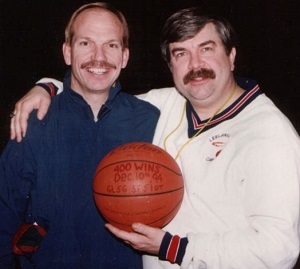
“Paul was my organizer, critic, conscience and cohort for three decades,” Miller said. “He is a Hall of Fame track coach but the real wind beneath my wings. None of this happens without Paul.”
 Both Miller and Christiansen were honored by BCAM in 1998, with Miller going into the HOF and Christiansen going into the Hall of Honor.
Miller also credits a number of coaching mentors including the late Larry Glass, a former Big Ten men’s coach and girls basketball coach at Leland, and great players and coaches he recruited to help at his summer camps in Wolverine and Glen Lake.
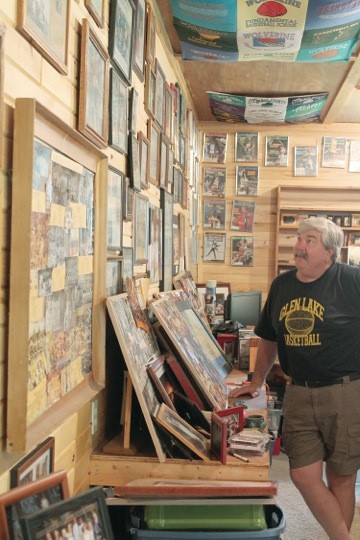
While Miller savors the friendships with other coaches, he’ll forever cherish his former players, who reciprocated their love by building him a man cave and basketball museum after he retired in 2004 and show up for weekly games of basketball at the Glen Arbor Town Hall – a 40-year-old tradition – with fellowship afterward.
“They call, email and treat me to meals out which really is too bad for my figure but great for my ego and friendships,” Miller admitted. “I love my boys (now men) and for that, I am truly the luckiest.”
“I was fortunate enough to be coached by Don when he was just starting out at Howell,” said Tom Murray, former Bay City John Glenn and Standish-Sterling Central coach. “He changed my life and many of my classmate’s lives.
“Don’s touched so many lives, it’s incredible. He instilled a lifelong love of basketball in me. He is a fantastic coach and man.”
Mike Spencer is a former MHSAA referee and sportswriter for the Bay City Times, Midland Daily News and Leelanau Enterprise and freelancer for both the Enterprise and the Traverse City Record Eagle.
Seven Decades of Miller Highlights
1960s – Last man on the Southfield High team. Watching MSU practice after class without a clue that he would coach someday. Getting hired in 1969 as the freshman coach at Howell because no else wanted the job and coaching Morey Ray, his first great player.
1970s – Coaching the 1977 Class D championship season and the slow evolution over the years of the front line of seniors Dave Prentice, Geof Kotila and Rick Baillergeon, who started for three years. Being down three points, without the ball and 30 seconds to go, and winning the Final by two on a shot with one second left against the No. 1-ranked team in the state, Detroit East Catholic, 70-68.
1980s – Keeping the ball rolling and seeing four of those starters – from the 1977 and 1978 teams – become captains of a college team. Reaching the quarters in 1980, the semis in 1981, 1984 and 1985. Standouts included Bob Sutherland (’80), Bill Zolman and Kevin Crinion (’81), Ron Winowiecki and Dan Witkowski (’84), and Mike Crinion and Ross Hazelton (’85). Beating No. 1 Bear Lake at Traverse City Central in front of 2,800 fans – “Loudest gym. Teamwork over talent and Mike Crinion was amazing.”
 1990s – Keeping ball rolling as elementary kids became high school stars. Reaching the quarters in 1991 and 1995 and semis in 1996. Standouts included Micah Deegan and Bryan Fosmore (’91), Todd Ciolek and Max Miller (’95), and Jamie Mazurek and Greg Aylsworth (‘96). Semifinal upset of reigning Class D champ Detroit Holy Redeemer, 81-66.
2000s – Retired in 2004, but with recent adoring memories of 2002 league and District championship team led by Chris Milliron and Steve Walker. Team showed great improvement in ability and attitude, avenging losses to Suttons Bay and Traverse City St. Francis with 24-point victories.
2010s – Returned in 2015 as assistant coach to Rich Ruelas and coached the boys junior varsity to 55-5 record over his first two seasons with three sophomores and a freshman on the varsity. Posted two 20-0 seasons.
2020 – Still coaching as an assistant.
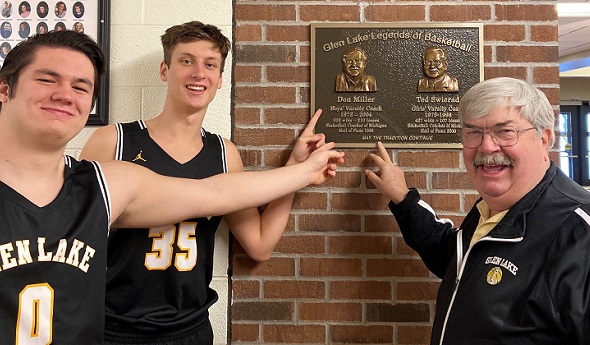
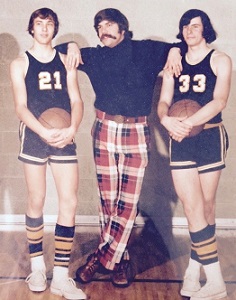
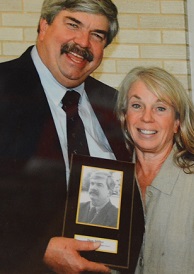
PHOTOS: (Top) Glen Lake assistant boys basketball coach Don Miller, with captains Ben Kroll (left) and Reece Hazelton, point to the plaque declaring his legendary status in the program. (2) Miller confers with a pair of players during the 1977 Class D championship season. (3) Miller and his wife Sandy. (4) Miller stands among the many mementos decorating his basketball museum built by former players. (5) Miller stands with longtime assistant Paul Christiansen, holding a ball commemorating Miller’s 400th coaching win in 1994. (Photos courtesy of Don Miller and the Leelanau Enterprise.)