

New Math: Division & Multiplication Problems
July 25, 2017
By Jack Roberts
MHSAA Executive Director
This is the second part in a series on MHSAA tournament classification, past and present, that will be published over the next two weeks. This series originally ran in this spring's edition of MHSAA benchmarks.
High school tournament classifications went viral before there was social media and most of us knew what “viral” meant.
Much as a virus infects computers today or has created epidemics of disease around the world for centuries, high school tournament classification – once introduced – tends to spread uncontrollably. Once started, it tends to keep expanding and rarely contracts.
While we are still some distance from providing every team a trophy as a result of expanding high school tournament classification across the country, there is criticism nevertheless that we are headed in that direction – a philosophy which is supposed to exist only in local youth sports for our youngest children.
Michigan could be blamed for all this. Michigan is generally accepted as the first state to provide different classifications for season-ending tournaments for different sized schools. It started a century ago. Today, every state has various classifications for its tournaments in most if not all sports. And it is a bit ironic that Michigan – creator of the classification chaos – more than most other states has kept the number of tournament classes or divisions under control.
Yes, there is evidence that tournament classifications have expanded over the years in Michigan, especially with the relatively recent introduction of tournaments in football and the late 1990s’ move from classes to divisions in most MHSAA tournaments. But the MHSAA Representative Council has held true to its word when it expanded the playoffs for football from four classes to eight divisions: this is needed because of unique factors of football, factors that exist in no other sport; and all other sports should be capped at a maximum of four classes or divisions.
Kentucky is the preeminent defender of single-class basketball. All of its 276 high schools compete for the single state championship for each gender. In Indiana, there are still open wounds from its move in 1998 from one to four classes for its 400 schools in basketball.
Multi-class tournaments have tended to increase the number of non-public school champions, which some states are trying to lower through enrollment “multipliers,” and also tend to increase the number of repeat champions, which some states are trying to affect with “success factors” which lift smaller schools into classifications for larger schools if they take home too many trophies.
While there is considerable evidence that state tournaments do as much bad as good for educational athletics, state associations persist in providing postseason tournaments because, on balance, the experiences are supposed to be good for student-athletes. And once we reach that conclusion it is just a small leap to believe that if the tournaments are good for a few, they must be better for more – which leads to creating more and more tournament classifications. One becomes two classes, then three, then four and so forth.
While the argument is that more classifications or divisions provides more students with opportunities to compete and win, it is undeniable that the experience changes as the number of tournament classifications expands. It is not possible for state associations to provide the same level of support when tournament classifications expand to multiple venues playing simultaneously. For example, there is less audio and video broadcast potential at each venue, and less media coverage to each venue. Focus is diluted and fans diminished at each championship.
No one can argue reasonably that today's two-day MHSAA Football Finals of eight championship games has the same pizazz as the one-day, four-games event conducted prior to 1990.
In some states the number of divisions has grown so much that it is difficult to see much difference between the many season-ending state championship games and a regular-season event in the same sport.
It is a balancing act. And Michigan has been studying that balance longer than any other state, and charting a steadier course than most.
Addition by Division
The shift to Divisions for MHSAA Tournament play in numerous sports has added up to a greater number of champions for teams and individuals across the state. Following are the sports currently employing a divisional format, and the procedures for determining enrollment and classification.
In 23 statewide or Lower Peninsula tournaments, schools which sponsor the sport are currently divided into nearly equal divisions. They are:
- Baseball - 4 Divisions
- Boys Bowling - 4 Divisions
- Girls Bowling - 4 Divisions
- Girls Competitive Cheer - 4 Divisions
- LP Boys Cross Country - 4 Divisions
- LP Girls Cross Country - 4 Divisions
- LP Boys Golf - 4 Divisions
- LP Girls Golf - 4 Divisions
- Ice Hockey - 3 Divisions
- Boys Lacrosse - 2 Divisions
- Girls Lacrosse - 2 Divisions
- Boys Skiing - 2 Divisions
- Girls Skiing - 2 Divisions
- LP Boys Soccer - 4 Divisions LP
- Girls Soccer - 4 Divisions
- Girls Softball - 4 Divisions
- LP Boys Swimming & Diving - 3 Divisions
- LP Girls Swimming & Diving - 3 Divisions
- LP Boys Tennis - 4 Divisions
- LP Girls Tennis - 4 Divisions
- LP Boys Track & Field - 4 Divisions
- LP Girls Track & Field - 4 Divisions
- Wrestling - 4 Divisions
Lists of schools for each division of these 23 tournaments are posted on MHSAA.com approximately April 1. Listings of schools in Upper Peninsula tournaments for their sports are also posted on MHSAA.com. The lists are based on school memberships and sports sponsorships in effect or anticipated for the following school year, as known to the MHSAA office as of a date in early March.
In football, the 256 schools which qualify for MHSAA 11-player playoffs are placed in eight equal divisions annually on Selection Sunday. Beginning in 2017, the 8-player divisions will be determined in a like manner on Selection Sunday as well, with 32 qualifying schools placed in two divisions.
Schools have the option to play in any higher division in one or more sports for a minimum of two years.
The deadlines for "opt-ups" are as follows:
- Applications for fall sports must be submitted by April 15
- Applications for winter sports must be submitted by Aug. 15
- Applications for spring sports must be submitted by Oct. 15
Subsequent to the date of these postings for these tournaments, no school will have its division raised or lowered by schools opening or closing, schools adding or dropping sports, schools exercising the option to play in a higher division, or approval or dissolution of cooperative programs.
When the same sport is conducted for boys and girls in the same season (e.g., track & field and cross country), the gender that has the most sponsoring schools controls the division breaks for both genders.
Kelsey Carries Well Richards' Legacy
January 9, 2020
By Tom Kendra
Special for Second Half
Kelsey Richards is constantly compared to her older sisters, which doesn’t bother her one bit.
 “They were both amazing players, so I’ll take it,” Kelsey said with her big smile, which is on display seemingly everywhere – except during her basketball games.
“I feel like it’s my time. It’s my time to show my senior leadership and my love for Christ as we play.”
Kelsey, a 6-0 senior, like older sisters Taylor and Allyson before her, is a fifth-year varsity starter for Fruitport Calvary Christian, a school of just 72 students which the Richards girls – with the help of their father and 10th-year coach Brad Richards – have transformed into a Division 4 powerhouse in West Michigan.
Fruitport Calvary has averaged 20 wins per season over the past nine years, with seven consecutive Alliance League championships and six straight MHSAA District titles. In five of those seasons, Calvary’s tournament run ended at the hands of state power Mount Pleasant Sacred Heart in Regional Finals.
But last year, the Eagles flew south for Regionals and Kelsey scored 21 points as they broke through with a 49-46 victory over Mendon for the school’s first-ever Regional championship in any sport. Calvary lost in the Quarterfinals to eventual Division 4 champion Adrian Lenawee Christian.
“It’s just a real blessing,” Coach Richards explained after a lopsided victory Tuesday night over visiting Hudsonville Libertas Christian. “We put God first, family second and basketball third. This school has allowed us to do all three of those things at one time, and we are so thankful for that.”
This year, the Eagles are off to a 6-2 start, with losses coming against Division 3 opponents Muskegon Western Michigan Christian and Hart, and the most notable win 50-46 over Division 2 Central Montcalm last week at the Cornerstone University Holiday Tournament. Richards matched her jersey number with 33 points in that game.
Fruitport Calvary will be shooting for its 51st consecutive Alliance League victory when it opens conference play Friday night at Byron Center Zion Christian.
 The first constant for the Eagles over the past nine years is an ultra-aggressive style of play, using relentless full-court pressure to break teams down. As a result, Calvary gets to the free-throw line often, with the goal every game to make more free throws than the other team attempts.
The second constant is the dominating play of the Richards sisters.
Taylor Richards put Calvary girls basketball on the map before graduating in 2014. She remains the school’s all-time career leader in points (2,455), rebounds (1,541) and assists (381). Taylor went on to a standout career at Cornerstone University in Grand Rapids and now coaches eighth-grade girls basketball at Northern Hills Middle School.
Allyson Richards had an amazing prep career of her own, graduating in 2017 as the school’s second-leading career scorer (1,951) and rebounder (1,167). She is now a junior forward for Cornerstone, but has played less than half the team’s games this season due to injuries.
Kelsey, who like her sisters has the ability to play every position on the court, is moving up the school’s record book. The two-time all-stater has scored 1,879 points and needs just 73 to surpass Allyson for second place on the school record list.
Some of Calvary’s best seasons came when the Richards sisters played together. While the three never played varsity at the same time, Taylor and Allyson played together for three years, while Allyson and Kelsey played together for two years.
Kelsey has not had a sibling on the roster for the past three years, but filling that void admirably has been 6-0 senior Lizzie Cammenga. Richards and Cammenga are the only seniors on Calvary’s 10-player roster, and both are fifth-year varsity players and returning all-staters, who can play any position based on the opponent. (Schools with fewer than 100 students may play eighth graders on high school teams, although only their statistics from grades 9-12 count toward MHSAA record book consideration.)
“This team is a joy to coach,” explained Brad Richards, who previously coached girls basketball for 12 years at Ravenna and was named The Associated Press Class C state Coach of the Year in 2002. “Lizzie and Kelsey are our leaders, but all of these girls come from great families and are self-motivated to keep getting better.”
The final piece of the Richards basketball puzzle is younger brother Bradley, a 6-foot-3 seventh grader at Calvary. Coach Richards is considering switching over to boys basketball after this season for the opportunity to coach his son.
Richards retired from teaching history at Ravenna in 2018, which gives him more time to devote to coaching, his second career as a realtor and now an unexpected “mid-life adventure” which has made him a national television figure.
 Richards is one of the researchers in “The Curse of Civil War Gold,” a series which premiered on The History Channel in the spring of 2018 and has reached an estimated 24.2 million viewers.
The show theorizes that Union soldiers confiscated millions of dollars in Confederate gold and silver during the final stages of the Civil War, then carried out a plot to smuggle the loot back to Michigan using the railway system and then laundered it through the banking system. According to a lighthouse keeper's deathbed confession years later, part of the stolen Confederate treasury was put into a train car on a barge and pushed off a ferry into Lake Michigan.
“It’s been a lot of fun and people from all over come up to me and talk about it,” said Richards, who has traveled as far away as Utah and Georgia to do research. “I am grateful to be a part of this project. I've been blessed by the Lord through this mid-life adventure.”
On the court, Kelsey and her father are focused on getting better each game to try and make another postseason run.
Kelsey is much happier talking about her teammates than herself, pointing out the improvement of the team’s other three starters – junior Kyra Hamilton, sophomore Cate Anhalt and freshman McKena Wilson.
“Each of the teams I’ve played on has been very different, but I’ve been really surprised how well some of our younger girls have played this year,” said Kelsey, noting Anhalt’s improved shooting and Wilson’s ability to stay calm in pressure situations.
Kelsey does plan to break one family tradition by not going to Cornerstone University, opting instead to play basketball at Spring Arbor College, an evangelical Christian school near Jackson. Brad played basketball at Cornerstone, her mother, Joy, played volleyball there and her two older sisters played basketball – but she chose a different path.
“I felt very comfortable when I visited Spring Arbor and I really like the girls on the team and Coach (Ryan) Frost,” said Kelsey, 17, who plans to sign with Spring Arbor on Jan. 28.
But first, she is determined to make the most of her final prep basketball season and the final five months of high school, where she is one of just 14 seniors.
“I really enjoy that we are small, because we are more like a family here,” said Kelsey, who runs track in the spring. “As big as basketball is for me, I really love being a chapel leader at school and a worship leader for youth group. A lot of people know me as a basketball player, but that part of my life is really important to me.”
 Tom Kendra worked 23 years at The Muskegon Chronicle, including five as assistant sports editor and the final six as sports editor through 2011. E-mail him at [email protected] with story ideas for Muskegon, Oceana, Mason, Lake, Oceola, Mecosta and Newaygo counties.
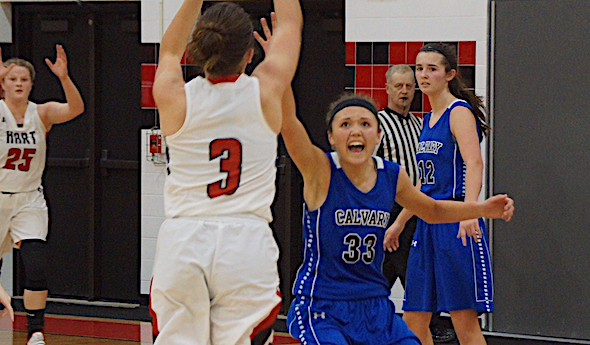
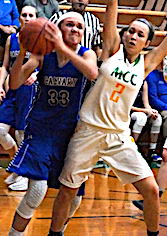
PHOTOS: (Top) Kelsey Richards defends during a game earlier this season against Hart. (Middle) Richards works to get past a Muskegon Catholic Central defender last season. (Below) The Richards children, from left: Kelsey Richards, Allyson Richards (junior at Cornerstone), Bradley Richards (6-3 seventh grader at Fruitport Calvary Christian) and Taylor Richards (Cornerstone graduate). (Action photos courtesy of Dr. Tom Watkins; family photo courtesy of the Richards family.)