

New Math: Division & Multiplication Problems
July 25, 2017
By Jack Roberts
MHSAA Executive Director
This is the second part in a series on MHSAA tournament classification, past and present, that will be published over the next two weeks. This series originally ran in this spring's edition of MHSAA benchmarks.
High school tournament classifications went viral before there was social media and most of us knew what “viral” meant.
Much as a virus infects computers today or has created epidemics of disease around the world for centuries, high school tournament classification – once introduced – tends to spread uncontrollably. Once started, it tends to keep expanding and rarely contracts.
While we are still some distance from providing every team a trophy as a result of expanding high school tournament classification across the country, there is criticism nevertheless that we are headed in that direction – a philosophy which is supposed to exist only in local youth sports for our youngest children.
Michigan could be blamed for all this. Michigan is generally accepted as the first state to provide different classifications for season-ending tournaments for different sized schools. It started a century ago. Today, every state has various classifications for its tournaments in most if not all sports. And it is a bit ironic that Michigan – creator of the classification chaos – more than most other states has kept the number of tournament classes or divisions under control.
Yes, there is evidence that tournament classifications have expanded over the years in Michigan, especially with the relatively recent introduction of tournaments in football and the late 1990s’ move from classes to divisions in most MHSAA tournaments. But the MHSAA Representative Council has held true to its word when it expanded the playoffs for football from four classes to eight divisions: this is needed because of unique factors of football, factors that exist in no other sport; and all other sports should be capped at a maximum of four classes or divisions.
Kentucky is the preeminent defender of single-class basketball. All of its 276 high schools compete for the single state championship for each gender. In Indiana, there are still open wounds from its move in 1998 from one to four classes for its 400 schools in basketball.
Multi-class tournaments have tended to increase the number of non-public school champions, which some states are trying to lower through enrollment “multipliers,” and also tend to increase the number of repeat champions, which some states are trying to affect with “success factors” which lift smaller schools into classifications for larger schools if they take home too many trophies.
While there is considerable evidence that state tournaments do as much bad as good for educational athletics, state associations persist in providing postseason tournaments because, on balance, the experiences are supposed to be good for student-athletes. And once we reach that conclusion it is just a small leap to believe that if the tournaments are good for a few, they must be better for more – which leads to creating more and more tournament classifications. One becomes two classes, then three, then four and so forth.
While the argument is that more classifications or divisions provides more students with opportunities to compete and win, it is undeniable that the experience changes as the number of tournament classifications expands. It is not possible for state associations to provide the same level of support when tournament classifications expand to multiple venues playing simultaneously. For example, there is less audio and video broadcast potential at each venue, and less media coverage to each venue. Focus is diluted and fans diminished at each championship.
No one can argue reasonably that today's two-day MHSAA Football Finals of eight championship games has the same pizazz as the one-day, four-games event conducted prior to 1990.
In some states the number of divisions has grown so much that it is difficult to see much difference between the many season-ending state championship games and a regular-season event in the same sport.
It is a balancing act. And Michigan has been studying that balance longer than any other state, and charting a steadier course than most.
Addition by Division
The shift to Divisions for MHSAA Tournament play in numerous sports has added up to a greater number of champions for teams and individuals across the state. Following are the sports currently employing a divisional format, and the procedures for determining enrollment and classification.
In 23 statewide or Lower Peninsula tournaments, schools which sponsor the sport are currently divided into nearly equal divisions. They are:
- Baseball - 4 Divisions
- Boys Bowling - 4 Divisions
- Girls Bowling - 4 Divisions
- Girls Competitive Cheer - 4 Divisions
- LP Boys Cross Country - 4 Divisions
- LP Girls Cross Country - 4 Divisions
- LP Boys Golf - 4 Divisions
- LP Girls Golf - 4 Divisions
- Ice Hockey - 3 Divisions
- Boys Lacrosse - 2 Divisions
- Girls Lacrosse - 2 Divisions
- Boys Skiing - 2 Divisions
- Girls Skiing - 2 Divisions
- LP Boys Soccer - 4 Divisions LP
- Girls Soccer - 4 Divisions
- Girls Softball - 4 Divisions
- LP Boys Swimming & Diving - 3 Divisions
- LP Girls Swimming & Diving - 3 Divisions
- LP Boys Tennis - 4 Divisions
- LP Girls Tennis - 4 Divisions
- LP Boys Track & Field - 4 Divisions
- LP Girls Track & Field - 4 Divisions
- Wrestling - 4 Divisions
Lists of schools for each division of these 23 tournaments are posted on MHSAA.com approximately April 1. Listings of schools in Upper Peninsula tournaments for their sports are also posted on MHSAA.com. The lists are based on school memberships and sports sponsorships in effect or anticipated for the following school year, as known to the MHSAA office as of a date in early March.
In football, the 256 schools which qualify for MHSAA 11-player playoffs are placed in eight equal divisions annually on Selection Sunday. Beginning in 2017, the 8-player divisions will be determined in a like manner on Selection Sunday as well, with 32 qualifying schools placed in two divisions.
Schools have the option to play in any higher division in one or more sports for a minimum of two years.
The deadlines for "opt-ups" are as follows:
- Applications for fall sports must be submitted by April 15
- Applications for winter sports must be submitted by Aug. 15
- Applications for spring sports must be submitted by Oct. 15
Subsequent to the date of these postings for these tournaments, no school will have its division raised or lowered by schools opening or closing, schools adding or dropping sports, schools exercising the option to play in a higher division, or approval or dissolution of cooperative programs.
When the same sport is conducted for boys and girls in the same season (e.g., track & field and cross country), the gender that has the most sponsoring schools controls the division breaks for both genders.
Performance: Stevenson's Seth Lause
January 9, 2020
 Seth Lause
Livonia Stevenson senior – Hockey
The four-year varsity center accomplished one of the rarest of hockey feats Saturday against No. 3 Hartland, scoring three short-handed goals in No. 2 Stevenson’s 5-2 win to earn the MHSAA “Performance of the Week.” Although the National Federation of State High School Associations does not keep a record for short-handed goals in one game, it is possible that Lause was only the second player nationally to score three at the high school level, following Lucas DeBenedet of International Falls, Minn., in 2011.
Lause is tied for the team lead in goals this winter with eight and ranks second with 12 assists as Stevenson is off to a 9-1-1 start. He made the Division 2 all-state second team last season with five goals and 12 assists over 19 games. The MHSAA also has not previously tracked a record for short-handed goals in one game – but for added perspective, the feat has been achieved only once in NHL history. Lause’s first goal came in the second period, and his second and third scores came during the same power play over 1 minute, 29 seconds, during the third period.
Stevenson has had one of the state’s strongest programs over the last decade, making at least the Quarterfinals five straight seasons, finishing Division 2 runner-up twice and winning the championship in 2013. After helping his team to another title pursuit, Lause hopes to continue playing at the junior level after graduation in the spring. Whether he begins college later or right away, he’s interested in the medical field and particularly psychology – and carries a 4.4 GPA at Stevenson.
Coach David Mitchell said: "Seth is a tireless worker ... both on the ice and in the classroom. He is an extremely high-character student-athlete that works tirelessly on his craft. It's been a real honor and pleasure to watch him grow as a player, as a person and as a leader. The sky's the limit for Seth with regards to his future. He is for sure leaving his mark on Livonia Stevenson hockey."
Performance Point: “The first goal was just a fortunate bounce. I think one of their guys missed a pass, and I ended up being on a line rush 2-on-1 with my teammate Noah (Turner). I was just looking for a shot on the first one, just trying to go low stick, since he had the low stick kinda showing me a little bit of that, and the rebound just came out to me when I shot it there, and I ended up burying it,” Lause said, describing his three goals. “The second one was (Ian) Kimble had a good play with his stick. He poke-checked it around one of their defensemen, came in, and created space for himself in the zone and saw my flying into the net. And so he threw it down into the corner and I picked it up down low, and I came around the net on my backhand side and I was looking around to see where everyone was at. I kinda looked off the goalie, and the goalie I saw was low and he had the high short side open, and so I flipped it up over and went up on the high far side. And then the third one was just a good play by Adam Heard. I was calling for it. I got behind their D at the far blue and he found me and gave me a great pass on my tape, and I just came in and shot it high glove. Honestly I didn’t even know we were still short-handed on my third goal, but everyone told me after the game that it was still short-handed and I’d scored three shorties, and I thought it was pretty cool. At first … I didn’t realize to scale how big of a deal it was.”
 Fueled by fun: “It’s just been fun. Last year, I was more focused on just doing as much as I could to win. I still do now, but I don’t put as much pressure on myself now. It’s just a great thing, since it is my last year, just kinda taking a different approach to it this year and just letting everything go and going out and having a blast. This may or may not be my last moments playing; with my friends and for my high school, obviously this is the last year. It’s just been a lot of fun playing with these guys. I think that’s just been the big difference – me letting go mentally and just having a blast doing it. … I’ve always known there’s been something special (with this team), just every year we’ve been here. But this year especially, it’s been just a lot of guys bought in earlier. It just happens quicker with some teams than others. The approach that we’ve had has just been a lot more relaxed, a lot more fun. This group has really connected with one another, and everything’s just clicking right now.”
Play hard, cheer hard: “We usually go to all the other events that we have (at school). So basketball, swimming, volleyball, other sports – we always attend their games. We try to show support that way by going and trying to create a small student section if you will, the whole hockey team. We go to every sport that we can, even tennis we go to. …. Our coach really takes pride in that too, because for everyone who comes to our games, all the peers who come to our games, he likes to give back to them and say thanks, honestly, just for a support they give us. Without them, it’s totally a different environment.”
Stevenson strong: “We just work hard. Our effort is our floor here. We’ve always prided ourselves on being one of the hardest-working teams, both on and off the ice, also involving ourselves in the community (and) we reach out to a lot of teams. We go to a lot of other team events here at our school. We just put a lot of pride in ourselves and the extra stuff we do. It’s just what makes us, us. We’re very involved in development and trusting the process of development and just being a team that works hard. We really just pride ourselves on that.”
The doctor is in: “Anything medical, I’m really interested in. … I’m mostly focused on the brain. I just love how the brain works. There are other organs like the heart that everyone knows about – we know every single little detail about the heart. But the brain is just something that’s so mysterious that a lot of people haven’t figured out yet. So that’s a thing that intrigues me – what is really going on, and something to just figure out because it’s a developing thing right now.”
– Geoff Kimmerly, Second Half editor
Past honorees
Dec. 5: Mareyohn Hrabowski, River Rouge football - Report
Nov. 28: Kathryn Ackerman, Grand Haven swimming - Report
Nov. 21: Emily Van Dyke, Southfield Christian volleyball - Report
Nov. 14: Taylor Wegener, Ida volleyball - Report
Nov. 7: Carter Solomon, Plymouth cross country - Report
Oct. 31: Jameson Goorman, Muskegon Western Michigan Christian soccer - Report
Oct. 24: Austin Plotkin, Brimley cross country - Report
Oct. 17: Jack Spamer, Brighton cross country - Report
Oct. 10: Kaylee Maat, Hudsonville volleyball - Report
Oct. 3: Emily Paupore, Negaunee cross country - Report
Sept. 26: Josh Mason, South Lyon soccer - Report
Sept. 19: Ariel Chang, Utica Eisenhower golf - Report
Sept. 12: Jordyn Shipps, DeWitt swimming - Report
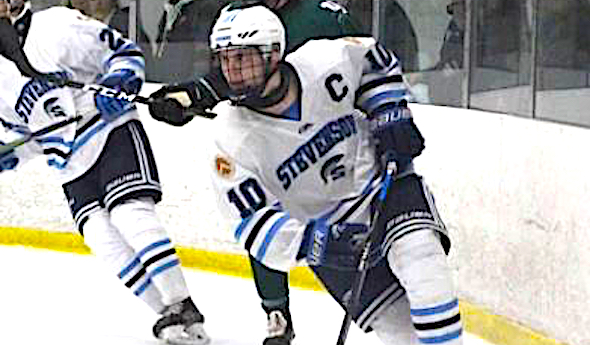
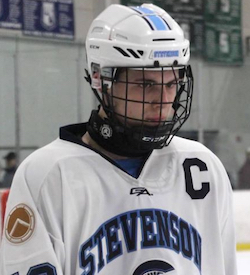
PHOTOS: (Top) Livonia Stevenson's Seth Lause is a four-year contributor to one of the state's top programs. (Middle) Lause also is serving as a captain this winter. (Photos courtesy of the Livonia Stevenson hockey program.)