

New Math: Division & Multiplication Problems
July 25, 2017
By Jack Roberts
MHSAA Executive Director
This is the second part in a series on MHSAA tournament classification, past and present, that will be published over the next two weeks. This series originally ran in this spring's edition of MHSAA benchmarks.
High school tournament classifications went viral before there was social media and most of us knew what “viral” meant.
Much as a virus infects computers today or has created epidemics of disease around the world for centuries, high school tournament classification – once introduced – tends to spread uncontrollably. Once started, it tends to keep expanding and rarely contracts.
While we are still some distance from providing every team a trophy as a result of expanding high school tournament classification across the country, there is criticism nevertheless that we are headed in that direction – a philosophy which is supposed to exist only in local youth sports for our youngest children.
Michigan could be blamed for all this. Michigan is generally accepted as the first state to provide different classifications for season-ending tournaments for different sized schools. It started a century ago. Today, every state has various classifications for its tournaments in most if not all sports. And it is a bit ironic that Michigan – creator of the classification chaos – more than most other states has kept the number of tournament classes or divisions under control.
Yes, there is evidence that tournament classifications have expanded over the years in Michigan, especially with the relatively recent introduction of tournaments in football and the late 1990s’ move from classes to divisions in most MHSAA tournaments. But the MHSAA Representative Council has held true to its word when it expanded the playoffs for football from four classes to eight divisions: this is needed because of unique factors of football, factors that exist in no other sport; and all other sports should be capped at a maximum of four classes or divisions.
Kentucky is the preeminent defender of single-class basketball. All of its 276 high schools compete for the single state championship for each gender. In Indiana, there are still open wounds from its move in 1998 from one to four classes for its 400 schools in basketball.
Multi-class tournaments have tended to increase the number of non-public school champions, which some states are trying to lower through enrollment “multipliers,” and also tend to increase the number of repeat champions, which some states are trying to affect with “success factors” which lift smaller schools into classifications for larger schools if they take home too many trophies.
While there is considerable evidence that state tournaments do as much bad as good for educational athletics, state associations persist in providing postseason tournaments because, on balance, the experiences are supposed to be good for student-athletes. And once we reach that conclusion it is just a small leap to believe that if the tournaments are good for a few, they must be better for more – which leads to creating more and more tournament classifications. One becomes two classes, then three, then four and so forth.
While the argument is that more classifications or divisions provides more students with opportunities to compete and win, it is undeniable that the experience changes as the number of tournament classifications expands. It is not possible for state associations to provide the same level of support when tournament classifications expand to multiple venues playing simultaneously. For example, there is less audio and video broadcast potential at each venue, and less media coverage to each venue. Focus is diluted and fans diminished at each championship.
No one can argue reasonably that today's two-day MHSAA Football Finals of eight championship games has the same pizazz as the one-day, four-games event conducted prior to 1990.
In some states the number of divisions has grown so much that it is difficult to see much difference between the many season-ending state championship games and a regular-season event in the same sport.
It is a balancing act. And Michigan has been studying that balance longer than any other state, and charting a steadier course than most.
Addition by Division
The shift to Divisions for MHSAA Tournament play in numerous sports has added up to a greater number of champions for teams and individuals across the state. Following are the sports currently employing a divisional format, and the procedures for determining enrollment and classification.
In 23 statewide or Lower Peninsula tournaments, schools which sponsor the sport are currently divided into nearly equal divisions. They are:
- Baseball - 4 Divisions
- Boys Bowling - 4 Divisions
- Girls Bowling - 4 Divisions
- Girls Competitive Cheer - 4 Divisions
- LP Boys Cross Country - 4 Divisions
- LP Girls Cross Country - 4 Divisions
- LP Boys Golf - 4 Divisions
- LP Girls Golf - 4 Divisions
- Ice Hockey - 3 Divisions
- Boys Lacrosse - 2 Divisions
- Girls Lacrosse - 2 Divisions
- Boys Skiing - 2 Divisions
- Girls Skiing - 2 Divisions
- LP Boys Soccer - 4 Divisions LP
- Girls Soccer - 4 Divisions
- Girls Softball - 4 Divisions
- LP Boys Swimming & Diving - 3 Divisions
- LP Girls Swimming & Diving - 3 Divisions
- LP Boys Tennis - 4 Divisions
- LP Girls Tennis - 4 Divisions
- LP Boys Track & Field - 4 Divisions
- LP Girls Track & Field - 4 Divisions
- Wrestling - 4 Divisions
Lists of schools for each division of these 23 tournaments are posted on MHSAA.com approximately April 1. Listings of schools in Upper Peninsula tournaments for their sports are also posted on MHSAA.com. The lists are based on school memberships and sports sponsorships in effect or anticipated for the following school year, as known to the MHSAA office as of a date in early March.
In football, the 256 schools which qualify for MHSAA 11-player playoffs are placed in eight equal divisions annually on Selection Sunday. Beginning in 2017, the 8-player divisions will be determined in a like manner on Selection Sunday as well, with 32 qualifying schools placed in two divisions.
Schools have the option to play in any higher division in one or more sports for a minimum of two years.
The deadlines for "opt-ups" are as follows:
- Applications for fall sports must be submitted by April 15
- Applications for winter sports must be submitted by Aug. 15
- Applications for spring sports must be submitted by Oct. 15
Subsequent to the date of these postings for these tournaments, no school will have its division raised or lowered by schools opening or closing, schools adding or dropping sports, schools exercising the option to play in a higher division, or approval or dissolution of cooperative programs.
When the same sport is conducted for boys and girls in the same season (e.g., track & field and cross country), the gender that has the most sponsoring schools controls the division breaks for both genders.
Sontag Inspires Amid 'Miracle' Cancer Fight
January 3, 2020
By Doug Donnelly
Special for Second Half
PINCKNEY – Dave Sontag could tell something was wrong.
 The gymnasium at Petersburg-Summerfield High School is bigger than most in Monroe County. But when Sontag, a veteran official, was running up and down the floor, he felt unusually tired and began feeling pain in his back.
“I knew something was wrong,” Sontag said. “During a timeout, I told one of the other officials who was in the stands watching that he might have to finish the game.”
Sontag, however, pushed through and made it.
“That’s when it all began,” he said.
A few weeks later, as the Saline varsity baseball coach, Sontag was hitting fly balls to the Hornets’ outfielders.
“I was struggling,” he said. “I called the players in and told them something was wrong. I had to stop.”
Still trying to fight through whatever was wrong, Sontag was coaching third base during a Saline intra-squad scrimmage a short time later.
“I started to see white,” he said.
He had another member of the Saline coaching staff call his wife, Michelle, who came and picked him up and took him to the hospital in Chelsea.
“My blood counts were trash, just trash,” he said. “The doctors said I need to have a blood transfusion.”
He was rushed to a Detroit-area hospital for the transfusion. After tests, Sontag was diagnosed with acute lymphoblastic leukemia, an extremely vigorous, aggressive cancer. That was May 15, 2018.
During the 18 months since, Sontag has gone through chemotherapy and radiation treatments. He’s watched multiple communities respond with fundraisers and benefits and amazing support. He’s had more than one bone marrow transplant. He’s heard from countless friends and ex-players who have continued to lift his spirits day after day via e-mails and text messages. He’s been counted out more than once.
Yet, he’s survived.
“Every day has been a challenge,” he said.
***
Sports and Sontag have gone together from the beginning.
He is a Monroe County native who was The Monroe Evening News Player of the Year in baseball in 1978 and went on to play at the University of Toledo. He taught journalism and English at his alma mater, Monroe Jefferson, before becoming a counselor for another 12 years. He was also the Jefferson director of athletics and recreation for a time.
 He coached baseball for the Bears, leading the team to nearly 400 victories and the Division 2 championship in 2002. He stepped down from coaching to follow his kids, who were playing at higher levels; Ryan Sontag played at Arizona State University and in the Chicago Cubs organization. Susan played softball at Bowling Green State University, and Brendan played ball at Indiana Tech University.
Still, the desire to coach never left their dad.
“After my kids were done playing, I coached freshman baseball at Jefferson,” he said. “I missed it and still wanted to be part of it.”
With his wife a principal in the Saline district, Sontag was asked by Scott Theisen, Saline’s head coach, to join his staff in 2015. He was with the Hornets when they captured the Division 1 championship in 2017, then was named head coach before the 2018 season started.
“That was the year I got sick,” he said. “I didn’t even finish the year.”
Sontag also has been a basketball official for years, getting his start in the early 1980s. He’s been a registered MHSAA high school basketball official for 40 years and has trained officials for the Monroe County Basketball Officials’ Association. He’s called four MHSAA Finals championship games.
“My first varsity game ever was when I was 21,” Sontag said. “I refereed a game at Whiteford.”
***
Sontag previously battled non-Hodgkin’s lymphoma in 1995-1996, beating that disease after a nine-month battle.
Although this cancer battle began as he was new to the Saline community, they embraced his fight, selling “Team Tags” T-shirts and painting the youth baseball diamond with a big ribbon. His son, Ryan, was invited to throw out the first pitch before the youth baseball season started in Dave’s honor.
Back home, in Monroe County, Sontag’s school held similar fundraisers and blood drives.
“I had so much support,” he said. “It was quite amazing to see.”
He tried all sorts of treatments, ultimately boarding an airplane and heading to Seattle for a clinical trial. It didn’t work.
“At that point, I didn’t think I was going to live,” Sontag said. “They told me there was nothing more they could do. They just were giving me something to take the pain away. I was miserable.”
Still, Sontag said, he held out hope.
“I felt it wasn’t time yet,” he said. “I have three grandkids. There are things I want to do. There’s so much I haven’t accomplished yet. In Seattle, they didn’t count on me living.”
But, for a still-unexplained reason, a combination of the medicine he was given to “take the pain away,” on his flight home and a different medicine he received when he returned to Michigan, started to change the way he felt. His blood counts started getting better.
“The side effects were lousy, but, for some reason, it threw me into remission. They checked for leukemia and it was not there.
“We called it a miracle.”
***
Sontag, who lives in Pinckney now, is still dealing with the side effects of nearly two years of treatments. He has a tingling sensation in his arms and legs – the feeling people get when their hands or feet ‘fall asleep’ – and he has a weak immune system.
 But he gets a little better every day.
“Every day is a blessing,” he said.
In addition to the community support and constant praying, he credits his wife with guiding him through this process.
“Michelle has been a rock through all of this,” he said. “She’s been by my side every single day. Without her, I don’t know if I would have made it.”
Recently, the Monroe County Officials’ Association held a banquet during which Sontag was presented with a “Courage Award.” He isn’t sure if he’ll be able to referee again anytime soon.
“I told them that night that I’d like to do it again, somewhere,” he said. “I don’t care of it’s a seventh-grade game. I just want to get out there again.”
In addition to the outpouring of love from multiple communities, family and friends, Sontag said sports has kept him alive.
“Sports is part of my fabric,” he said. “Baseball and officiating basketball games has given me that motivation I’ve needed to fight through this. I don’t know if I will coach again or referee again. I’m definitely not going to jump into the same schedule. But there are things I would like to do.
“Will I become a head coach again? Probably not. The task of being a head coach is probably too big right now. But I’d like to be involved. I’d still like to run camps and clinics. I’d still like to officiate too. I want to be a part of it. It’s something that’s in my blood.”
His son Ryan lives in Saline and has three children. Ryan coaches his son in a youth baseball league.
“He called me the other day and asked if I’d help him out,” Dave Sontag said. “I told him I think he will get me out there at some point.”
 Doug Donnelly has served as a sports and news reporter and city editor over 25 years, writing for the Daily Chief-Union in Upper Sandusky, Ohio from 1992-1995, the Monroe Evening News from 1995-2012 and the Adrian Daily Telegram since 2013. He's also written a book on high school basketball in Monroe County and compiles record books for various schools in southeast Michigan. E-mail him at [email protected] with story ideas for Jackson, Washtenaw, Hillsdale, Lenawee and Monroe counties.
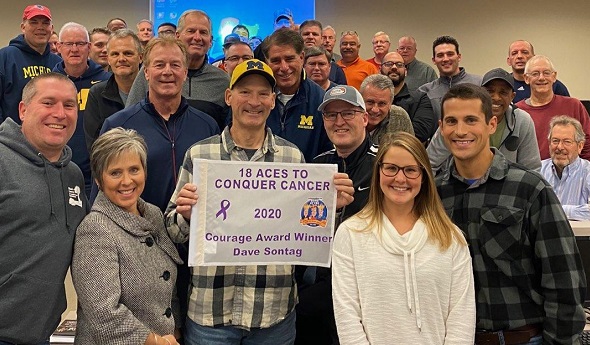
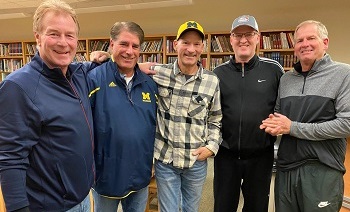
PHOTOS: Longtime official and coach Dave Sontag – standing in front row with wife Michelle, daughter-in-law Amy and son Brendan – is presented a “Courage Award” by the Monroe County Officials Association. (Middle) Sontag, formerly baseball coach at Monroe Jefferson and Saline, mans his spot on the baseline. (Below) Sontag with officials, from left, Mike Gaynier, Mike Bitz, Mike Knabusch and Dan Jukuri. (Top and below photos courtesy of Knabusch; middle photo courtesy of the Monroe News.)