

New Math: Division & Multiplication Problems
July 25, 2017
By Jack Roberts
MHSAA Executive Director
This is the second part in a series on MHSAA tournament classification, past and present, that will be published over the next two weeks. This series originally ran in this spring's edition of MHSAA benchmarks.
High school tournament classifications went viral before there was social media and most of us knew what “viral” meant.
Much as a virus infects computers today or has created epidemics of disease around the world for centuries, high school tournament classification – once introduced – tends to spread uncontrollably. Once started, it tends to keep expanding and rarely contracts.
While we are still some distance from providing every team a trophy as a result of expanding high school tournament classification across the country, there is criticism nevertheless that we are headed in that direction – a philosophy which is supposed to exist only in local youth sports for our youngest children.
Michigan could be blamed for all this. Michigan is generally accepted as the first state to provide different classifications for season-ending tournaments for different sized schools. It started a century ago. Today, every state has various classifications for its tournaments in most if not all sports. And it is a bit ironic that Michigan – creator of the classification chaos – more than most other states has kept the number of tournament classes or divisions under control.
Yes, there is evidence that tournament classifications have expanded over the years in Michigan, especially with the relatively recent introduction of tournaments in football and the late 1990s’ move from classes to divisions in most MHSAA tournaments. But the MHSAA Representative Council has held true to its word when it expanded the playoffs for football from four classes to eight divisions: this is needed because of unique factors of football, factors that exist in no other sport; and all other sports should be capped at a maximum of four classes or divisions.
Kentucky is the preeminent defender of single-class basketball. All of its 276 high schools compete for the single state championship for each gender. In Indiana, there are still open wounds from its move in 1998 from one to four classes for its 400 schools in basketball.
Multi-class tournaments have tended to increase the number of non-public school champions, which some states are trying to lower through enrollment “multipliers,” and also tend to increase the number of repeat champions, which some states are trying to affect with “success factors” which lift smaller schools into classifications for larger schools if they take home too many trophies.
While there is considerable evidence that state tournaments do as much bad as good for educational athletics, state associations persist in providing postseason tournaments because, on balance, the experiences are supposed to be good for student-athletes. And once we reach that conclusion it is just a small leap to believe that if the tournaments are good for a few, they must be better for more – which leads to creating more and more tournament classifications. One becomes two classes, then three, then four and so forth.
While the argument is that more classifications or divisions provides more students with opportunities to compete and win, it is undeniable that the experience changes as the number of tournament classifications expands. It is not possible for state associations to provide the same level of support when tournament classifications expand to multiple venues playing simultaneously. For example, there is less audio and video broadcast potential at each venue, and less media coverage to each venue. Focus is diluted and fans diminished at each championship.
No one can argue reasonably that today's two-day MHSAA Football Finals of eight championship games has the same pizazz as the one-day, four-games event conducted prior to 1990.
In some states the number of divisions has grown so much that it is difficult to see much difference between the many season-ending state championship games and a regular-season event in the same sport.
It is a balancing act. And Michigan has been studying that balance longer than any other state, and charting a steadier course than most.
Addition by Division
The shift to Divisions for MHSAA Tournament play in numerous sports has added up to a greater number of champions for teams and individuals across the state. Following are the sports currently employing a divisional format, and the procedures for determining enrollment and classification.
In 23 statewide or Lower Peninsula tournaments, schools which sponsor the sport are currently divided into nearly equal divisions. They are:
- Baseball - 4 Divisions
- Boys Bowling - 4 Divisions
- Girls Bowling - 4 Divisions
- Girls Competitive Cheer - 4 Divisions
- LP Boys Cross Country - 4 Divisions
- LP Girls Cross Country - 4 Divisions
- LP Boys Golf - 4 Divisions
- LP Girls Golf - 4 Divisions
- Ice Hockey - 3 Divisions
- Boys Lacrosse - 2 Divisions
- Girls Lacrosse - 2 Divisions
- Boys Skiing - 2 Divisions
- Girls Skiing - 2 Divisions
- LP Boys Soccer - 4 Divisions LP
- Girls Soccer - 4 Divisions
- Girls Softball - 4 Divisions
- LP Boys Swimming & Diving - 3 Divisions
- LP Girls Swimming & Diving - 3 Divisions
- LP Boys Tennis - 4 Divisions
- LP Girls Tennis - 4 Divisions
- LP Boys Track & Field - 4 Divisions
- LP Girls Track & Field - 4 Divisions
- Wrestling - 4 Divisions
Lists of schools for each division of these 23 tournaments are posted on MHSAA.com approximately April 1. Listings of schools in Upper Peninsula tournaments for their sports are also posted on MHSAA.com. The lists are based on school memberships and sports sponsorships in effect or anticipated for the following school year, as known to the MHSAA office as of a date in early March.
In football, the 256 schools which qualify for MHSAA 11-player playoffs are placed in eight equal divisions annually on Selection Sunday. Beginning in 2017, the 8-player divisions will be determined in a like manner on Selection Sunday as well, with 32 qualifying schools placed in two divisions.
Schools have the option to play in any higher division in one or more sports for a minimum of two years.
The deadlines for "opt-ups" are as follows:
- Applications for fall sports must be submitted by April 15
- Applications for winter sports must be submitted by Aug. 15
- Applications for spring sports must be submitted by Oct. 15
Subsequent to the date of these postings for these tournaments, no school will have its division raised or lowered by schools opening or closing, schools adding or dropping sports, schools exercising the option to play in a higher division, or approval or dissolution of cooperative programs.
When the same sport is conducted for boys and girls in the same season (e.g., track & field and cross country), the gender that has the most sponsoring schools controls the division breaks for both genders.
Expert Teammates Fill Health Roster
January 2, 2020
By Rob Kaminski
MHSAA benchmarks editor
Teamwork is a necessity in athletics. The MHSAA has put together the beginnings of a solid roster to combat mental health ailments throughout schools in the state.
Among the experts listed on the MHSAA Mental Health Speakers Bureau are Christy Buck, executive director, and Cat Lanting, program coordinator at the Mental Health Foundation of West Michigan; and Brooke Buys, mental and behavioral health specialist and founder of BLND Health. They already are serving MHSAA schools in various capacities.
Through personal appearances, promotional videos and staff availability, both organizations emphasize the same strategy when tackling mental health issues: recognition and treatment from within the school buildings and districts.
“We wanted to create self-starting kits that anyone in the district can implement,” said Lanting. “We have in-person trainings and opportunities for students to get together – students talking to students – for high schools and for middle schools.”
Lanting coordinates the be nice.® Action Plan, founded by Buck. The plan calls for people to “notice, invite, challenge and empower” when recognizing changes in those close to them.
“It’s an attractive statement, but the key to the action plan is that it’s transferable. It can work from the pre-K level to senior citizens,” she said. “We want people to notice change, invite people into the conversation, challenge stigmas, and empower themselves with knowledge surrounding mental health.”
Buys, meanwhile, is one of a team of behavioral health specialists delivering messages to student-athletes around the state. Many of her associates in BLND (pronounced “blend”) not only talk the talk, but have walked the walk as collegiate athletes.
“The best course of action for administrators, teachers, coaches is to strive to build and maintain trust with the student-athlete; have genuine, non-judgmental conversations to include open-ended questions and authentic concern,” said Buys, who played soccer at Kalamazoo College.
Both be nice.® and BLND staff members made appearances at schools this year to assist in promoting recognition. A 90-second video produced by be nice.® was included in all MHSAA online rules meetings this year, featuring endorsements from University of Michigan coaches Jim Harbaugh and Carol Hutchins and Michigan State University coaches Mark Dantonio and Tom Izzo.
“When our team met with Mark (Uyl) and some athletic directors in Spring 2019, the room was filled with people who have just started to recognize mental health as an issue. The challenge was to deliver a 90-second video promoting the be nice.® Action Plan with a quick turnaround so it was ready for the fall rules meetings,” said Lanting.
She encourages people to visit be nice.org and “take the be nice.® pledge.”
“be nice.® started in 2010, and when people first see it they think, ‘bullying prevention,’ but really it is an action plan that is evidence-based,” Lanting said. “The be nice.® Action Plan can be used anywhere – in the workplace, community organizations – but schools is where we started and where we are currently having the most impact.”
 Connecting with the most people possible is the goal across the board. Buys encourages schools to utilize the “one-stop shopping method” in the BLND programming.
“An external referral service that is qualified, efficient, dynamic, and integrated in nature – like BLND – helps provide a one-stop shop for student-athletes and parents to receive the support they need,” said Buys.
Lanting agrees, stating, “The more students and parents become familiar with some of the signs and symptoms, the better. Coaches and teammates might be the first to notice a change in someone’s behavior whether through daily interaction or social media activity.”
Buys and company have noticed a few recent trends leading to school-aged anxiety and stress, and have people in place to visit groups and lead discussions.
“The signs and symptoms can be very individualized, but some general factors may include isolation, irritability, drastic changes to an individual’s common mood or behavior,” noted Buys. “Students can also be affected by major life changes such as parent divorce, break-up with significant other, changing schools, things of that nature.”
When Lanting receives inquiries from individual coaches regarding the be nice.® program, she encourages them to get entire teams or districts involved, because, “it’s a K-12 initiative, and sports is really a great place to start.”
Sport participation offers a different set of variables. Student-athletes enjoy additional support and guidance, but there is a flip side.
“Student-athletes do have access to more adult guidance through coaches, and certainly enjoy inclusion as part of a team, but they also tend to be more at risk for anxiety,” Lanting said.
Buys points out several reasons for this, including added expectations – whether from within or from peers, parents and coaches. They are also busier than many others.
“Time management is an issue for all of us, but student-athletes can have difficulties finding that rhythm,” Buys said. “This can cause a lot of anxiety if an area of the athlete’s life that they value is perceived as not getting the attention it needs.”
Another source of stress more likely to affect athletes is injuries.
“One of the biggest challenges in the athlete population dealing with stress and anxiety is the strong relationship between stress and injury,” said Buys. “Susceptibility to injury as well as the length of time for recovery are affected by stress.”
Identifying physical conditions is much simpler than recognizing behavioral ailments. That’s why it’s important for groups like BLND and be nice.® to teach the school population to self-diagnose.
Lanting coordinated a be nice.® football game between Holland/Zeeland-area high schools last fall, and is planning a similar event during a Fennville-Saugatuck boys basketball game this winter.
“We see all the ‘pink-out’ games and events for other causes, and that’s great,” Lanting said. “But a person in high school is so much more likely to be affected by mental health than suffer a physical ailment. That’s why the student-led part of this is so important; they tell us when things happen that might trigger certain behaviors.”
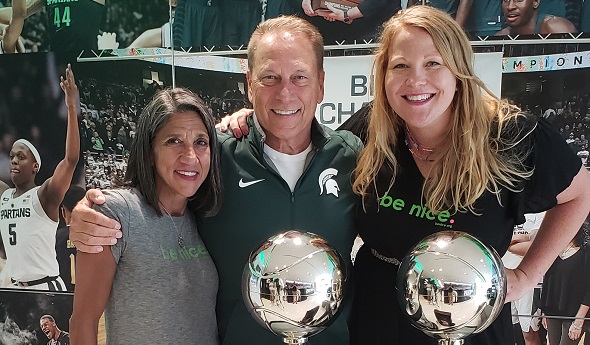
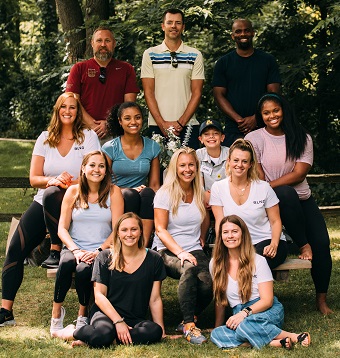
PHOTOS: (Top) be nice. founder Christy Buck (left) and program coordinator Cat Lanting pose with MSU men’s basketball coach Tom Izzo during production of a promotional video this summer. (Middle) The BLND Health Detroit Metro Team, including founder Brooke Buys (seated middle, second row from bottom.)