

New Math: Division & Multiplication Problems
July 25, 2017
By Jack Roberts
MHSAA Executive Director
This is the second part in a series on MHSAA tournament classification, past and present, that will be published over the next two weeks. This series originally ran in this spring's edition of MHSAA benchmarks.
High school tournament classifications went viral before there was social media and most of us knew what “viral” meant.
Much as a virus infects computers today or has created epidemics of disease around the world for centuries, high school tournament classification – once introduced – tends to spread uncontrollably. Once started, it tends to keep expanding and rarely contracts.
While we are still some distance from providing every team a trophy as a result of expanding high school tournament classification across the country, there is criticism nevertheless that we are headed in that direction – a philosophy which is supposed to exist only in local youth sports for our youngest children.
Michigan could be blamed for all this. Michigan is generally accepted as the first state to provide different classifications for season-ending tournaments for different sized schools. It started a century ago. Today, every state has various classifications for its tournaments in most if not all sports. And it is a bit ironic that Michigan – creator of the classification chaos – more than most other states has kept the number of tournament classes or divisions under control.
Yes, there is evidence that tournament classifications have expanded over the years in Michigan, especially with the relatively recent introduction of tournaments in football and the late 1990s’ move from classes to divisions in most MHSAA tournaments. But the MHSAA Representative Council has held true to its word when it expanded the playoffs for football from four classes to eight divisions: this is needed because of unique factors of football, factors that exist in no other sport; and all other sports should be capped at a maximum of four classes or divisions.
Kentucky is the preeminent defender of single-class basketball. All of its 276 high schools compete for the single state championship for each gender. In Indiana, there are still open wounds from its move in 1998 from one to four classes for its 400 schools in basketball.
Multi-class tournaments have tended to increase the number of non-public school champions, which some states are trying to lower through enrollment “multipliers,” and also tend to increase the number of repeat champions, which some states are trying to affect with “success factors” which lift smaller schools into classifications for larger schools if they take home too many trophies.
While there is considerable evidence that state tournaments do as much bad as good for educational athletics, state associations persist in providing postseason tournaments because, on balance, the experiences are supposed to be good for student-athletes. And once we reach that conclusion it is just a small leap to believe that if the tournaments are good for a few, they must be better for more – which leads to creating more and more tournament classifications. One becomes two classes, then three, then four and so forth.
While the argument is that more classifications or divisions provides more students with opportunities to compete and win, it is undeniable that the experience changes as the number of tournament classifications expands. It is not possible for state associations to provide the same level of support when tournament classifications expand to multiple venues playing simultaneously. For example, there is less audio and video broadcast potential at each venue, and less media coverage to each venue. Focus is diluted and fans diminished at each championship.
No one can argue reasonably that today's two-day MHSAA Football Finals of eight championship games has the same pizazz as the one-day, four-games event conducted prior to 1990.
In some states the number of divisions has grown so much that it is difficult to see much difference between the many season-ending state championship games and a regular-season event in the same sport.
It is a balancing act. And Michigan has been studying that balance longer than any other state, and charting a steadier course than most.
Addition by Division
The shift to Divisions for MHSAA Tournament play in numerous sports has added up to a greater number of champions for teams and individuals across the state. Following are the sports currently employing a divisional format, and the procedures for determining enrollment and classification.
In 23 statewide or Lower Peninsula tournaments, schools which sponsor the sport are currently divided into nearly equal divisions. They are:
- Baseball - 4 Divisions
- Boys Bowling - 4 Divisions
- Girls Bowling - 4 Divisions
- Girls Competitive Cheer - 4 Divisions
- LP Boys Cross Country - 4 Divisions
- LP Girls Cross Country - 4 Divisions
- LP Boys Golf - 4 Divisions
- LP Girls Golf - 4 Divisions
- Ice Hockey - 3 Divisions
- Boys Lacrosse - 2 Divisions
- Girls Lacrosse - 2 Divisions
- Boys Skiing - 2 Divisions
- Girls Skiing - 2 Divisions
- LP Boys Soccer - 4 Divisions LP
- Girls Soccer - 4 Divisions
- Girls Softball - 4 Divisions
- LP Boys Swimming & Diving - 3 Divisions
- LP Girls Swimming & Diving - 3 Divisions
- LP Boys Tennis - 4 Divisions
- LP Girls Tennis - 4 Divisions
- LP Boys Track & Field - 4 Divisions
- LP Girls Track & Field - 4 Divisions
- Wrestling - 4 Divisions
Lists of schools for each division of these 23 tournaments are posted on MHSAA.com approximately April 1. Listings of schools in Upper Peninsula tournaments for their sports are also posted on MHSAA.com. The lists are based on school memberships and sports sponsorships in effect or anticipated for the following school year, as known to the MHSAA office as of a date in early March.
In football, the 256 schools which qualify for MHSAA 11-player playoffs are placed in eight equal divisions annually on Selection Sunday. Beginning in 2017, the 8-player divisions will be determined in a like manner on Selection Sunday as well, with 32 qualifying schools placed in two divisions.
Schools have the option to play in any higher division in one or more sports for a minimum of two years.
The deadlines for "opt-ups" are as follows:
- Applications for fall sports must be submitted by April 15
- Applications for winter sports must be submitted by Aug. 15
- Applications for spring sports must be submitted by Oct. 15
Subsequent to the date of these postings for these tournaments, no school will have its division raised or lowered by schools opening or closing, schools adding or dropping sports, schools exercising the option to play in a higher division, or approval or dissolution of cooperative programs.
When the same sport is conducted for boys and girls in the same season (e.g., track & field and cross country), the gender that has the most sponsoring schools controls the division breaks for both genders.
Port Huron Unified Providing Opportunity
By
Paul Costanzo
Special for MHSAA.com
December 4, 2019
Growing up in Yale, Trevor Sugars never thought about playing high school hockey. He bounced around Sanilac, St. Clair and Lapeer counties finding house leagues to stay involved in the sport he loved, as Yale didn’t have a team.
But a year ago, thanks to an expansion of the Port Huron Unified cooperative team, a new option arose, and Sugars has taken full advantage.
“This is great for Yale because we get to come out and have a hockey team, and younger kids can get into the sport of hockey,” said Sugars, a junior defenseman. “They’re able to go further without having to pay all the money for AAA.”
Three players from Yale and six players from St. Clair join the 11 from Port Huron in donning the Big Reds jersey this season. It’s the fourth that Port Huron has collaborated with East China School District – St. Clair and Marine City – and the second it has collaborated with Yale. The collaboration has given players from those schools an opportunity they wouldn’t otherwise have, while saving the Port Huron program.
“I went to a coaching clinic before the season started, and we actually had a roundtable about unified hockey programs,” Port Huron coach Ben Pionk said. “It was kind of interesting, because we all had one common theme. Most of us were all there for survival. That’s why we’re unified. A lot of the teams were in the same boat. Some of the other unified programs, they have like seven schools and you’re getting two kids from each school just to make a team. Honestly, it was all for survival, and that was solely ours. It wasn’t to build a superpower team; it was to make sure we had a team we could even put on the ice.”
Pionk has been at Port Huron for two decades, most of which spent coaching a team solely from his school. But numbers began to dwindle not long ago, threatening the future of the program.
“I can’t remember what year it was, but we had tryouts and I had eight kids standing here,” Pionk said. “I went to our former athletic director and talked to him and said, ‘What do you want us to do here? You really can’t put a program on the ice.’ We actually started the season that way and then we picked up a few more; I think we ended up with 12 that year. We got through the year, and kind of the next year was the same way. You go back four or five years and people weren’t working a lot, so what are you going to do? Are you going to play hockey or pay your bills?”
Not only was it hard to be competitive with so few players, but Pionk was worried about the safety of his players, who were forced to take longer shifts. He said he knew there were players in St. Clair – a school that had a program through the 2012-13 season – so Port Huron became a unified team for the 2016-17 season.
It didn’t happen overnight, but the team has now nearly doubled in size.
 “Even after the first year or so of being unified with St. Clair, we still weren’t getting really good numbers,” Pionk said. “We just found that a lot of the older kids down there had been with their teams, and at this point they were established where they were and didn’t want to leave to come play high school hockey. They would love to have played high school hockey but didn’t want to leave at that point. Through Port Huron Minor Hockey’s help, they knew there were a couple kids in Yale who had kind of aged out and weren’t going to have anywhere to play, so we kind of approached their school about it and next thing you know, we had Yale as well. Now, a few years into it everybody knows we’re unified and the kids are coming out. We have 17 skaters and three goalies this year.”
The six players from St. Clair this season make up the biggest group Port Huron Unified has brought in from another school besides Port Huron High. While they may have grown up expecting to one day be Saints, they’re grateful for the opportunity they now have.
“The high school experience is so much fun,” said Duncan McLeod, a junior defenseman from St. Clair. “It’s just fun to play for something – something big.”
While players from out of town are excited about a newer opportunity, those within the program are excited to see their team growing again.
“My freshman year, my sophomore year, we were really struggling on numbers,” Port Huron junior Kevin Schott said. “It was tough having to double shift a lot and pretty much play wherever Coach needed you to play. This year I was really excited to hear that we had a lot of kids coming from St. Clair and Yale – some better skating kids that I knew had played travel. So, I was really super excited to see that we were going to have a full and deep team this year.”
With all the new faces and multiple schools combining to create one team, not a lot of the players had played with one another prior to high school. That hasn’t been an issue, though.
“We all came together real quick, because we all know how to play hockey – we've all been playing hockey for at least four years,” Sugars said. “We all know our positions, got together and figured it out.”
This year’s team has already enjoyed as much success as any of its unified predecessors. The Big Reds opened the season with a pair of wins, eclipsing last year’s win total (one).
“We’re trying to be at least .500 this year,” Sugars said. “I wanted to be the best Yale high school team, but we already did that.”
A flu bug hit the team right before Thanksgiving, which didn’t help during a busy week. But even sitting at 2-3, there’s optimism about the season and the future, as without a senior on the roster, there’s a possibility everyone could come back next year.
“It’s looking positive for the year,” McLeod said. “We have a good team going.”
 Paul Costanzo served as a sportswriter at The Port Huron Times Herald from 2006-15, including three years as lead sportswriter, and prior to that as sports editor at the Hillsdale Daily News from 2005-06. He can be reached at [email protected] with story ideas for Genesee, Lapeer, St. Clair, Sanilac, Huron, Tuscola, Saginaw, Bay, Arenac, Midland and Gladwin counties.
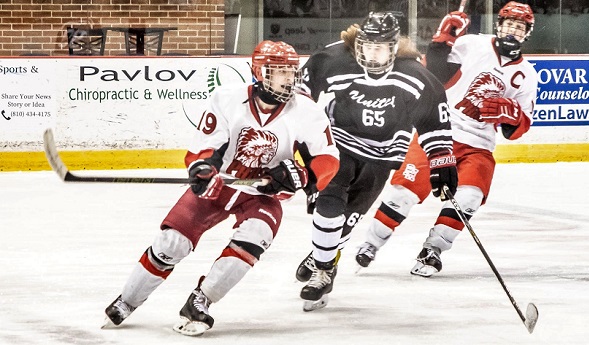
PHOTOS: (Top) Port Huron Unified’s Noah Gunderson (19) is among Port Huron High School students who help make up the program again this winter. (Middle) Duncan McLeod, a St. Clair student, controls the puck. (Photos by Jeremiah May.)