

New Math: Division & Multiplication Problems
July 25, 2017
By Jack Roberts
MHSAA Executive Director
This is the second part in a series on MHSAA tournament classification, past and present, that will be published over the next two weeks. This series originally ran in this spring's edition of MHSAA benchmarks.
High school tournament classifications went viral before there was social media and most of us knew what “viral” meant.
Much as a virus infects computers today or has created epidemics of disease around the world for centuries, high school tournament classification – once introduced – tends to spread uncontrollably. Once started, it tends to keep expanding and rarely contracts.
While we are still some distance from providing every team a trophy as a result of expanding high school tournament classification across the country, there is criticism nevertheless that we are headed in that direction – a philosophy which is supposed to exist only in local youth sports for our youngest children.
Michigan could be blamed for all this. Michigan is generally accepted as the first state to provide different classifications for season-ending tournaments for different sized schools. It started a century ago. Today, every state has various classifications for its tournaments in most if not all sports. And it is a bit ironic that Michigan – creator of the classification chaos – more than most other states has kept the number of tournament classes or divisions under control.
Yes, there is evidence that tournament classifications have expanded over the years in Michigan, especially with the relatively recent introduction of tournaments in football and the late 1990s’ move from classes to divisions in most MHSAA tournaments. But the MHSAA Representative Council has held true to its word when it expanded the playoffs for football from four classes to eight divisions: this is needed because of unique factors of football, factors that exist in no other sport; and all other sports should be capped at a maximum of four classes or divisions.
Kentucky is the preeminent defender of single-class basketball. All of its 276 high schools compete for the single state championship for each gender. In Indiana, there are still open wounds from its move in 1998 from one to four classes for its 400 schools in basketball.
Multi-class tournaments have tended to increase the number of non-public school champions, which some states are trying to lower through enrollment “multipliers,” and also tend to increase the number of repeat champions, which some states are trying to affect with “success factors” which lift smaller schools into classifications for larger schools if they take home too many trophies.
While there is considerable evidence that state tournaments do as much bad as good for educational athletics, state associations persist in providing postseason tournaments because, on balance, the experiences are supposed to be good for student-athletes. And once we reach that conclusion it is just a small leap to believe that if the tournaments are good for a few, they must be better for more – which leads to creating more and more tournament classifications. One becomes two classes, then three, then four and so forth.
While the argument is that more classifications or divisions provides more students with opportunities to compete and win, it is undeniable that the experience changes as the number of tournament classifications expands. It is not possible for state associations to provide the same level of support when tournament classifications expand to multiple venues playing simultaneously. For example, there is less audio and video broadcast potential at each venue, and less media coverage to each venue. Focus is diluted and fans diminished at each championship.
No one can argue reasonably that today's two-day MHSAA Football Finals of eight championship games has the same pizazz as the one-day, four-games event conducted prior to 1990.
In some states the number of divisions has grown so much that it is difficult to see much difference between the many season-ending state championship games and a regular-season event in the same sport.
It is a balancing act. And Michigan has been studying that balance longer than any other state, and charting a steadier course than most.
Addition by Division
The shift to Divisions for MHSAA Tournament play in numerous sports has added up to a greater number of champions for teams and individuals across the state. Following are the sports currently employing a divisional format, and the procedures for determining enrollment and classification.
In 23 statewide or Lower Peninsula tournaments, schools which sponsor the sport are currently divided into nearly equal divisions. They are:
- Baseball - 4 Divisions
- Boys Bowling - 4 Divisions
- Girls Bowling - 4 Divisions
- Girls Competitive Cheer - 4 Divisions
- LP Boys Cross Country - 4 Divisions
- LP Girls Cross Country - 4 Divisions
- LP Boys Golf - 4 Divisions
- LP Girls Golf - 4 Divisions
- Ice Hockey - 3 Divisions
- Boys Lacrosse - 2 Divisions
- Girls Lacrosse - 2 Divisions
- Boys Skiing - 2 Divisions
- Girls Skiing - 2 Divisions
- LP Boys Soccer - 4 Divisions LP
- Girls Soccer - 4 Divisions
- Girls Softball - 4 Divisions
- LP Boys Swimming & Diving - 3 Divisions
- LP Girls Swimming & Diving - 3 Divisions
- LP Boys Tennis - 4 Divisions
- LP Girls Tennis - 4 Divisions
- LP Boys Track & Field - 4 Divisions
- LP Girls Track & Field - 4 Divisions
- Wrestling - 4 Divisions
Lists of schools for each division of these 23 tournaments are posted on MHSAA.com approximately April 1. Listings of schools in Upper Peninsula tournaments for their sports are also posted on MHSAA.com. The lists are based on school memberships and sports sponsorships in effect or anticipated for the following school year, as known to the MHSAA office as of a date in early March.
In football, the 256 schools which qualify for MHSAA 11-player playoffs are placed in eight equal divisions annually on Selection Sunday. Beginning in 2017, the 8-player divisions will be determined in a like manner on Selection Sunday as well, with 32 qualifying schools placed in two divisions.
Schools have the option to play in any higher division in one or more sports for a minimum of two years.
The deadlines for "opt-ups" are as follows:
- Applications for fall sports must be submitted by April 15
- Applications for winter sports must be submitted by Aug. 15
- Applications for spring sports must be submitted by Oct. 15
Subsequent to the date of these postings for these tournaments, no school will have its division raised or lowered by schools opening or closing, schools adding or dropping sports, schools exercising the option to play in a higher division, or approval or dissolution of cooperative programs.
When the same sport is conducted for boys and girls in the same season (e.g., track & field and cross country), the gender that has the most sponsoring schools controls the division breaks for both genders.
Drive Complete: 2019 Finals in Review
December 3, 2019
By Geoff Kimmerly
Second Half editor
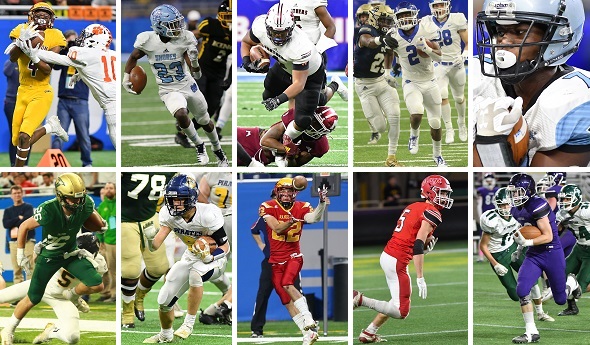
Teams that reach the MHSAA Football Finals have been running around in helmets and pads for just short of four months, starting when we’re keeping an eye out for high temperatures and finishing as we watch the snow fall.

Second Half covered all 10 championship games last weekend at Ford Field and two weekends ago at the Superior Dome, with quick recaps and links (click on the game scores) to those stories below followed by notations of performances entered into the MHSAA Finals record book and a report on some of the biggest and best stories to emerge from the 2019 Finals. See also below highlights from the weekend from State Champs Sports Network, and keep an eye on Second Half for a schedule of replays of the 8 and 11-Player Finals on FOX Sports Detroit.
Finals in Review
11-Player Division 1: Davison 35, Brighton 25
The two first-time Finals qualifiers helped fill most of Ford Field’s lower bowl Saturday, and Davison emerged with its first championship. The game was highlighted by the play of standout quarterbacks Brendan Sullivan of Davison and Colby Newburg of Brighton, who both were added to the MHSAA record book for their performances (see more below).
11-Player Division 2: Muskegon Mona Shores 35, Detroit Martin Luther King 26
The Sailors earned the first of the weekend’s “upsets,” never trailing against the 2018 Division 3 champion Crusaders. For the second-straight week, back-up quarterback Brady Rose led the way with all-stater Caden Broersma injured. After King came within two points early in the fourth quarter, Rose led another scoring drive to put the game away.
11-Player Division 3: River Rouge 30, Muskegon 7
River Rouge suffered only one loss this season and played a solid group of opponents, so calling this an upset is tough – but likely still accurate as Muskegon had been considered the state’s best regardless of division (especially after defeating Mona Shores 53-0 during the regular season) and had received national recognition. Rouge scored the final 30 points after an early deficit.
11-Player Division 4: Grand Rapids Catholic Central 44, Detroit Country Day 0
When these two met in the 2016 Final, they combined to score 17 points. This rematch saw many more, at least for GRCC as it scored 44 of the 111 total points Country Day gave up this season. Cougars quarterback Joey Silveri, just a sophomore, cemented himself as a player to watch over the next two years as well, and receiver Jace Williams tied a Finals record as GRCC won its third title in four seasons.
11-Player Division 5: Lansing Catholic 31, Almont 17
The Cougars came back from a bit of an ugly first half offensively to claim their first championship since 1985. Lansing Catholic scored the final 24 points of the game, also earning coach Jim Ahern his first Finals title of a career that began 50 years ago. This was the third Cougars team he had brought to Ford Field this decade, while Almont was making its first Finals appearance.
11-Player Division 6: Monroe St. Mary Catholic Central 7, Maple City Glen Lake 0
The Falcons scored their first Finals championship since 2014 in one of the lowest-scoring title games in 45 seasons of MHSAA Football Playoffs. SMCC put the game’s only points on the board on quarterback Wyatt Bergmoser’s six-yard TD run with 7:17 to play in the first half. The Falcons otherwise dominated defensively and controlled the clock to secure the win.
11-Player Division 7: Pewamo-Westphalia 14, Jackson Lumen Christi 0
The arguably most power-packed of the weekend’s Finals saw Pewamo-Westphalia win its third championship in four seasons and end a 35-game winning streak for Lumen Christi, which had won three straight Division 6 titles. Both teams had fewer than 120 yards of total offense, but P-W was able to get into the end zone with three seconds left in the first half and again during the game’s final minutes to finish an unbeaten fall.
 11-Player Division 8: Reading 33, Beal City 6
The Rangers opened the weekend with a repeat championship in Division 8, moving to 27-1 over the last two seasons with only a 14-0 Week 1 loss this fall to Pewamo-Westphalia breaking up the perfection. Reading scored the final 19 points and outrushed Beal City 260-42. The Aggies were playing in the Finals for the first time since 2013 and coming off two-straight sub-.500 seasons.
8-Player Division 1: Colon 26, Suttons Bay 14
Colon also won a Division 1 matchup of two teams seeking their first championship, following two-way standout Brandon Crawford to victory at the Superior Dome. The game was tied into the final minute of the third quarter, but the Magi scored the final 12 points to finish off an undefeated season and their closest of 13 wins.
8-Player Division 2: Pickford 48, Portland St. Patrick 15
The Panthers returned to the 8-Player Finals and claimed their first championship after finishing Division 1 runner-up in 2018. Quarterback Jimmy Storey closed his high school career running for three touchdowns and throwing for two more, helping hand the Shamrocks their second runner-up finish in three seasons and only loss of this fall.
Record Report
Star quarterbacks found the spotlight at both the 11 and 8-Player Finals. The Division 1 game saw Brighton’s Colby Newburg (332 yards) and Davison’s Brendan Sullivan (330) both make the all-time 11-Player Finals record list for total offense and passing yards as well with 290 and 249, respectively. Grand Rapids Catholic Central’s Joey Silveri is ranked 10th in Finals total offense after his 375 yards (236 passing, 139 rushing) in Division 4, and Pickford’s Jimmy Storey ranks sixth on the 8-Player Finals list with 298 totals yards after passing for 152 and running for 146.
Silveri also made the 11-player passing touchdowns list with four, and Jace Williams was the main beneficiary. He tied the 11-Player Finals record with three touchdown catches and was the first to catch that many since 2013.
Colon’s Brandon Crawford made the 8-player records twice for rushing – his 205 yards were the third-most in 8-Player Finals history, and his 94-yard touchdown run was the longest rushing play. Colon as a team ranked fifth with 340 yards rushing.
Muskegon Mona Shores kicker Keegan DeKuiper and Davison kicker Trennor Rhodes both were added to the 11-player list for most extra points in a Final, both connecting on all five of their respective attempts.
Brighton, while in defeat, made the 11-Player Finals list with 23 first downs against Davison. Detroit Martin Luther King and Muskegon Mona Shores in Division 2 joined Hartford and Onsted from the 1993 Class CC Final as the only opponents to go an entire championship game without punting.
Monroe St. Mary Catholic Central became one of eight teams to win a championship by scoring seven points or fewer.
Both Grand Rapids Catholic Central and Reading tied for second on the first downs allowed list giving up only four apiece.
Lansing Catholic’s Zack Stone and Zach Gillespie both snagged two interceptions, joining 31 others tied for third for most interceptions in one championship game.
There previously was not a category for most extra-point attempts blocked, but it was impossible to not add one after Detroit Country Day blocked five tries by Grand Rapids Catholic Central.
Stories Behind the Scores
First-time champions: They reigned again, with Davison, Muskegon Mona Shores, River Rouge, Colon and Pickford matching last season’s total of five first-time winners. That makes 10 first-time champions over the last two seasons, compared with a combined three in 2016 and 2017.
 Defense wins championships: After no Finals shutouts in 2018 and just one apiece in 2017 and 2016, this season’s Finals saw Monroe St. Mary Catholic Central, Grand Rapids Catholic Central and Pewamo-Westphalia all hold their opponents scoreless. Total, the 10 runner-up teams scored an average of 11 points. River Rouge saw its season defensive points allowed average fall to 7.6, GRCC’s fell to 8.8, P-W’s to 4.5 and Reading’s to 7.4 points per game. Colon finished the season giving up just 5.5 points per game – perhaps even more notable given the wide-open offensive attack characteristic of 8-player.
Unsung no more: A pair of previously or at least little-known quarterbacks before last week’s 11-Player Finals will certainly be well-known entering next fall. As noted above, Mona Shores junior Brady Rose was forced into action early in his team’s one-point Semifinal win over Walled Lake Western, and he finished an incredible two weeks running for 90 yards and three touchdowns, completing 8-of-11 passes for 122 yards and a score and making a team-high 10 tackles with an interception against King. River Rouge junior Mareyohn Hrabowski burst onto the statewide scene in the weekend’s final game with 175 yards and three touchdowns on the ground and 45 yards passing against Muskegon.
Ahern’s work rewarded: As noted above, Lansing Catholic coach Jim Ahern finished with a Finals championship for the first time, a well-deserved achievement for an architect of multiple programs that have had elite success. Ahern ranks 13th in MHSAA history with a 301-152-6 record at three in-state schools beginning in 1969 (and not counting his seasons coaching in Florida during the end of the last decade). In addition to bringing the Cougars to Ford Field three times over the last nine years, Ahern led Ithaca’s program from 1972-2003. Among his standouts there was current Yellowjackets coach Terry Hessbrook, who is the first to credit Ahern with building the foundation that has led to Ithaca’s five Division 6 titles and two runner-up finishes over the last decade. Ahern pioneered the spread offense in this state, writing a book nearly 20 years ago teaching the scheme that is now used all over the country.
Fun with numbers: Friday’s four-game attendance was just 17,971 fans – the lowest of the decade for one day at Ford Field. But Saturday’s four-game attendance of 30,466 was the highest since 2010 for one day. Together, the 48,437 fans for the weekend fell in line with the five-year average for the 11-Player Finals.
Second Half’s weekly “Drive for Detroit” previews are powered by MI Student Aid, a part of the Office of Postsecondary Financial Planning located within the Michigan Department of Treasury. MI Student Aid encourages students to pursue postsecondary education by providing access to student financial resources and information. MI Student Aid administers the state’s 529 college savings programs (MET/MESP), as well as scholarship and grant programs that help make college Accessible, Affordable and Attainable for you. Connect with MI Student Aid at www.michigan.gov/mistudentaid and find more information on Facebook and Twitter @mistudentaid.
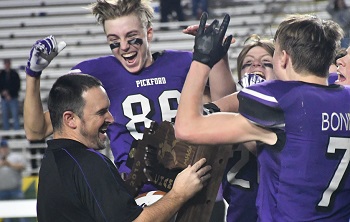
PHOTOS: (Top) Davison and Brighton fans helped fill the lower bowl of Ford Field on Saturday. (Middle) Pickford celebrates its championship at the Superior Dome two weekends ago. (Top photo by Paige Winne; middle photo by Cara Kamps.)