

New Math: Division & Multiplication Problems
July 25, 2017
By Jack Roberts
MHSAA Executive Director
This is the second part in a series on MHSAA tournament classification, past and present, that will be published over the next two weeks. This series originally ran in this spring's edition of MHSAA benchmarks.
High school tournament classifications went viral before there was social media and most of us knew what “viral” meant.
Much as a virus infects computers today or has created epidemics of disease around the world for centuries, high school tournament classification – once introduced – tends to spread uncontrollably. Once started, it tends to keep expanding and rarely contracts.
While we are still some distance from providing every team a trophy as a result of expanding high school tournament classification across the country, there is criticism nevertheless that we are headed in that direction – a philosophy which is supposed to exist only in local youth sports for our youngest children.
Michigan could be blamed for all this. Michigan is generally accepted as the first state to provide different classifications for season-ending tournaments for different sized schools. It started a century ago. Today, every state has various classifications for its tournaments in most if not all sports. And it is a bit ironic that Michigan – creator of the classification chaos – more than most other states has kept the number of tournament classes or divisions under control.
Yes, there is evidence that tournament classifications have expanded over the years in Michigan, especially with the relatively recent introduction of tournaments in football and the late 1990s’ move from classes to divisions in most MHSAA tournaments. But the MHSAA Representative Council has held true to its word when it expanded the playoffs for football from four classes to eight divisions: this is needed because of unique factors of football, factors that exist in no other sport; and all other sports should be capped at a maximum of four classes or divisions.
Kentucky is the preeminent defender of single-class basketball. All of its 276 high schools compete for the single state championship for each gender. In Indiana, there are still open wounds from its move in 1998 from one to four classes for its 400 schools in basketball.
Multi-class tournaments have tended to increase the number of non-public school champions, which some states are trying to lower through enrollment “multipliers,” and also tend to increase the number of repeat champions, which some states are trying to affect with “success factors” which lift smaller schools into classifications for larger schools if they take home too many trophies.
While there is considerable evidence that state tournaments do as much bad as good for educational athletics, state associations persist in providing postseason tournaments because, on balance, the experiences are supposed to be good for student-athletes. And once we reach that conclusion it is just a small leap to believe that if the tournaments are good for a few, they must be better for more – which leads to creating more and more tournament classifications. One becomes two classes, then three, then four and so forth.
While the argument is that more classifications or divisions provides more students with opportunities to compete and win, it is undeniable that the experience changes as the number of tournament classifications expands. It is not possible for state associations to provide the same level of support when tournament classifications expand to multiple venues playing simultaneously. For example, there is less audio and video broadcast potential at each venue, and less media coverage to each venue. Focus is diluted and fans diminished at each championship.
No one can argue reasonably that today's two-day MHSAA Football Finals of eight championship games has the same pizazz as the one-day, four-games event conducted prior to 1990.
In some states the number of divisions has grown so much that it is difficult to see much difference between the many season-ending state championship games and a regular-season event in the same sport.
It is a balancing act. And Michigan has been studying that balance longer than any other state, and charting a steadier course than most.
Addition by Division
The shift to Divisions for MHSAA Tournament play in numerous sports has added up to a greater number of champions for teams and individuals across the state. Following are the sports currently employing a divisional format, and the procedures for determining enrollment and classification.
In 23 statewide or Lower Peninsula tournaments, schools which sponsor the sport are currently divided into nearly equal divisions. They are:
- Baseball - 4 Divisions
- Boys Bowling - 4 Divisions
- Girls Bowling - 4 Divisions
- Girls Competitive Cheer - 4 Divisions
- LP Boys Cross Country - 4 Divisions
- LP Girls Cross Country - 4 Divisions
- LP Boys Golf - 4 Divisions
- LP Girls Golf - 4 Divisions
- Ice Hockey - 3 Divisions
- Boys Lacrosse - 2 Divisions
- Girls Lacrosse - 2 Divisions
- Boys Skiing - 2 Divisions
- Girls Skiing - 2 Divisions
- LP Boys Soccer - 4 Divisions LP
- Girls Soccer - 4 Divisions
- Girls Softball - 4 Divisions
- LP Boys Swimming & Diving - 3 Divisions
- LP Girls Swimming & Diving - 3 Divisions
- LP Boys Tennis - 4 Divisions
- LP Girls Tennis - 4 Divisions
- LP Boys Track & Field - 4 Divisions
- LP Girls Track & Field - 4 Divisions
- Wrestling - 4 Divisions
Lists of schools for each division of these 23 tournaments are posted on MHSAA.com approximately April 1. Listings of schools in Upper Peninsula tournaments for their sports are also posted on MHSAA.com. The lists are based on school memberships and sports sponsorships in effect or anticipated for the following school year, as known to the MHSAA office as of a date in early March.
In football, the 256 schools which qualify for MHSAA 11-player playoffs are placed in eight equal divisions annually on Selection Sunday. Beginning in 2017, the 8-player divisions will be determined in a like manner on Selection Sunday as well, with 32 qualifying schools placed in two divisions.
Schools have the option to play in any higher division in one or more sports for a minimum of two years.
The deadlines for "opt-ups" are as follows:
- Applications for fall sports must be submitted by April 15
- Applications for winter sports must be submitted by Aug. 15
- Applications for spring sports must be submitted by Oct. 15
Subsequent to the date of these postings for these tournaments, no school will have its division raised or lowered by schools opening or closing, schools adding or dropping sports, schools exercising the option to play in a higher division, or approval or dissolution of cooperative programs.
When the same sport is conducted for boys and girls in the same season (e.g., track & field and cross country), the gender that has the most sponsoring schools controls the division breaks for both genders.
Davison Earns 1st-Time Football Glory
November 30, 2019
By Tom Kendra
Special for Second Half
DETROIT – Davison senior wide receiver Latrell Fordham strolled into the postgame press conference with his left arm in a sling, and an enormous smile on his face.
Fordham played a huge role in Davison’s 35-25 victory over Brighton in the MHSAA Division 1 Final on Saturday at Ford Field – before landing awkwardly and fracturing his left elbow late in the second quarter.
“It hurts a lot, and I need surgery, but winning a state championship overrides all of that,” said Fordham, a 6-foot-3 Ball State commit who had four catches for 88 yards before his injury, including an electrifying 74-yard sprint along the Davison sideline that helped his team assume control in the second quarter.
Davison (12-2) won the first football Finals championship in school history and the first title for a Saginaw Valley League school since 1999 Saginaw High, which was led by Charles Rogers and also featured LaMarr Woodley.
The Cardinals, who had won their first four playoff games in come-from-behind fashion powered by their running game, shifted gears completely Saturday.
Davison never trailed and pulled away behind an impressive passing attack, as 6-3 junior quarterback Brendan Sullivan completed 14-of-19 passes for 290 yards. He connected with six receivers.
Brighton coach Brian Lemons said after the game that his team was committed to shutting down the run, which made it susceptible through the air.
“We had to pick our poison,” said Lemons, whose team stunned top-ranked Belleville 22-19 in the Semifinals to earn its first Finals appearance. “We had some single coverage, and they did a great job of connecting in those situations.”
Sullivan opened the scoring on a one-yard plunge in the first quarter set up by a crucial two-yard, fourth-down completion to Fordham and a 14-yard pass to Harrison Terry on the next play. Terry led all receivers with six catches for 94 yards.
After a Brighton field goal narrowed the lead to 7-3 in the second quarter, second-year Davison coach Jake Weingartz seized on an opportunity to go for a home run.
“We had trips (three receivers) to one side and Latrell by himself on the other side,” explained Weingartz. “He had single coverage and the safety shaded to the trips side. We had to take a shot. We’re not going to beat our head against the wall and try to run against a loaded front.”
Fordham took off on a straight go route along the Davison sideline and Sullivan delivered a strike, which Fordham caught in stride as he sprinted the rest of the way for a 74-yard score and 14-3 lead.
 “We were waiting for the right moment, and on that play we had the matchup we wanted,” explained Fordham, who expects to miss a good portion of basketball season, but hopes to be back by March. “Brendan made a perfect throw. I just had to grab it and take it to the house.”
That play brought the huge crowd from Davison to its feet and seemingly opened the floodgates. The Cardinals scored on a one-yard run by Carter Cryderman before halftime and a 10-yard scramble run by Sullivan early in the third quarter to take a seemingly comfortable 28-3 lead.
Brighton (11-3) showed no quit, however, led by dual-threat senior quarterback Colby Newburg and junior running back Nicholas Nemecek.
The Bulldogs scored 16 points in a row – on a one-yard run by Nemecek and a 27-yard pass from Newburg to Nemecek (along with a pair of 2-point conversions) – to close to within 28-19 with four minutes remaining, bringing the orange-clad Brighton fans to life.
Newburg, a 6-0, 190-pound senior, completed 16-of-28 passes for 249 yards and two touchdowns, and also ran 22 times for 83 yards.
“All I can say is that I’m super proud of everybody,” said Newburg. “We fought to the end.”
With Brighton back within striking distance, Sullivan took his turn in the quarterback shootout.
He connected with senior Caleb Smith on a 63-yard pass down to the 1-yard line, which Cryderman took in on the next play to push the lead back to 35-19.
Even then, Brighton was still not done, as Newburg completed six passes on the next drive, including a three-yard TD connection with Austin Lin with 43 seconds remaining. It wasn’t until the ensuing 2-point conversion pass fell incomplete that the game was decided.
Davison finished with a slight 441-425 edge in total yardage, but it was the efficiency of Sullivan through the air which proved to be the difference.
“I told my coach to trust me in this game,” said Sullivan, who stepped up as a junior on the biggest stage. “I want the ball in my hands in those pressure situations.”
The game featured two schools making their first appearances in the Finals, which is becoming more and more rare after 45 years of MHSAA Playoffs, which began in 1975.
That first-time excitement was apparent as both communities turned out in droves at Ford Field, Brighton in orange and Davison in gold.
Adding to the excitement was the fact neither team was expected to make a long playoff run after finishing second in their respective conferences – Davison in the Saginaw Valley League Red (behind Lapeer) and Brighton in the Kensington Lakes Activities Association West (behind Plymouth).
Davison senior linebacker Logan Pasco was all over the field with a game-high 16 tackles, while Smith had nine tackles and defensive end Harry Unger made seven stops. Ian Hummel led Brighton with eight tackles, and Cole Riddle and Carson Billig each made six.
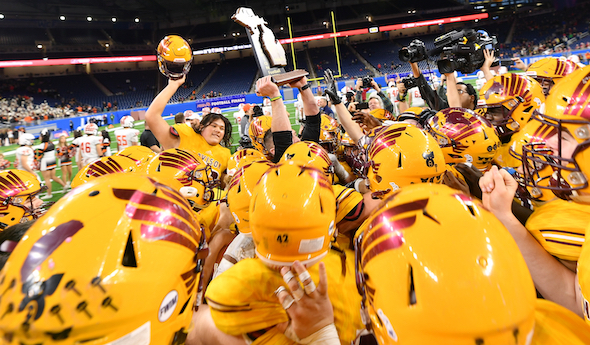
PHOTOS: (Top) Davison celebrates its first MHSAA Football Finals championship Saturday at Ford Field. (Middle) Brighton’s Ruben Salinas (1) keeps his eyes on a pass as Davison’s JayLen Murray Flowers works to deflect it.