

New Math: Division & Multiplication Problems
July 25, 2017
By Jack Roberts
MHSAA Executive Director
This is the second part in a series on MHSAA tournament classification, past and present, that will be published over the next two weeks. This series originally ran in this spring's edition of MHSAA benchmarks.
High school tournament classifications went viral before there was social media and most of us knew what “viral” meant.
Much as a virus infects computers today or has created epidemics of disease around the world for centuries, high school tournament classification – once introduced – tends to spread uncontrollably. Once started, it tends to keep expanding and rarely contracts.
While we are still some distance from providing every team a trophy as a result of expanding high school tournament classification across the country, there is criticism nevertheless that we are headed in that direction – a philosophy which is supposed to exist only in local youth sports for our youngest children.
Michigan could be blamed for all this. Michigan is generally accepted as the first state to provide different classifications for season-ending tournaments for different sized schools. It started a century ago. Today, every state has various classifications for its tournaments in most if not all sports. And it is a bit ironic that Michigan – creator of the classification chaos – more than most other states has kept the number of tournament classes or divisions under control.
Yes, there is evidence that tournament classifications have expanded over the years in Michigan, especially with the relatively recent introduction of tournaments in football and the late 1990s’ move from classes to divisions in most MHSAA tournaments. But the MHSAA Representative Council has held true to its word when it expanded the playoffs for football from four classes to eight divisions: this is needed because of unique factors of football, factors that exist in no other sport; and all other sports should be capped at a maximum of four classes or divisions.
Kentucky is the preeminent defender of single-class basketball. All of its 276 high schools compete for the single state championship for each gender. In Indiana, there are still open wounds from its move in 1998 from one to four classes for its 400 schools in basketball.
Multi-class tournaments have tended to increase the number of non-public school champions, which some states are trying to lower through enrollment “multipliers,” and also tend to increase the number of repeat champions, which some states are trying to affect with “success factors” which lift smaller schools into classifications for larger schools if they take home too many trophies.
While there is considerable evidence that state tournaments do as much bad as good for educational athletics, state associations persist in providing postseason tournaments because, on balance, the experiences are supposed to be good for student-athletes. And once we reach that conclusion it is just a small leap to believe that if the tournaments are good for a few, they must be better for more – which leads to creating more and more tournament classifications. One becomes two classes, then three, then four and so forth.
While the argument is that more classifications or divisions provides more students with opportunities to compete and win, it is undeniable that the experience changes as the number of tournament classifications expands. It is not possible for state associations to provide the same level of support when tournament classifications expand to multiple venues playing simultaneously. For example, there is less audio and video broadcast potential at each venue, and less media coverage to each venue. Focus is diluted and fans diminished at each championship.
No one can argue reasonably that today's two-day MHSAA Football Finals of eight championship games has the same pizazz as the one-day, four-games event conducted prior to 1990.
In some states the number of divisions has grown so much that it is difficult to see much difference between the many season-ending state championship games and a regular-season event in the same sport.
It is a balancing act. And Michigan has been studying that balance longer than any other state, and charting a steadier course than most.
Addition by Division
The shift to Divisions for MHSAA Tournament play in numerous sports has added up to a greater number of champions for teams and individuals across the state. Following are the sports currently employing a divisional format, and the procedures for determining enrollment and classification.
In 23 statewide or Lower Peninsula tournaments, schools which sponsor the sport are currently divided into nearly equal divisions. They are:
- Baseball - 4 Divisions
- Boys Bowling - 4 Divisions
- Girls Bowling - 4 Divisions
- Girls Competitive Cheer - 4 Divisions
- LP Boys Cross Country - 4 Divisions
- LP Girls Cross Country - 4 Divisions
- LP Boys Golf - 4 Divisions
- LP Girls Golf - 4 Divisions
- Ice Hockey - 3 Divisions
- Boys Lacrosse - 2 Divisions
- Girls Lacrosse - 2 Divisions
- Boys Skiing - 2 Divisions
- Girls Skiing - 2 Divisions
- LP Boys Soccer - 4 Divisions LP
- Girls Soccer - 4 Divisions
- Girls Softball - 4 Divisions
- LP Boys Swimming & Diving - 3 Divisions
- LP Girls Swimming & Diving - 3 Divisions
- LP Boys Tennis - 4 Divisions
- LP Girls Tennis - 4 Divisions
- LP Boys Track & Field - 4 Divisions
- LP Girls Track & Field - 4 Divisions
- Wrestling - 4 Divisions
Lists of schools for each division of these 23 tournaments are posted on MHSAA.com approximately April 1. Listings of schools in Upper Peninsula tournaments for their sports are also posted on MHSAA.com. The lists are based on school memberships and sports sponsorships in effect or anticipated for the following school year, as known to the MHSAA office as of a date in early March.
In football, the 256 schools which qualify for MHSAA 11-player playoffs are placed in eight equal divisions annually on Selection Sunday. Beginning in 2017, the 8-player divisions will be determined in a like manner on Selection Sunday as well, with 32 qualifying schools placed in two divisions.
Schools have the option to play in any higher division in one or more sports for a minimum of two years.
The deadlines for "opt-ups" are as follows:
- Applications for fall sports must be submitted by April 15
- Applications for winter sports must be submitted by Aug. 15
- Applications for spring sports must be submitted by Oct. 15
Subsequent to the date of these postings for these tournaments, no school will have its division raised or lowered by schools opening or closing, schools adding or dropping sports, schools exercising the option to play in a higher division, or approval or dissolution of cooperative programs.
When the same sport is conducted for boys and girls in the same season (e.g., track & field and cross country), the gender that has the most sponsoring schools controls the division breaks for both genders.
Glen Lake Plays for Weekends Like This
November 15, 2019
By Chris Dobrowolski
Special for Second Half
There’s nothing that could spoil Jerry Angers’ mood right now.
 When you love coaching football as much as Maple City Glen Lake’s varsity leader, being able to continue preparing your team deep into the playoffs trumps any tough situations that might come along.
That’s why an early-season snowstorm that hammered Leelanau County and shut down a number of schools in the area hardly registered as problematic for Angers, who is guiding his Lakers into a Division 6 Regional championship game against Calumet on Saturday — a clash of 10-1 squads aiming to advance to the Semifinal round.
“It’s totally awesome,” said Angers, in his 11th year in charge of the Lakers. “We’re getting pounded with snow up here, and we’ve got guys plowing our field off. We practiced in the gym today because it was snowing so bad. We were told we had to go home early. I wouldn’t trade that adversity for anything.”
This will be the second time in the last four years Glen Lake has ventured to the Upper Peninsula to face the Copper Kings. In 2016 the two teams met in the same round of the postseason, with the Lakers pulling out a 14-0 win on the way to reaching the Division 6 Final against Jackson Lumen Christi, which won the title with a 26-14 victory. Nearly all of the 16 seniors on Glen Lake’s roster were freshmen on the 2016 team and have the experience of an eight-hour bus trip to the Keweenaw Peninsula under their belts.
“That’s a really cool similarity because those kids have experienced this trip,” said Angers. “They weren’t playing, but they experienced what it took to get there.”
Angers makes the experience more than just playing the game. Getting in a practice on the way to Calumet, the team meals, the hotel stay — each aspect becomes part of the joy of the journey.
“It’s fun getting on the bus and basically spending two days with the kids and experience all the different things,” said Angers. “It’s like college football life on the high school level.”
There’s little doubt this is a business trip for the Lakers, though.
“When we got into film session on Sunday, Coach just told us it’s college football 101,” said senior running back/linebacker Johnathan Wright. “Long bus ride. We’ve got to stay focused.
“(They are) definitely a typical U.P. power team. They want to run downhill and run the clock out and just keep smashing you in the mouth.”
Angers admits to being superstitious enough that he’s trying to mimic as much of the trip this time to the one in 2016 in hopes that it can lead to a similar outcome. Just maybe not an exact mirror, however.
Right as the Lakers were getting ready to head from the hotel to the field in that Regional contest in 2016, they realized they had been locked out of their bus. Without panicking, players had to file into parents’ vehicles to transport them to the game in time. The Lakers managed to overcome that moment of turmoil by winning the game.
“So, if that’s what goes wrong and you still get to play a game? I was laughing about it,” said Angers. “How many other people are playing football right now?”
The seeds for this season were sown during an up-and-down 5-5 campaign a year ago that included a first-round playoff loss to Beaverton. The senior class — which showed its potential when it got significant playing time and performed well in a postseason victory against Roscommon as freshmen — wanted to leave its own legacy with a deep playoff run like the one the Lakers experienced three years ago.
“That was a huge motivation,” said senior lineman Ben Kroll. “We hated how we exited last year. We did not like the way we played. We do a boot camp every summer before the season starts. It was definitely the best boot camp I’ve been to, how close we all were and how we get along. We’ll fight for each other every day.”
Glen Lake has good athletes at the skill positions. Wright is in his second year starting on offense — he’s also been a three-year starter at linebacker — and is the leading rusher. Quarterback Reece Hazelton, at 6-foot-7, has a greater stature than a typical high school quarterback, though his best sport is basketball. He signed his letter of intent Wednesday to play hoops for Ferris State. His favorite target is junior receiver Finn Hogan.
The line, a position group near and dear to Angers’ heart, is the heartbeat of the team, with seniors Garrett Tremble, Dylan Kilinski, River Dallas and Kroll, and junior tackle Sam Keys.
“Without them nothing would happen,” said Wright.
Angers makes sure everyone on the roster knows they have key roles, whether it’s starting on offense, defense or special teams. Guys who make up the scout team are held in high value. Angers can go down the line and name off kids on his team and big plays they’ve been able to make at some point this season.
“There’s 31 kids I can turn to at any time, and I feel very comfortable and confident that they’re going to go in and get the job done,” said Angers. “Next man up. You’re one play away from being a starter. I think these kids also understand that.”
The Lakers have gone through a brutal schedule nearly unscathed. Five of the nine teams on the schedule qualified for the playoffs, and four of those teams won at least one postseason game. The schedule is specifically created that way for Glen Lake to be properly prepared to handle tough teams during the playoffs.
The one slip up came in the seventh week when Kingsley — which remains undefeated and is playing for a Regional crown in Division 5 — handed the Lakers a 53-14 loss. Angers shoulders the blame, saying he didn’t have the Lakers ready for a game of that magnitude and Glen Lake was uncharacteristically sloppy.
“That was a real wake-up call, and I think that was really good for our team because now in these playoff runs we know we can’t take any days off, any moments off,” said Kroll.
The ultimate goal, of course, is to win the Division 6 championship at Ford Field. Two more wins and Glen Lake will be back in the position it was in three years ago, playing in Detroit with a title on the line. Glen Lake’s last football championship came in 1994 when the Lakers won the Class DD crown with a 20-10 victory against Waterford Our Lady of the Lakes.
“There’s nothing like it,” said Wright. “All the lights are on you. You’re at the center of a huge dome, and it feels amazing. I just want to get back to that.”
The memory of being in Detroit for Thanksgiving weekend is still fresh in Angers’ mind — arriving at the stadium and feeling the electricity in the air as an earlier game unfolded.
“One of the coolest experiences was when we were all walking in from the bus into the tunnel and there was a big play made in the game before us,” said Angers. “The crowd just erupted, and it just ran down that tunnel. My kids, they were just starry eyed and they looked at me and I went, ‘You’re in the big time boys.’”
And nothing could be better than that.
 Chris Dobrowolski has covered northern Lower Peninsula sports since 1999 at the Ogemaw County Herald, Alpena News, Traverse City Record-Eagle and currently as sports editor at the Antrim Kalkaska Review since 2016. He can be reached at [email protected] with story ideas for Manistee, Wexford, Missaukee, Roscommon, Ogemaw, Iosco, Alcona, Oscoda, Crawford, Kalkaska, Grand Traverse, Benzie, Leelanau, Antrim, Otsego, Montmorency, Alpena, Presque Isle, Cheboygan, Charlevoix and Emmet counties.
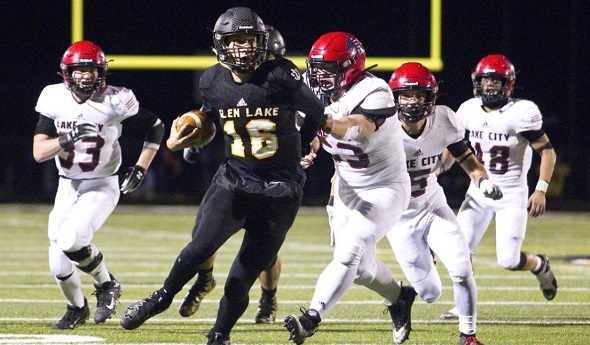
PHOTO: Maple City Glen Lake quarterback Reece Hazelton breaks free from Lake City defenders during a 30-19 Pre-District win. (Photo courtesy of the Traverse City Record-Eagle.)