


New Math: Division & Multiplication Problems
July 25, 2017
By Jack Roberts
MHSAA Executive Director
This is the second part in a series on MHSAA tournament classification, past and present, that will be published over the next two weeks. This series originally ran in this spring's edition of MHSAA benchmarks.
High school tournament classifications went viral before there was social media and most of us knew what “viral” meant.
Much as a virus infects computers today or has created epidemics of disease around the world for centuries, high school tournament classification – once introduced – tends to spread uncontrollably. Once started, it tends to keep expanding and rarely contracts.
While we are still some distance from providing every team a trophy as a result of expanding high school tournament classification across the country, there is criticism nevertheless that we are headed in that direction – a philosophy which is supposed to exist only in local youth sports for our youngest children.
Michigan could be blamed for all this. Michigan is generally accepted as the first state to provide different classifications for season-ending tournaments for different sized schools. It started a century ago. Today, every state has various classifications for its tournaments in most if not all sports. And it is a bit ironic that Michigan – creator of the classification chaos – more than most other states has kept the number of tournament classes or divisions under control.
Yes, there is evidence that tournament classifications have expanded over the years in Michigan, especially with the relatively recent introduction of tournaments in football and the late 1990s’ move from classes to divisions in most MHSAA tournaments. But the MHSAA Representative Council has held true to its word when it expanded the playoffs for football from four classes to eight divisions: this is needed because of unique factors of football, factors that exist in no other sport; and all other sports should be capped at a maximum of four classes or divisions.
Kentucky is the preeminent defender of single-class basketball. All of its 276 high schools compete for the single state championship for each gender. In Indiana, there are still open wounds from its move in 1998 from one to four classes for its 400 schools in basketball.
Multi-class tournaments have tended to increase the number of non-public school champions, which some states are trying to lower through enrollment “multipliers,” and also tend to increase the number of repeat champions, which some states are trying to affect with “success factors” which lift smaller schools into classifications for larger schools if they take home too many trophies.
While there is considerable evidence that state tournaments do as much bad as good for educational athletics, state associations persist in providing postseason tournaments because, on balance, the experiences are supposed to be good for student-athletes. And once we reach that conclusion it is just a small leap to believe that if the tournaments are good for a few, they must be better for more – which leads to creating more and more tournament classifications. One becomes two classes, then three, then four and so forth.
While the argument is that more classifications or divisions provides more students with opportunities to compete and win, it is undeniable that the experience changes as the number of tournament classifications expands. It is not possible for state associations to provide the same level of support when tournament classifications expand to multiple venues playing simultaneously. For example, there is less audio and video broadcast potential at each venue, and less media coverage to each venue. Focus is diluted and fans diminished at each championship.
No one can argue reasonably that today's two-day MHSAA Football Finals of eight championship games has the same pizazz as the one-day, four-games event conducted prior to 1990.
In some states the number of divisions has grown so much that it is difficult to see much difference between the many season-ending state championship games and a regular-season event in the same sport.
It is a balancing act. And Michigan has been studying that balance longer than any other state, and charting a steadier course than most.
Addition by Division
The shift to Divisions for MHSAA Tournament play in numerous sports has added up to a greater number of champions for teams and individuals across the state. Following are the sports currently employing a divisional format, and the procedures for determining enrollment and classification.
In 23 statewide or Lower Peninsula tournaments, schools which sponsor the sport are currently divided into nearly equal divisions. They are:
- Baseball - 4 Divisions
- Boys Bowling - 4 Divisions
- Girls Bowling - 4 Divisions
- Girls Competitive Cheer - 4 Divisions
- LP Boys Cross Country - 4 Divisions
- LP Girls Cross Country - 4 Divisions
- LP Boys Golf - 4 Divisions
- LP Girls Golf - 4 Divisions
- Ice Hockey - 3 Divisions
- Boys Lacrosse - 2 Divisions
- Girls Lacrosse - 2 Divisions
- Boys Skiing - 2 Divisions
- Girls Skiing - 2 Divisions
- LP Boys Soccer - 4 Divisions LP
- Girls Soccer - 4 Divisions
- Girls Softball - 4 Divisions
- LP Boys Swimming & Diving - 3 Divisions
- LP Girls Swimming & Diving - 3 Divisions
- LP Boys Tennis - 4 Divisions
- LP Girls Tennis - 4 Divisions
- LP Boys Track & Field - 4 Divisions
- LP Girls Track & Field - 4 Divisions
- Wrestling - 4 Divisions
Lists of schools for each division of these 23 tournaments are posted on MHSAA.com approximately April 1. Listings of schools in Upper Peninsula tournaments for their sports are also posted on MHSAA.com. The lists are based on school memberships and sports sponsorships in effect or anticipated for the following school year, as known to the MHSAA office as of a date in early March.
In football, the 256 schools which qualify for MHSAA 11-player playoffs are placed in eight equal divisions annually on Selection Sunday. Beginning in 2017, the 8-player divisions will be determined in a like manner on Selection Sunday as well, with 32 qualifying schools placed in two divisions.
Schools have the option to play in any higher division in one or more sports for a minimum of two years.
The deadlines for "opt-ups" are as follows:
- Applications for fall sports must be submitted by April 15
- Applications for winter sports must be submitted by Aug. 15
- Applications for spring sports must be submitted by Oct. 15
Subsequent to the date of these postings for these tournaments, no school will have its division raised or lowered by schools opening or closing, schools adding or dropping sports, schools exercising the option to play in a higher division, or approval or dissolution of cooperative programs.
When the same sport is conducted for boys and girls in the same season (e.g., track & field and cross country), the gender that has the most sponsoring schools controls the division breaks for both genders.
Pellston Writing Unforgettable Story
November 1, 2019
By Chris Dobrowolski
Special for Second Half
PELLSTON — It’s a story that could easily derive from Hollywood.
 Only, this script is being written in Pellston.
Leading up to the 2019 season, the narrative for the Pellston football team has been mostly a tale of woe.
Zero playoff appearances.
Twenty-three years without a winning season.
A .260 winning percentage since 1950.
This year, however, the plot has turned into a feel-good story as the Hornets have put together a season that’s only been dreamed about over the years, posting an 8-1 record and earning their first postseason berth.
“To go 8-1, it was great,” said Pellston head coach Jack Carter, a 1987 graduate of the school. “I knew we had some really good players, some great seniors. Strong leadership on that end. It all kind of came together for us, at least through the regular season. I don’t know if it’s being a miracle worker as much as we’re at the right place at the right time.”
Pellston quarterback Glenn Bonter is one of those seniors. Bonter moved to town two years ago from Grand Haven and immediately found his niche within the confines of the weight room. The other players who were there made him feel welcome, and they quickly became friends. They also filled him in on the school’s history in football.
“(I heard) that it was a struggle,” said Bonter. “That they hadn’t had a whole lot of success. That was something where we looked at it and all of us wanted it to change. Looking around in the weight room, I saw how much hard work and dedication kids were really putting into it. Pretty much the whole entire team would go to weight room in the summer. We would all go out to the field and just pass and do some running. I think it was a whole team thing. We were like, ‘You know what? We want to win, and we’re going to do it.’ We just kind of put our foot down and went for it.”
Carter is in just his third year leading the Hornets, though he is well-versed in how difficult it has been for the school to win on the football field having off-and-on been a part of the program in one capacity or another since 2001. He’s seen players and coaches come and go, working to get things heading in the right direction but often finding that to be an insurmountable hurdle.
 “If you look at it strictly from wins and losses, it wouldn’t tell the complete story because we have not been that great,” said Carter. “But we’ve had, every single year, guys that went out there and worked so hard. Played with as much heart and emotion as you could expect. For me, I think that was the template, or the groundwork for us to build off.”
Pellston also laid some of the foundation for this season during last year’s 4-5 campaign. What might seem like a rebuilding year for some was a breakthrough for the Hornets. It was the most wins they had recorded in six years. Three of those wins came in succession, too — the first time the program had strung together consecutive victories since it opened the 2012 season with four straight victories.
That propelled the Hornets into the offseason with a ton of hunger. The team’s four seniors — Bonter, running back/defensive back Lakota Worthington, and linemen Evan Cameron and Joey Rizzardi — spearheaded the team’s participation in summer training. When the full squad met for the first time in August, it came in with good fitness, strength, talent and desire.
“We made sure to make the weight room a thing,” said Worthington. “We made sure to come in during the offseason and put in the work and made sure we worked on our routes.”
It didn’t take long for Pellston to reap the benefits of its hard work as it started the year with six wins in a row — the longest winning streak in school history. Among those victories were dramatic triumphs over Posen (42-38) and Au Gres-Sims (32-30) where the Hornets overcame halftime deficits of 16 and 18 points, respectively, to remain undefeated.
“Normally you just don’t come back from those type of deficits,” said Carter. “This group of guys, they just keep fighting. They keep believing, and they keep their heads up. Their positive outlook and attitude is first rate.”
“For us to rally back and win those games, it was unbelievable,” said Bonter.
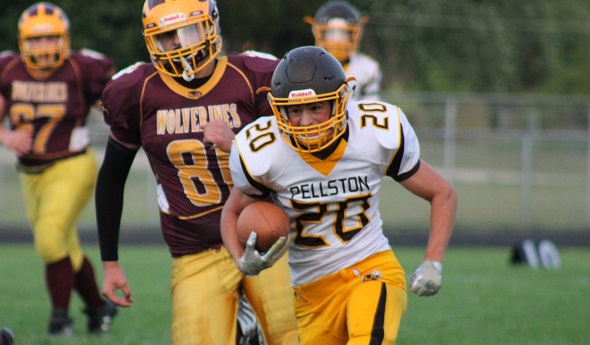
Three games into his junior season, Bonter switched from running back to quarterback. He’s been dynamic in running the Hornets’ spread offense, accounting for 16 touchdowns rushing and 13 through the air. Junior David Jamroz, like Bonter, has rushed for more than 1,000 yards. Worthington joins them in a backfield that features a great deal of speed. He also provides electricity in the return game.
“(He’s a) special returner,” Carter said of Worthington, a four-year varsity player. “He’s been that sparkplug and that catalyst that we’ve been needing for quite a while. In 8-man football a lot of times teams choose not to really kick to guys who are like that. It seems like every time a ball did go to him, he made the most of it. If he didn’t get a touchdown out of it, he certainly flipped the field for us and gave us great starting position on offense.”
The Hornets have averaged 46 points per game. The only time they’ve been held under 30 points was a 38-14 loss to Hillman in the seventh week, a game where injuries hampered Pellston’s chances.
“I think we just had an off night,” said Bonter. “They’re a really good football team. A lot of respect to Hillman. They should go far; but yeah, that was a tough loss.”
 “We learned that sometimes only going in with 11 players can get you in trouble,” said Carter. “We did get hit with some injuries that night. Secondly, Hillman was the first team that really came out and really played good, sound, hard-hitting football, especially on the defensive side. They have a history of being able to make the playoffs, and they’ve had success in football. They showed why they’re at where they’re at.”
The Hornets were able to rebound and finished the regular season with a pair of convincing wins over St. Helen Charlton Heston and Central Lake.
If the current football playoff system was in place in 1995, Pellston wouldn’t have had to wait until this season to gain its first postseason bid. That year the Hornets went 8-1 but did not qualify because they ultimately didn’t have enough playoff points.
Twenty-four years later Pellston finally buzzed its way into the postseason. It opens the MHSAA 8-player Division 1 tournament with a Pre-Regional on Friday against Gaylord St. Mary.
“I’m so ready. I’m ready today,” said Worthington. “I just want to go out there and show everybody what we can do. I know Gaylord (St. Mary) is pretty good, but I’m ready to get them.”
The Snowbirds come into the game with a 4-5 record, but four of their first six wins were forfeited for using an ineligible player.
“St. Mary is coming in with a really, really good football team,” said Carter. “I look at them as an 8-1 football team, and we have to look at them that way.”
As magical as this season has been for the Hornets, they feel like there is still more of the story to be told and are looking to add a few more chapters in the coming weeks as the playoff scenario unfolds.
“Hopefully we have a good Hollywood ending with it and keep it going into the playoffs,” said Carter.
 Chris Dobrowolski has covered northern Lower Peninsula sports since 1999 at the Ogemaw County Herald, Alpena News, Traverse City Record-Eagle and currently as sports editor at the Antrim Kalkaska Review since 2016. He can be reached at [email protected] with story ideas for Manistee, Wexford, Missaukee, Roscommon, Ogemaw, Iosco, Alcona, Oscoda, Crawford, Kalkaska, Grand Traverse, Benzie, Leelanau, Antrim, Otsego, Montmorency, Alpena, Presque Isle, Cheboygan, Charlevoix and Emmet counties.
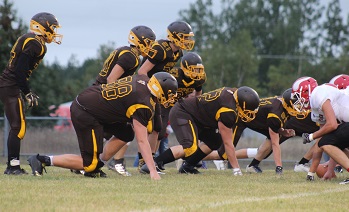
PHOTOS: (Top) Pellston’s David Jamroz (20) races through the Au Gres-Sims defense during a Week 3 win. (Middle) The Hornets stack the line during a Week 2 victory over Posen. (Photos courtesy of the Pellston athletic department.)