

New Math: Division & Multiplication Problems
July 25, 2017
By Jack Roberts
MHSAA Executive Director
This is the second part in a series on MHSAA tournament classification, past and present, that will be published over the next two weeks. This series originally ran in this spring's edition of MHSAA benchmarks.
High school tournament classifications went viral before there was social media and most of us knew what “viral” meant.
Much as a virus infects computers today or has created epidemics of disease around the world for centuries, high school tournament classification – once introduced – tends to spread uncontrollably. Once started, it tends to keep expanding and rarely contracts.
While we are still some distance from providing every team a trophy as a result of expanding high school tournament classification across the country, there is criticism nevertheless that we are headed in that direction – a philosophy which is supposed to exist only in local youth sports for our youngest children.
Michigan could be blamed for all this. Michigan is generally accepted as the first state to provide different classifications for season-ending tournaments for different sized schools. It started a century ago. Today, every state has various classifications for its tournaments in most if not all sports. And it is a bit ironic that Michigan – creator of the classification chaos – more than most other states has kept the number of tournament classes or divisions under control.
Yes, there is evidence that tournament classifications have expanded over the years in Michigan, especially with the relatively recent introduction of tournaments in football and the late 1990s’ move from classes to divisions in most MHSAA tournaments. But the MHSAA Representative Council has held true to its word when it expanded the playoffs for football from four classes to eight divisions: this is needed because of unique factors of football, factors that exist in no other sport; and all other sports should be capped at a maximum of four classes or divisions.
Kentucky is the preeminent defender of single-class basketball. All of its 276 high schools compete for the single state championship for each gender. In Indiana, there are still open wounds from its move in 1998 from one to four classes for its 400 schools in basketball.
Multi-class tournaments have tended to increase the number of non-public school champions, which some states are trying to lower through enrollment “multipliers,” and also tend to increase the number of repeat champions, which some states are trying to affect with “success factors” which lift smaller schools into classifications for larger schools if they take home too many trophies.
While there is considerable evidence that state tournaments do as much bad as good for educational athletics, state associations persist in providing postseason tournaments because, on balance, the experiences are supposed to be good for student-athletes. And once we reach that conclusion it is just a small leap to believe that if the tournaments are good for a few, they must be better for more – which leads to creating more and more tournament classifications. One becomes two classes, then three, then four and so forth.
While the argument is that more classifications or divisions provides more students with opportunities to compete and win, it is undeniable that the experience changes as the number of tournament classifications expands. It is not possible for state associations to provide the same level of support when tournament classifications expand to multiple venues playing simultaneously. For example, there is less audio and video broadcast potential at each venue, and less media coverage to each venue. Focus is diluted and fans diminished at each championship.
No one can argue reasonably that today's two-day MHSAA Football Finals of eight championship games has the same pizazz as the one-day, four-games event conducted prior to 1990.
In some states the number of divisions has grown so much that it is difficult to see much difference between the many season-ending state championship games and a regular-season event in the same sport.
It is a balancing act. And Michigan has been studying that balance longer than any other state, and charting a steadier course than most.
Addition by Division
The shift to Divisions for MHSAA Tournament play in numerous sports has added up to a greater number of champions for teams and individuals across the state. Following are the sports currently employing a divisional format, and the procedures for determining enrollment and classification.
In 23 statewide or Lower Peninsula tournaments, schools which sponsor the sport are currently divided into nearly equal divisions. They are:
- Baseball - 4 Divisions
- Boys Bowling - 4 Divisions
- Girls Bowling - 4 Divisions
- Girls Competitive Cheer - 4 Divisions
- LP Boys Cross Country - 4 Divisions
- LP Girls Cross Country - 4 Divisions
- LP Boys Golf - 4 Divisions
- LP Girls Golf - 4 Divisions
- Ice Hockey - 3 Divisions
- Boys Lacrosse - 2 Divisions
- Girls Lacrosse - 2 Divisions
- Boys Skiing - 2 Divisions
- Girls Skiing - 2 Divisions
- LP Boys Soccer - 4 Divisions LP
- Girls Soccer - 4 Divisions
- Girls Softball - 4 Divisions
- LP Boys Swimming & Diving - 3 Divisions
- LP Girls Swimming & Diving - 3 Divisions
- LP Boys Tennis - 4 Divisions
- LP Girls Tennis - 4 Divisions
- LP Boys Track & Field - 4 Divisions
- LP Girls Track & Field - 4 Divisions
- Wrestling - 4 Divisions
Lists of schools for each division of these 23 tournaments are posted on MHSAA.com approximately April 1. Listings of schools in Upper Peninsula tournaments for their sports are also posted on MHSAA.com. The lists are based on school memberships and sports sponsorships in effect or anticipated for the following school year, as known to the MHSAA office as of a date in early March.
In football, the 256 schools which qualify for MHSAA 11-player playoffs are placed in eight equal divisions annually on Selection Sunday. Beginning in 2017, the 8-player divisions will be determined in a like manner on Selection Sunday as well, with 32 qualifying schools placed in two divisions.
Schools have the option to play in any higher division in one or more sports for a minimum of two years.
The deadlines for "opt-ups" are as follows:
- Applications for fall sports must be submitted by April 15
- Applications for winter sports must be submitted by Aug. 15
- Applications for spring sports must be submitted by Oct. 15
Subsequent to the date of these postings for these tournaments, no school will have its division raised or lowered by schools opening or closing, schools adding or dropping sports, schools exercising the option to play in a higher division, or approval or dissolution of cooperative programs.
When the same sport is conducted for boys and girls in the same season (e.g., track & field and cross country), the gender that has the most sponsoring schools controls the division breaks for both genders.
Inside Selection Sunday: Mapnalysis '19
By
Geoff Kimmerly
MHSAA.com senior editor
October 27, 2019
This will be the final MHSAA Football Playoffs under the format created in 1999, with significant changes coming beginning with the 2020 season.
But the soon-to-be old way isn’t going out without a bang.
From a record number of additional qualifiers, to a first-ever coin flip to determine the final team in the 11-player field, to a series of maps that arguably included the toughest to draw at least this decade, this year’s “Selection Sunday” was jammed with notable moments that will play out in 10 divisions over the next five weeks.
Below, we explain how we made many of the most difficult decisions – and follow with a few points of interest that immediately jump out from this season’s brackets.
This process actually begins in April, when we start collecting schedules for the upcoming season – this time for 607 teams, from which 531 ended up eligible for the 11-player playoffs and 71 were eligible in 8-player. And of course, now that the brackets are drawn the major lifting begins – assigning officials for every game, gathering potential Semifinal sites in 11-player and working with our Finals hosts to again create once-in-a-lifetime experiences (for most) when our 8-player finalists face off Nov. 23 at Northern Michigan University’s Superior Dome and our 11-player finalists play for titles Nov. 29-30 at Ford Field.
So let’s dive in. Those familiar with this “Selection Sunday” recap will recognize first a refresher on the playoff selection process, followed by “Observations & Answers: 2019.” That’s followed by thoughts after a glance at this year’s brackets, and be sure to visit MHSAA.com to see all of the pairings in full.
Ground Rules
Our past: The MHSAA 11-player playoff structure – with 256 teams in eight divisions, and six wins equaling an automatic berth (or five wins for teams playing eight or fewer games) – debuted in 1999. An 8-player tournament was added in 2011, and in 2017 a second division of 8-player football was introduced.
The first playoffs were conducted in 1975 with four champions. Four more football classes were added in 1990 for a total of eight champions each fall. Through 1998, only 128 teams made the postseason, based on their playoff point averages within regions (four for each class) that were drawn before the beginning of the season. The drawing of Districts and Regionals after the end of the regular season did not begin until the most recent 11-player playoff expansion.
In early years of the current process, lines were drawn by hand. Dots representing qualifying schools were pasted on maps, one map for each division, and those maps were then covered by plastic sheets. Districts and Regionals literally were drawn with dry-erase markers.
Our present: The last few scores of this regular season were added to MHSAA.com by 8 p.m. Saturday. Re-checking and triple-checking of enrollments, what schools played in co-ops and opted to play as a higher class start a week in advance, and more numbers are crunched Sunday morning as the fields are set.
This final season of 6-wins-and-in (or five wins playing eight games or fewer) produced 202 automatic qualifiers for the 11-player field with a record 54 additional qualifiers then selected by playoff point average – that group of additional qualifiers easily blowing past last year’s then-record total of 43. Additional qualifiers were selected from each class in order (A, B, C, D) until the field was filled. There were only two Class D additional qualifiers with 5-4 or 4-4 (playing eight games) records from which we could choose, and likewise there were 16 additional qualifiers available in Class C – so with those 18 spots filled, we added 18 teams from both Class A and B to fill out the field.
Here’s where the tie-breaker was forced into play. Among Class B teams, Durand and Imlay City tied for the 18th spot with playoff point averages of 42.667. They did not play each other during the regular season – so the first tie-breaker of head-to-head result couldn’t be used. The next tie-breaker is opponents’ winning percentage – and both teams’ opponents won 45.7 percent of their games this season. So we went to the coin flip, and Durand was awarded the final spot in the field.
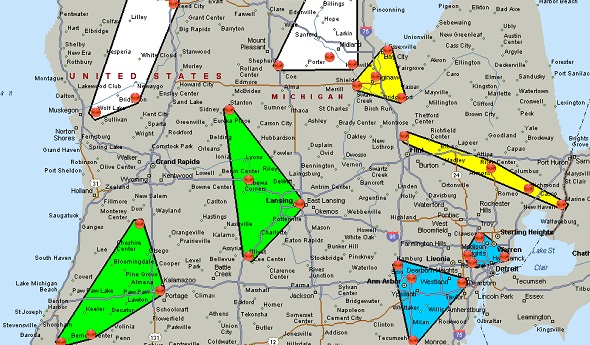
Those 256 11-player teams were then split into eight equal divisions based on enrollment, and their locations were marked on digital maps then projected on wall-size screens and discussed by nearly half of the MHSAA staff plus two representatives from the Michigan High School Football Coaches Association. Only the locations themselves were marked (by red dots) – not records, playoff point averages or names of the schools or towns. In fact, mentions of those are strictly prohibited. Records and playoff points are not part of the criteria. Matchups, rivalries, previous playoff pairings, etc. also DO NOT come into play.
The 8-player process is different for team selection and similar for designation of Regionals. We take the top 32 teams in 8-player based on playoff point average as our field, then re-sort those 32 by enrollment – the 16 biggest make up Division 1, followed by the next 16 in Division 2. There are no automatic qualifiers by record for 8-player, and those fields remain in flux right through the last Week 9 games. For example: Colon as recently as after Week 7 was slated for Division 2. But the Magi after this weekend ended up in Division 1 with the second-highest playoff-point average but the 16th-highest enrollment – meaning Colon (160 students) and Cedarville (154) were the line between Divisions 1 and 2 this year.
Our future: 11-player divisions determined in March. More bonus points awarded in losses. Read all about it: Comparison of old and new playoff formats
Geography rules: This long has been rule number one for drawing MHSAA brackets in any sport. Travel distance and ease DO come into play. Jumping on a major highway clearly is easier than driving across county-wide back roads, and that’s taken into consideration. Also, remember there’s only one Mackinac Bridge and hence only one way to cross between peninsulas – and boats are not considered a possible form of transportation. When opponents from both peninsulas will be in the same District, distance to the bridge is far more important than as the bird flies.
Tradition doesn’t reign: Every group of 32 (or in 8-player, 16) dots is a new group – these 32 teams have not been placed in a bracket together before. How maps have been drawn in the past isn’t considered – it’s hard to say a division has been drawn in a certain way traditionally when this set of 32 teams is making up a division for the first time.
Observations & Answers: 2019
We always start with CONGRATULATIONS: Detroit Leadership Academy, Detroit Communication Media Arts, and Pellston will be making their debuts in the MHSAA Playoffs this week, taking the list of teams that have never qualified for the postseason down to 11. Beal City and Crystal Falls Forest Park will make their MHSAA-best 35th playoff appearances. Five teams will be playing in at least their 17th consecutive playoffs – Rockford (25), Forest Park (23), Jackson Lumen Christi (22), Macomb Dakota (20) and Climax-Scotts (17).
Head-to-head rules: As noted above, it’s the first tie-breaker and comes into play immediately this week. In Division 3, East Lansing and DeWitt have identical playoff point averages, and East Lansing will host their first-round game thanks to a 21-2 Week 5 win. If Portland and Lansing Catholic both advance to an 11-Player Division 5 District Final, Portland will host thanks to a 21-20 Week 5 win over the Cougars. Same in 8-player Division 2, where if Powers North Central and Pickford meet in a Regional Final, the Jets will host thanks to their 20-14 win when the teams met in Week 3.
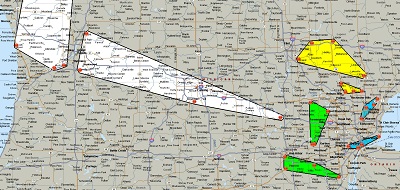 Traverse City traveling: Many years, we have to pay special consideration to ease of travel when we have one of 32 teams from a division in the Upper Peninsula. This year, we spent a lot more time discussing Traverse City schools – notably how to position Traverse City West in Division 1 and Traverse City Central in Division 2. There are three main north-south highways in the Lower Peninsula, with U.S. 131 the thoroughfare out of Traverse City. We also used it as the defining line in Division 1, with West going west with Grand Haven, Grandville and Hudsonville instead of staying with a more northern group that would’ve included Rockford and split Grandville and Hudsonville – which are six miles apart down I-196. In Division 2, we brought U.S. 127 into the mix, figuring it made more sense for travel to use that and 131 in grouping Traverse City Central with Muskegon Mona Shores, Midland and Midland Dow instead of creating a western District stretching from Traverse City to south of Kalamazoo.
Avoid the crisscross: Sometimes Districts drawn on the maps look perfect – but we run into trouble putting them together for a logical Regional. Sometimes we know eight dots should be a Regional, but there’s no reasonable way to split them into two four-team Districts. We do everything possible to keep a team from driving past a different District (or in 8-player Regional) on the way to its first or second-round game. The 8-Player Division 1 map probably looks a little odd with Deckerville possibly playing Morrice in the second round and the Orioles driving past Mayville or Kingston from another Regional to get there. However, there is a distinct northeast-to-southwest line separating those four schools – and if the Regional had been drawn to keep Deckerville with Mayville and Kingston, it would’ve meant Regional champs “jumping” over each other for their Semifinal matchup.
North/South vs. East/West: There isn’t one guiding directional when creating these Districts and Regionals. The 11-player Division 7 map has a little bit of both, with a pair of Districts along I-94 on the south side of the Lower Peninsula, but then Madison Heights Bishop Foley grouped with three Thumb-area teams for a north-south grouping. The other option was sending Bishop Foley northwest toward Flint and Lansing, but that would’ve left the Thumb schools and Beaverton maneuvering around Saginaw Bay.
At the end of the day …
Here’s my annual reminder: We draw these maps not knowing which schools are represented by the dots. The Division 5 and 6 maps were so easy to draw, I had no idea which schools were matched up until checking out the brackets hours later to put together this report.
But with all of that in front of me, here’s a glance at what jumps off the page:
• The Division 1 District made up of unbeaten Belleville and Brownstown Woodhaven, Saline (8-1) and Ann Arbor Pioneer (5-4) is obviously loaded. Belleville and Saline both made the Semifinals last season, and Saline’s only loss this fall was to reigning Division 1 champion Clinton Township Chippewa Valley. Woodhaven finished the regular season unbeaten for the second time in six years and its seeking its first District title.
• Last season’s Division 4 champion Edwardsburg has won 23 straight games and is back in the Division 3 bracket – the Eddies played in Division 4 the last two seasons and most recently in Division 3 in 2016. A possible return to Ford Field starts this week with St. Joseph and could include a trip to Zeeland West and matchup with also-unbeaten Mason.
• Hudsonville Unity Christian is another reigning champion in a new division, moving into Division 4 after winning the championship in Division 5 last fall. Unity begins with Otsego and would play either Grand Rapids Christian or South Christian with a win.
• Make way for Division 7. Unbeaten New Lothrop is the reigning champion and shares a District with undefeated Beaverton and a Regional with also-undefeated Pewamo-Westphalia. Iron Mountain, Lawton, Jackson Lumen Christi and Clinton also have yet to lose a game this season. Lumen Christi has won the last three Division 6 championships and 31 straight games.
• Math can lead to some unpredictable situations, including the occasional undefeated road team during the first round. Almont defeated Richmond 28-10 in Week 7 on the way to the Blue Water Area Conference title and a perfect regular-season record. But the Raiders will travel this week back to Richmond because the Blue Devils finished with a better playoff point average – Almont’s two nonleague opponents finished a combined 1-17, and Richmond’s both made the playoffs with a combined 13-5 record. That difference made the difference in playoff point average by about nine-tenths of a point in Richmond’s favor.
• This year’s 8-player brackets are loaded with intrigue, especially with 2018 Division 2 champion Rapid River not in the field and last year’s Division 1 runner-up Pickford in Division 2 this time. Morrice is the reigning Division 1 champion and could see undefeated Deckerville in a Regional Final. Pickford has to get through another 8-1 team in Engadine this week but could see undefeated Powers North Central in a Division 2 Regional Final.
• And it should shock no one if a team entering the playoffs 4-5 makes it to NMU. Gaylord St. Mary had to forfeit four victories but still made the playoffs with that record. Undefeated Suttons Bay is a possible Regional Final opponent, and St. Mary won their Week 6 matchup on the field 48-47 before later forfeiting that game.
That’s the start of what we’re looking forward to over the next five weeks. The steps taken today were just a few along the way as memories are made for thousands of Michigan high school football players this November.
PHOTOS: (Top) The Division 5 map, with clear-cut Districts, received quick support from the selection committee. (Middle) The Division 1 map split Grand Rapids-area teams along U.S. 131.