

New Math: Division & Multiplication Problems
July 25, 2017
By Jack Roberts
MHSAA Executive Director
This is the second part in a series on MHSAA tournament classification, past and present, that will be published over the next two weeks. This series originally ran in this spring's edition of MHSAA benchmarks.
High school tournament classifications went viral before there was social media and most of us knew what “viral” meant.
Much as a virus infects computers today or has created epidemics of disease around the world for centuries, high school tournament classification – once introduced – tends to spread uncontrollably. Once started, it tends to keep expanding and rarely contracts.
While we are still some distance from providing every team a trophy as a result of expanding high school tournament classification across the country, there is criticism nevertheless that we are headed in that direction – a philosophy which is supposed to exist only in local youth sports for our youngest children.
Michigan could be blamed for all this. Michigan is generally accepted as the first state to provide different classifications for season-ending tournaments for different sized schools. It started a century ago. Today, every state has various classifications for its tournaments in most if not all sports. And it is a bit ironic that Michigan – creator of the classification chaos – more than most other states has kept the number of tournament classes or divisions under control.
Yes, there is evidence that tournament classifications have expanded over the years in Michigan, especially with the relatively recent introduction of tournaments in football and the late 1990s’ move from classes to divisions in most MHSAA tournaments. But the MHSAA Representative Council has held true to its word when it expanded the playoffs for football from four classes to eight divisions: this is needed because of unique factors of football, factors that exist in no other sport; and all other sports should be capped at a maximum of four classes or divisions.
Kentucky is the preeminent defender of single-class basketball. All of its 276 high schools compete for the single state championship for each gender. In Indiana, there are still open wounds from its move in 1998 from one to four classes for its 400 schools in basketball.
Multi-class tournaments have tended to increase the number of non-public school champions, which some states are trying to lower through enrollment “multipliers,” and also tend to increase the number of repeat champions, which some states are trying to affect with “success factors” which lift smaller schools into classifications for larger schools if they take home too many trophies.
While there is considerable evidence that state tournaments do as much bad as good for educational athletics, state associations persist in providing postseason tournaments because, on balance, the experiences are supposed to be good for student-athletes. And once we reach that conclusion it is just a small leap to believe that if the tournaments are good for a few, they must be better for more – which leads to creating more and more tournament classifications. One becomes two classes, then three, then four and so forth.
While the argument is that more classifications or divisions provides more students with opportunities to compete and win, it is undeniable that the experience changes as the number of tournament classifications expands. It is not possible for state associations to provide the same level of support when tournament classifications expand to multiple venues playing simultaneously. For example, there is less audio and video broadcast potential at each venue, and less media coverage to each venue. Focus is diluted and fans diminished at each championship.
No one can argue reasonably that today's two-day MHSAA Football Finals of eight championship games has the same pizazz as the one-day, four-games event conducted prior to 1990.
In some states the number of divisions has grown so much that it is difficult to see much difference between the many season-ending state championship games and a regular-season event in the same sport.
It is a balancing act. And Michigan has been studying that balance longer than any other state, and charting a steadier course than most.
Addition by Division
The shift to Divisions for MHSAA Tournament play in numerous sports has added up to a greater number of champions for teams and individuals across the state. Following are the sports currently employing a divisional format, and the procedures for determining enrollment and classification.
In 23 statewide or Lower Peninsula tournaments, schools which sponsor the sport are currently divided into nearly equal divisions. They are:
- Baseball - 4 Divisions
- Boys Bowling - 4 Divisions
- Girls Bowling - 4 Divisions
- Girls Competitive Cheer - 4 Divisions
- LP Boys Cross Country - 4 Divisions
- LP Girls Cross Country - 4 Divisions
- LP Boys Golf - 4 Divisions
- LP Girls Golf - 4 Divisions
- Ice Hockey - 3 Divisions
- Boys Lacrosse - 2 Divisions
- Girls Lacrosse - 2 Divisions
- Boys Skiing - 2 Divisions
- Girls Skiing - 2 Divisions
- LP Boys Soccer - 4 Divisions LP
- Girls Soccer - 4 Divisions
- Girls Softball - 4 Divisions
- LP Boys Swimming & Diving - 3 Divisions
- LP Girls Swimming & Diving - 3 Divisions
- LP Boys Tennis - 4 Divisions
- LP Girls Tennis - 4 Divisions
- LP Boys Track & Field - 4 Divisions
- LP Girls Track & Field - 4 Divisions
- Wrestling - 4 Divisions
Lists of schools for each division of these 23 tournaments are posted on MHSAA.com approximately April 1. Listings of schools in Upper Peninsula tournaments for their sports are also posted on MHSAA.com. The lists are based on school memberships and sports sponsorships in effect or anticipated for the following school year, as known to the MHSAA office as of a date in early March.
In football, the 256 schools which qualify for MHSAA 11-player playoffs are placed in eight equal divisions annually on Selection Sunday. Beginning in 2017, the 8-player divisions will be determined in a like manner on Selection Sunday as well, with 32 qualifying schools placed in two divisions.
Schools have the option to play in any higher division in one or more sports for a minimum of two years.
The deadlines for "opt-ups" are as follows:
- Applications for fall sports must be submitted by April 15
- Applications for winter sports must be submitted by Aug. 15
- Applications for spring sports must be submitted by Oct. 15
Subsequent to the date of these postings for these tournaments, no school will have its division raised or lowered by schools opening or closing, schools adding or dropping sports, schools exercising the option to play in a higher division, or approval or dissolution of cooperative programs.
When the same sport is conducted for boys and girls in the same season (e.g., track & field and cross country), the gender that has the most sponsoring schools controls the division breaks for both genders.
Plotkin Completes 2nd Boys Finals 4-Peat
By
John Vrancic
Special for MHSAA.com
October 19, 2019
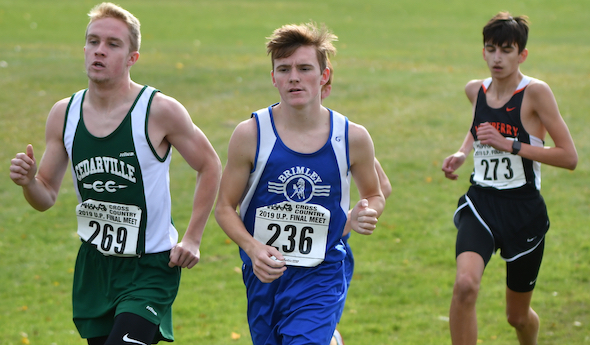
MARQUETTE – Brimley senior Austin Plotkin said he tried to run Saturday’s Upper Peninsula Division 3 Final like any other race.
But, perhaps as expected, it was much more.
Plotkin crossed the finish line in 17:20.7, winning his fourth MHSAA Finals championship and becoming just the second boys cross country runner to do so, joining Central Lake’s Ryan Shay who accomplished the feat in Lower Peninsula Class D from 1993-96.
"I tried to get under 17 minutes, but going under 17 is hard to do on this course," said Plotkin. "There's a lot of rolling hills out there. It's a very deceptive course. I just tried to run this like any other race, and it paid off. I tried to focus and do what I needed to do."
Plotkin was followed at Gentz's Golf Course in Chocolay Township by Cedarville senior Thomas Bohn, who finished runner-up for the third straight season and this time in 17:31.1. Brimley junior Cameron Hoornstra was third at 18:00.5.
Rudyard was crowned Division 3 team champion for the first time in a decade with 72 points, followed by Dollar Bay with 93 and Brimley with 96.
"This was kind of a surprise for me," said Rudyard coach Mark Rice. "I thought we could be runner-up. We depended a lot on our No. 5 runner (sophomore Ross Malaska), and he came through for us. Hayden Mills (who placed fifth at 18:20.1) was working with a little bit of an injury issue a few weeks ago, which I think came from running too many races. We're going to revamp our schedule next year."
 Division 2
All aboard. Here comes the Hematite train!
The Ishpeming boys, who call themselves that, chugged to their second straight Upper Peninsula Division 2 cross country championship Saturday with 27 points.
The title also was the fifth in six years for the Hematites, who were followed by Ironwood with 51 points, Gogebic (Wakefield-Marenisco/Bessemer) at 67 and Norway at 92.
"My wife (Christie) and I start them off in grade school," said Ishpeming coach P.J. Pruett. "When cross country season starts, they're ready to go. Our program is very solid. We have a lot of runners coming back next year. The future looks bright."
Ishpeming senior Jonah Broberg earned his first individual title, covering the 3.1-mile event in 17 minutes, 29 seconds. He was followed by Norway sophomore Adam Cavagnetto (17:33.9), Ishpeming junior Jordan Longtine (17:48.6) and Gogebic (Bessemer) senior Adam Mazurek (17:54.5) on this partly sunny, breezy and mild day.
"The wind picked up for our race, which made it very challenging," said Broberg. "But I still won, and running into the wind makes it that much more satisfying. I wanted to go out hard, and the first 800 (meters) was very fast."
Cavagnetto's time was three minutes, 20 seconds better than a year ago.
"It's fun," he said. "I get up in the morning thinking about running and go to bed thinking about running.
"I wanted to go out fast and stay with Jonah and Adam, and I think it worked out very well."
Division 1
Marquette secured its first Division 1 title in five years with 51 points, followed by 2018 champ Sault Ste. Marie with 57 and Houghton with 63.
"We've alternated No. 1 runners throughout the year and (senior) Hogan Nemetz was our top runner today," said Marquette coach Kyle Detmers. "Sault was right there. Hats off the (coach) Jim Martin. They have a great program, and Houghton has a real good team.
 "I appreciate the Gentz family allowing us to use their facility. This is an excellent setting for a meet. I also appreciate the efforts by our athletic director Alex Tiseo, assistant coach Mike Leanes and the many volunteers."
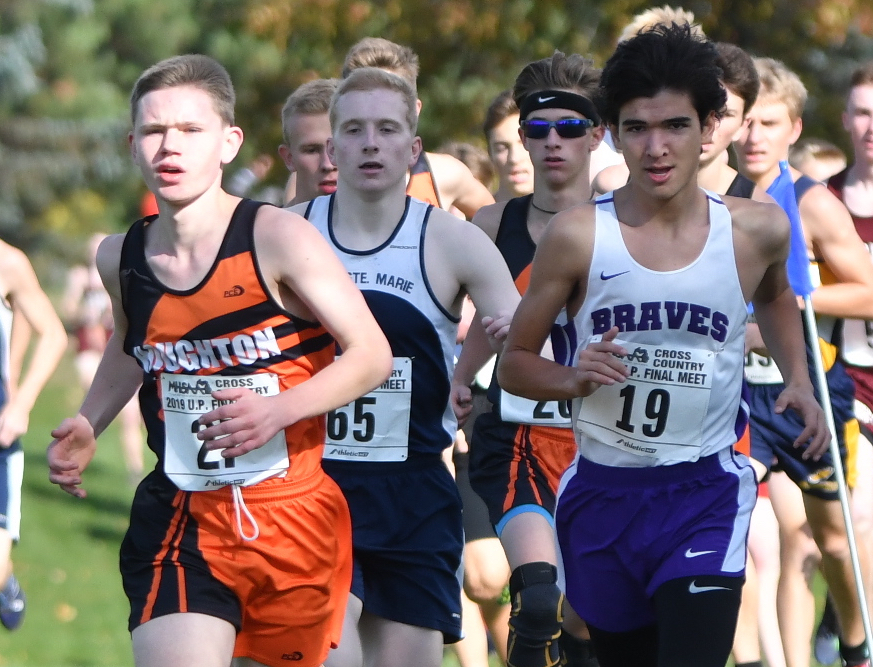
Houghton junior Joe Wood won a Final for the first time in a personal-best 16:57.8, followed by Gladstone sophomore Giovanni Mathews (17:27,6) and Sault junior Jaron Wyma (17:30.8).
"I wanted to stay with the front pack in the beginning," said Wood. "I ran with Giovanni for a while, then I made my move a little after the mile mark. I felt I could break away.
“It feels good to get a PR (personal record). This is definitely a confidence boost and a good way to end the season. Our whole team did pretty well."
Mathews said he was pleased with the overall conditions.
"The weather conditions were great today," he added. "The only problem is it was real windy. We (freshman Drew Hughes and Mathews) had a pretty big gap in the beginning. Only, I think Joe could sense I was feeling it. A couple times, I almost stopped. Joe was in a little better shape today."
PHOTOS: (Top) Cedarville's Thomas Bohn (269), Brimley's Austin Plotkin (236) and Newberry's Ephram Evans (273) run in the UPD3 Final. (Middle) Ishpeming's Jonah Broberg (151), Gogebic’s Adam Murzek (180), Norway's Adam Cavagnetto (166) and Ishpeming's David Liimatta (156) lead the UPD2 race Saturday. (Below) Houghton's Joe Wood (27) runs to the Division 1 title, here followed closely by eventual second-place finisher Giovanni Mathews from Gladstone. (Photos by Cara Kamps.)