

New Math: Division & Multiplication Problems
July 25, 2017
By Jack Roberts
MHSAA Executive Director
This is the second part in a series on MHSAA tournament classification, past and present, that will be published over the next two weeks. This series originally ran in this spring's edition of MHSAA benchmarks.
High school tournament classifications went viral before there was social media and most of us knew what “viral” meant.
Much as a virus infects computers today or has created epidemics of disease around the world for centuries, high school tournament classification – once introduced – tends to spread uncontrollably. Once started, it tends to keep expanding and rarely contracts.
While we are still some distance from providing every team a trophy as a result of expanding high school tournament classification across the country, there is criticism nevertheless that we are headed in that direction – a philosophy which is supposed to exist only in local youth sports for our youngest children.
Michigan could be blamed for all this. Michigan is generally accepted as the first state to provide different classifications for season-ending tournaments for different sized schools. It started a century ago. Today, every state has various classifications for its tournaments in most if not all sports. And it is a bit ironic that Michigan – creator of the classification chaos – more than most other states has kept the number of tournament classes or divisions under control.
Yes, there is evidence that tournament classifications have expanded over the years in Michigan, especially with the relatively recent introduction of tournaments in football and the late 1990s’ move from classes to divisions in most MHSAA tournaments. But the MHSAA Representative Council has held true to its word when it expanded the playoffs for football from four classes to eight divisions: this is needed because of unique factors of football, factors that exist in no other sport; and all other sports should be capped at a maximum of four classes or divisions.
Kentucky is the preeminent defender of single-class basketball. All of its 276 high schools compete for the single state championship for each gender. In Indiana, there are still open wounds from its move in 1998 from one to four classes for its 400 schools in basketball.
Multi-class tournaments have tended to increase the number of non-public school champions, which some states are trying to lower through enrollment “multipliers,” and also tend to increase the number of repeat champions, which some states are trying to affect with “success factors” which lift smaller schools into classifications for larger schools if they take home too many trophies.
While there is considerable evidence that state tournaments do as much bad as good for educational athletics, state associations persist in providing postseason tournaments because, on balance, the experiences are supposed to be good for student-athletes. And once we reach that conclusion it is just a small leap to believe that if the tournaments are good for a few, they must be better for more – which leads to creating more and more tournament classifications. One becomes two classes, then three, then four and so forth.
While the argument is that more classifications or divisions provides more students with opportunities to compete and win, it is undeniable that the experience changes as the number of tournament classifications expands. It is not possible for state associations to provide the same level of support when tournament classifications expand to multiple venues playing simultaneously. For example, there is less audio and video broadcast potential at each venue, and less media coverage to each venue. Focus is diluted and fans diminished at each championship.
No one can argue reasonably that today's two-day MHSAA Football Finals of eight championship games has the same pizazz as the one-day, four-games event conducted prior to 1990.
In some states the number of divisions has grown so much that it is difficult to see much difference between the many season-ending state championship games and a regular-season event in the same sport.
It is a balancing act. And Michigan has been studying that balance longer than any other state, and charting a steadier course than most.
Addition by Division
The shift to Divisions for MHSAA Tournament play in numerous sports has added up to a greater number of champions for teams and individuals across the state. Following are the sports currently employing a divisional format, and the procedures for determining enrollment and classification.
In 23 statewide or Lower Peninsula tournaments, schools which sponsor the sport are currently divided into nearly equal divisions. They are:
- Baseball - 4 Divisions
- Boys Bowling - 4 Divisions
- Girls Bowling - 4 Divisions
- Girls Competitive Cheer - 4 Divisions
- LP Boys Cross Country - 4 Divisions
- LP Girls Cross Country - 4 Divisions
- LP Boys Golf - 4 Divisions
- LP Girls Golf - 4 Divisions
- Ice Hockey - 3 Divisions
- Boys Lacrosse - 2 Divisions
- Girls Lacrosse - 2 Divisions
- Boys Skiing - 2 Divisions
- Girls Skiing - 2 Divisions
- LP Boys Soccer - 4 Divisions LP
- Girls Soccer - 4 Divisions
- Girls Softball - 4 Divisions
- LP Boys Swimming & Diving - 3 Divisions
- LP Girls Swimming & Diving - 3 Divisions
- LP Boys Tennis - 4 Divisions
- LP Girls Tennis - 4 Divisions
- LP Boys Track & Field - 4 Divisions
- LP Girls Track & Field - 4 Divisions
- Wrestling - 4 Divisions
Lists of schools for each division of these 23 tournaments are posted on MHSAA.com approximately April 1. Listings of schools in Upper Peninsula tournaments for their sports are also posted on MHSAA.com. The lists are based on school memberships and sports sponsorships in effect or anticipated for the following school year, as known to the MHSAA office as of a date in early March.
In football, the 256 schools which qualify for MHSAA 11-player playoffs are placed in eight equal divisions annually on Selection Sunday. Beginning in 2017, the 8-player divisions will be determined in a like manner on Selection Sunday as well, with 32 qualifying schools placed in two divisions.
Schools have the option to play in any higher division in one or more sports for a minimum of two years.
The deadlines for "opt-ups" are as follows:
- Applications for fall sports must be submitted by April 15
- Applications for winter sports must be submitted by Aug. 15
- Applications for spring sports must be submitted by Oct. 15
Subsequent to the date of these postings for these tournaments, no school will have its division raised or lowered by schools opening or closing, schools adding or dropping sports, schools exercising the option to play in a higher division, or approval or dissolution of cooperative programs.
When the same sport is conducted for boys and girls in the same season (e.g., track & field and cross country), the gender that has the most sponsoring schools controls the division breaks for both genders.
Reigning D4 Champ Finding Title Mix Again
By
Wes Morgan
Special for MHSAA.com
October 8, 2019
Losing half its roster following a Division 4 championship season presented plenty of challenges to the Mendon varsity volleyball program this fall.
 But the resourceful Hornets, led by second-year head coach Heather Bowers, have managed to compete at a high level while simultaneously forming a new identity.
With a dominant offense in 2018 that resulted in an MHSAA postseason run that was nearly perfect (just one set dropped in seven matches) and culminated with a 25-16, 25-21, 25-14 victory over No. 1-ranked Leland in the Final at Kellogg Arena, Bowers’ first year in charge was a smooth transition for the program. This year, without as much firepower, a slew of injuries and players having to learn new and critical positions, a match record of 21-6-6 has required a more blue-collar approach.
“They still have that drive that has been instilled in them,” Bowers said. “They’re not satisfied; they want more all the time. They have that competitiveness this year, too. The talent is there, and it is a very athletic group that’s fun to work with.”
Still, at 6-0 in the Southwest 10 Conference and carrying a No. 2 ranking in the latest Michigan Interscholastic Volleyball Coaches Association poll, the Hornets have positioned themselves well for a repeat run.
Bowers, who played her senior year at Mendon in 2011 for legendary coach Kathy Trenary before competing for Huntington University in Indiana, has implemented a similar, defensive-minded approach along with a focus on serving.
“We have always prided ourselves on serving,” said Bowers, whose team is operating at a 90.1-percent clip this year with 279 aces. “Serving has been a staple and defense has been a staple, too.”
Senior defensive specialist Juliana Hagenbuch has registered 265 digs so far this year, with four more teammates having made significant impacts in the same category. Junior outside hitter Anna Smith, who has verbally committed to play for Division I College of Charleston (S.C.), might be best known for her offensive prowess, but she’s second on the team with 187 digs. Senior Gracie Russell is up to 157, and sophomore Payton Griffith boasts 150.
 “Juliana runs the defense and makes sure people are in the right spots,” Bowers said. “She is really, really good at reading and very good at serve receive. I don’t think I’ve run into another high school player who’s that consistent at serve receiving.”
“We have kind of filled the spots of the people that have graduated, regrouped and found that drive again,” Hagenbuch said. “I think we’re capable of making it pretty far again this year.”
Senior middle blocker Taylor Heitkamp has had the hottest hand at the service line with 67 aces, followed by Smith (55) and Hagenbuch (53). Smith has logged a team-best 43 blocks — which is rare from the outside hitter position — and junior middle Andrea Hoffman has 41 blocks.
That’s not to say the Hornets aren’t well-equipped offensively. Smith, a 2018 all-state selection and the second in her family to attract attention from Division I college coaches (older sister Kaley is a junior libero at Western Michigan University), is a powerhouse at the net with 409 kills this year. Heitkamp is responsible for 149 and Hoffman has 117.
“Anna leads us on our offense every outing,” Bowers explained. “She is a very powerful hitter. She sees the court well, she’s a great leader and a great defensive player as well. It’s amazing to see the kind of power she has in her serves and her hitting. She just reads really well; she’s played so much.”
The common denominator is Russell, who moved from defensive specialist to fill the massive shoes of graduated all-state setter Aubrey Crotser.
“She’s quick and has really good hands,” Bowers said. “Throughout the summer she worked really hard and is doing really well. She is more of a quiet leader with scoring. She makes great choices and is just so quick to the ball.”
Smith’s ability and experience have been invaluable, and the program is thrilled to have her back for another year in 2020. Though the makeup of the squad is different than that of the 2018 championship team, having seen what it takes to be the last team standing, Smith feels another deep run is within reach.
“We knew we had big expectations this year,” she said. “We’re reinventing ourselves. Our chemistry was not the best, but now I think we’re starting to finally get into a groove. We all have the same goals, and it’s to win another (championship). We’ve tried to focus on only what we can control, the basics, and just play our game.”
 Wes Morgan has reported for the Kalamazoo Gazette, ESPN and ESPNChicago.com, 247Sports and Blue & Gold Illustrated over the last 12 years and is the publisher of JoeInsider.com. He can be reached at [email protected] with story ideas for Berrien, Cass, St. Joseph and Branch counties.
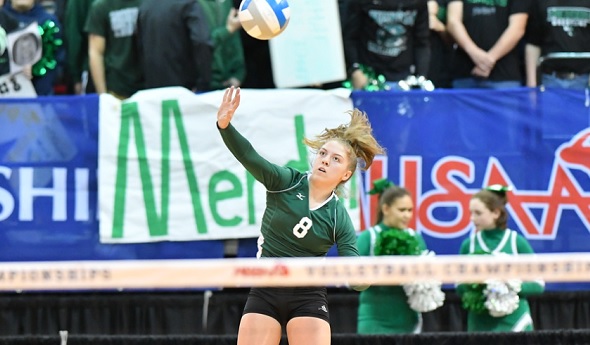
PHOTOS: (Top) Mendon’s Anna Smith sends a serve toward Southfield Christian during her team’s Division 4 Semifinal win last season at Kellogg Arena. (Middle) The Hornets celebrate a tournament victory this fall. (Middle photo courtesy of the Mendon volleyball program.)