

New Math: Division & Multiplication Problems
July 25, 2017
By Jack Roberts
MHSAA Executive Director
This is the second part in a series on MHSAA tournament classification, past and present, that will be published over the next two weeks. This series originally ran in this spring's edition of MHSAA benchmarks.
High school tournament classifications went viral before there was social media and most of us knew what “viral” meant.
Much as a virus infects computers today or has created epidemics of disease around the world for centuries, high school tournament classification – once introduced – tends to spread uncontrollably. Once started, it tends to keep expanding and rarely contracts.
While we are still some distance from providing every team a trophy as a result of expanding high school tournament classification across the country, there is criticism nevertheless that we are headed in that direction – a philosophy which is supposed to exist only in local youth sports for our youngest children.
Michigan could be blamed for all this. Michigan is generally accepted as the first state to provide different classifications for season-ending tournaments for different sized schools. It started a century ago. Today, every state has various classifications for its tournaments in most if not all sports. And it is a bit ironic that Michigan – creator of the classification chaos – more than most other states has kept the number of tournament classes or divisions under control.
Yes, there is evidence that tournament classifications have expanded over the years in Michigan, especially with the relatively recent introduction of tournaments in football and the late 1990s’ move from classes to divisions in most MHSAA tournaments. But the MHSAA Representative Council has held true to its word when it expanded the playoffs for football from four classes to eight divisions: this is needed because of unique factors of football, factors that exist in no other sport; and all other sports should be capped at a maximum of four classes or divisions.
Kentucky is the preeminent defender of single-class basketball. All of its 276 high schools compete for the single state championship for each gender. In Indiana, there are still open wounds from its move in 1998 from one to four classes for its 400 schools in basketball.
Multi-class tournaments have tended to increase the number of non-public school champions, which some states are trying to lower through enrollment “multipliers,” and also tend to increase the number of repeat champions, which some states are trying to affect with “success factors” which lift smaller schools into classifications for larger schools if they take home too many trophies.
While there is considerable evidence that state tournaments do as much bad as good for educational athletics, state associations persist in providing postseason tournaments because, on balance, the experiences are supposed to be good for student-athletes. And once we reach that conclusion it is just a small leap to believe that if the tournaments are good for a few, they must be better for more – which leads to creating more and more tournament classifications. One becomes two classes, then three, then four and so forth.
While the argument is that more classifications or divisions provides more students with opportunities to compete and win, it is undeniable that the experience changes as the number of tournament classifications expands. It is not possible for state associations to provide the same level of support when tournament classifications expand to multiple venues playing simultaneously. For example, there is less audio and video broadcast potential at each venue, and less media coverage to each venue. Focus is diluted and fans diminished at each championship.
No one can argue reasonably that today's two-day MHSAA Football Finals of eight championship games has the same pizazz as the one-day, four-games event conducted prior to 1990.
In some states the number of divisions has grown so much that it is difficult to see much difference between the many season-ending state championship games and a regular-season event in the same sport.
It is a balancing act. And Michigan has been studying that balance longer than any other state, and charting a steadier course than most.
Addition by Division
The shift to Divisions for MHSAA Tournament play in numerous sports has added up to a greater number of champions for teams and individuals across the state. Following are the sports currently employing a divisional format, and the procedures for determining enrollment and classification.
In 23 statewide or Lower Peninsula tournaments, schools which sponsor the sport are currently divided into nearly equal divisions. They are:
- Baseball - 4 Divisions
- Boys Bowling - 4 Divisions
- Girls Bowling - 4 Divisions
- Girls Competitive Cheer - 4 Divisions
- LP Boys Cross Country - 4 Divisions
- LP Girls Cross Country - 4 Divisions
- LP Boys Golf - 4 Divisions
- LP Girls Golf - 4 Divisions
- Ice Hockey - 3 Divisions
- Boys Lacrosse - 2 Divisions
- Girls Lacrosse - 2 Divisions
- Boys Skiing - 2 Divisions
- Girls Skiing - 2 Divisions
- LP Boys Soccer - 4 Divisions LP
- Girls Soccer - 4 Divisions
- Girls Softball - 4 Divisions
- LP Boys Swimming & Diving - 3 Divisions
- LP Girls Swimming & Diving - 3 Divisions
- LP Boys Tennis - 4 Divisions
- LP Girls Tennis - 4 Divisions
- LP Boys Track & Field - 4 Divisions
- LP Girls Track & Field - 4 Divisions
- Wrestling - 4 Divisions
Lists of schools for each division of these 23 tournaments are posted on MHSAA.com approximately April 1. Listings of schools in Upper Peninsula tournaments for their sports are also posted on MHSAA.com. The lists are based on school memberships and sports sponsorships in effect or anticipated for the following school year, as known to the MHSAA office as of a date in early March.
In football, the 256 schools which qualify for MHSAA 11-player playoffs are placed in eight equal divisions annually on Selection Sunday. Beginning in 2017, the 8-player divisions will be determined in a like manner on Selection Sunday as well, with 32 qualifying schools placed in two divisions.
Schools have the option to play in any higher division in one or more sports for a minimum of two years.
The deadlines for "opt-ups" are as follows:
- Applications for fall sports must be submitted by April 15
- Applications for winter sports must be submitted by Aug. 15
- Applications for spring sports must be submitted by Oct. 15
Subsequent to the date of these postings for these tournaments, no school will have its division raised or lowered by schools opening or closing, schools adding or dropping sports, schools exercising the option to play in a higher division, or approval or dissolution of cooperative programs.
When the same sport is conducted for boys and girls in the same season (e.g., track & field and cross country), the gender that has the most sponsoring schools controls the division breaks for both genders.
Junior Hitter's Spirit, Skill Give Lawton Lift
By
Pam Shebest
Special for MHSAA.com
September 25, 2019
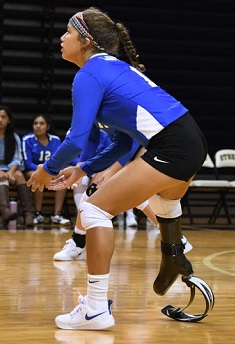
LAWTON — Olivia Cramer wears her friends proudly — on her leg.
 When she is not wearing a blade to play volleyball or basketball, the Lawton High School junior wears a prosthetic, but it’s not just any leg.
“I’ve had pictures of my friends on it for a couple years, and there’s the homecoming court my freshman year, softball game, at work,” she said.
While the decoration of the prosthetic leg is a novelty, the need for the limb certainly isn’t.
Cramer was born with non-genetic proximal femoral focal deficiency (PFFD), a condition that has resulted in her right leg measuring inches shorter than her left.
It is an uncommon condition that affects about 1 in every 200,000 children, according to statistics from the Children’s Hospital of Philadelphia.
The prosthetic leg assists with everyday life. But when it comes to athletics, she wears a blade, similar to those worn by runners.
“We call it my running blade,” Cramer said. “Mine is designed a little differently than an amputee because I still have my leg bones and foot.”
The custom-made blade, officially called the Freedom Innovations Catapult, is made of carbon fiber and has a rubber tread on the bottom so it will not damage the court.
“It’s about a two-week process and it was a little bit of a challenge to make,” said Tim Darling, a certified prosthetist at Hanger Clinic in Kalamazoo who fashioned the leg and blade.
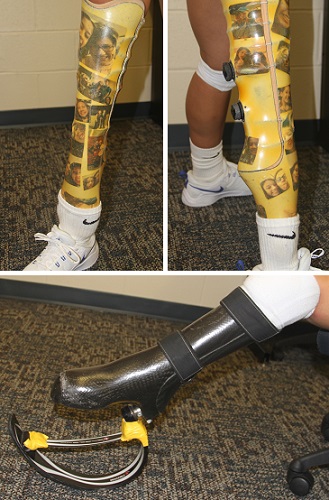 He also was instrumental in adding the photos. “She provided the photos printed on a T-shirt and we used materials to reinforce it and then used an acrylic lamination,” Darling added.
Instead of Velcro straps to keep the leg attached, Cramer has two dials that tighten the leg.
“It has string made of Kevlar and you can tighten them so I don’t have to have straps covering my leg anymore,” she said. “Before, it was just Velcro and came loose a lot.”
Darling said it is a relatively new process for a prosthetic.
100 Percent
“Working with her is humbling,” Lawton volleyball coach Megan McCorry said. “When you see someone with a physical disability like that and you see that same person is also the most positive and most encouraging, it really makes you do a gut check.
“It gives you some perspective in life that what you have going on may not really be that bad, and you need to work harder at putting your best foot forward.”
Cramer was pulled up from junior varsity during the District last year and practiced but did not play.
This season, she sees court time and, “She’s honestly one of those kids that you can’t not have on your team,” McCorry said.
“I mean she is always 100-percent positive. She is going to be the loudest one on the court, loudest one on the bench. She’s always supporting her team, and she’s just so determined to get better individually and make her teammates better.”
Since she jumps off her stronger left leg, the blade does not give Cramer any advantage, but at least once caused a gaffe.
“During a match, my friend Madison Lawson and I were going for a block on the outside and we fought for the block and we came back down,” Cramer said. “Madison landed on my blade and snapped it.
“We didn’t know what happened at first because there was this huge (sound) right in the middle of the match and I was like, ‘What just happened?’ We even stopped playing because of it. I went to step and my leg didn’t spring like it usually does.”
 The junior said her teammates are very supportive.
“She holds herself accountable for everything she does,” senior Gabi Martinez said. “Everything she does basically makes us realize she can do everything we can do. It doesn’t stop her from anything.
“We do watch out for her leg to make sure she doesn’t hurt it, but usually even if she falls down, she gets right back up and she’s usually the one picking everybody else up.”
Cramer’s mother, Megan Cramer, said when she was pregnant, her first ultrasound showed an abnormality in the leg, so she was prepared when Olivia was born.
When learning to walk, Olivia would walk on her short leg and balance on the knee of her good leg, her mother said.
As Olivia grew older, doctors gave her mother two choices: amputation or rotationplasty (fusing the knee on her shorter leg and rotating her foot around to where her knee joint would be). That new joint is where her prosthetic would have connected.
Her mother chose neither.
“I was a young mother, and I was scared to death and I was, ‘You’re not cutting her foot off,’” she said.
They visited several hospitals and finally went to the Shriners Hospital for Children in Chicago.
“That was the first place we went where they said let her be,” Megan said.
That is what her mother did.
“I am glad that they never had it amputated, and I never had rotationplasty,” Olivia Cramer said. “My condition is pretty rare, and because I didn’t do any of the amputation that makes me even more special than it already was, so I really appreciate it.”
She goes to the Shriners Hospital every six months for checkups and gets a new leg and blade when she outgrows the old ones.
Driving and Striving
Golf is Cramer’s true love, and she hopes to pursue it in college.
When playing, she wears her regular prosthetic, not the blade, and, last year, was captain of the school’s boys team (Lawton has no girls team).
 She also played the Lakeshore Junior Golf Association tour during the summer, carrying a 12 handicap and winning the 16-18 girls division.
“Those accomplishments are all special, of course,” Lawton golf coach Barry Shanley said. “But what makes her truly remarkable is her spirit. If you didn't see her prosthetic, you would never know she even has one.
“For now it's actually an advantage for her college goal to play on a high school boys team. The boys play from the men's tees, which is the typical length for collegiate women, so college coaches know her scores now already match what length their own players are using.”
Shanley said the only way her prosthetic affects her swing is that her hip alignment can be a little unbalanced.
“Once she stops growing and her prosthetic is matched to her other leg permanently, there won't be any issue at all,” he said.
“Because it's difficult to keep them matched, which now can cause her some pain if she walks the typical 5.6 miles in 18 holes or the 2.8 miles for 9 holes, we wrote and received permission from the MHSAA to let her take a golf cart during matches.”
Right now, though, Cramer is focused on volleyball, with her team’s record 13-9 midway through the season. The Blue Devils will host an MHSAA Division 3 District beginning Nov. 4.
Other players on the volleyball team are senior Jessica Grear, juniors are Mackenzie Nickrent, Kiana Auton, Caitlen Romo, Josie Buchkowski, Wendy Guerra and Dezare’ Smith; and sophomores Sarah Dekoning and Lily Grear.
No matter the sport, Cramer said she follows her grandfather’s advice.
“My grandpa always has said, ‘Don’t ever say “can’t” in this household. That’s a word that’s not in our dictionary.’
“I guess that’s shaped me into who I am today, being able to persevere through all the difficulties, even though I like to think I have it just as fair as everybody else does, that we’re on an equal playing level.”
Cramer has one hope:
“I hope that if anybody sees this and is down in the dumps for any kind of condition they have, just persevere through it and prove to other people that you are better than they can ever think that you can be.”
 Pam Shebest served as a sportswriter at the Kalamazoo Gazette from 1985-2009 after 11 years part-time with the Gazette while teaching French and English at White Pigeon High School. She can be reached at [email protected] with story ideas for Calhoun, Kalamazoo and Van Buren counties.
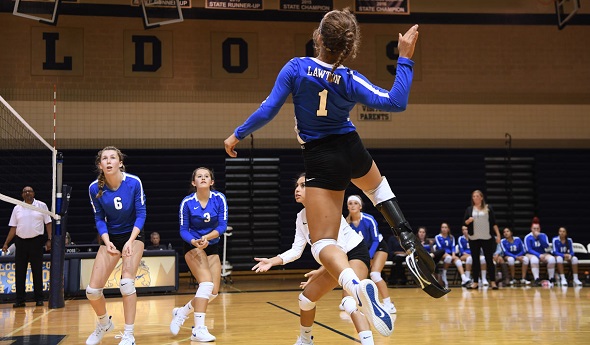
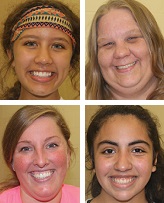
PHOTOS: (Top) Lawton’s Olivia Cramer loads for a kill attempt during a match this fall. (Middle top) Cramer’s prosthetic leg, front and back, and the blade she wears for sports. (Middle) From top left: Olivia Cramer, mother Megan Cramer, teammate Gabi Martinez and volleyball coach Megan McCorry. (Below) Cramer awaits the opponent’s serve. (Action photos by Gary Shook; prosthetic photos and head shots by Pam Shebest.)