

New Math: Division & Multiplication Problems
July 25, 2017
By Jack Roberts
MHSAA Executive Director
This is the second part in a series on MHSAA tournament classification, past and present, that will be published over the next two weeks. This series originally ran in this spring's edition of MHSAA benchmarks.
High school tournament classifications went viral before there was social media and most of us knew what “viral” meant.
Much as a virus infects computers today or has created epidemics of disease around the world for centuries, high school tournament classification – once introduced – tends to spread uncontrollably. Once started, it tends to keep expanding and rarely contracts.
While we are still some distance from providing every team a trophy as a result of expanding high school tournament classification across the country, there is criticism nevertheless that we are headed in that direction – a philosophy which is supposed to exist only in local youth sports for our youngest children.
Michigan could be blamed for all this. Michigan is generally accepted as the first state to provide different classifications for season-ending tournaments for different sized schools. It started a century ago. Today, every state has various classifications for its tournaments in most if not all sports. And it is a bit ironic that Michigan – creator of the classification chaos – more than most other states has kept the number of tournament classes or divisions under control.
Yes, there is evidence that tournament classifications have expanded over the years in Michigan, especially with the relatively recent introduction of tournaments in football and the late 1990s’ move from classes to divisions in most MHSAA tournaments. But the MHSAA Representative Council has held true to its word when it expanded the playoffs for football from four classes to eight divisions: this is needed because of unique factors of football, factors that exist in no other sport; and all other sports should be capped at a maximum of four classes or divisions.
Kentucky is the preeminent defender of single-class basketball. All of its 276 high schools compete for the single state championship for each gender. In Indiana, there are still open wounds from its move in 1998 from one to four classes for its 400 schools in basketball.
Multi-class tournaments have tended to increase the number of non-public school champions, which some states are trying to lower through enrollment “multipliers,” and also tend to increase the number of repeat champions, which some states are trying to affect with “success factors” which lift smaller schools into classifications for larger schools if they take home too many trophies.
While there is considerable evidence that state tournaments do as much bad as good for educational athletics, state associations persist in providing postseason tournaments because, on balance, the experiences are supposed to be good for student-athletes. And once we reach that conclusion it is just a small leap to believe that if the tournaments are good for a few, they must be better for more – which leads to creating more and more tournament classifications. One becomes two classes, then three, then four and so forth.
While the argument is that more classifications or divisions provides more students with opportunities to compete and win, it is undeniable that the experience changes as the number of tournament classifications expands. It is not possible for state associations to provide the same level of support when tournament classifications expand to multiple venues playing simultaneously. For example, there is less audio and video broadcast potential at each venue, and less media coverage to each venue. Focus is diluted and fans diminished at each championship.
No one can argue reasonably that today's two-day MHSAA Football Finals of eight championship games has the same pizazz as the one-day, four-games event conducted prior to 1990.
In some states the number of divisions has grown so much that it is difficult to see much difference between the many season-ending state championship games and a regular-season event in the same sport.
It is a balancing act. And Michigan has been studying that balance longer than any other state, and charting a steadier course than most.
Addition by Division
The shift to Divisions for MHSAA Tournament play in numerous sports has added up to a greater number of champions for teams and individuals across the state. Following are the sports currently employing a divisional format, and the procedures for determining enrollment and classification.
In 23 statewide or Lower Peninsula tournaments, schools which sponsor the sport are currently divided into nearly equal divisions. They are:
- Baseball - 4 Divisions
- Boys Bowling - 4 Divisions
- Girls Bowling - 4 Divisions
- Girls Competitive Cheer - 4 Divisions
- LP Boys Cross Country - 4 Divisions
- LP Girls Cross Country - 4 Divisions
- LP Boys Golf - 4 Divisions
- LP Girls Golf - 4 Divisions
- Ice Hockey - 3 Divisions
- Boys Lacrosse - 2 Divisions
- Girls Lacrosse - 2 Divisions
- Boys Skiing - 2 Divisions
- Girls Skiing - 2 Divisions
- LP Boys Soccer - 4 Divisions LP
- Girls Soccer - 4 Divisions
- Girls Softball - 4 Divisions
- LP Boys Swimming & Diving - 3 Divisions
- LP Girls Swimming & Diving - 3 Divisions
- LP Boys Tennis - 4 Divisions
- LP Girls Tennis - 4 Divisions
- LP Boys Track & Field - 4 Divisions
- LP Girls Track & Field - 4 Divisions
- Wrestling - 4 Divisions
Lists of schools for each division of these 23 tournaments are posted on MHSAA.com approximately April 1. Listings of schools in Upper Peninsula tournaments for their sports are also posted on MHSAA.com. The lists are based on school memberships and sports sponsorships in effect or anticipated for the following school year, as known to the MHSAA office as of a date in early March.
In football, the 256 schools which qualify for MHSAA 11-player playoffs are placed in eight equal divisions annually on Selection Sunday. Beginning in 2017, the 8-player divisions will be determined in a like manner on Selection Sunday as well, with 32 qualifying schools placed in two divisions.
Schools have the option to play in any higher division in one or more sports for a minimum of two years.
The deadlines for "opt-ups" are as follows:
- Applications for fall sports must be submitted by April 15
- Applications for winter sports must be submitted by Aug. 15
- Applications for spring sports must be submitted by Oct. 15
Subsequent to the date of these postings for these tournaments, no school will have its division raised or lowered by schools opening or closing, schools adding or dropping sports, schools exercising the option to play in a higher division, or approval or dissolution of cooperative programs.
When the same sport is conducted for boys and girls in the same season (e.g., track & field and cross country), the gender that has the most sponsoring schools controls the division breaks for both genders.
Colleagues Connect in Classroom, Coaching
By
Pam Shebest
Special for MHSAA.com
September 17, 2019
MATTAWAN — When students enter one of the social studies rooms at Mattawan High School, they should not be surprised to see a white board full of Xs and Os.
 It is not a game of tic-tac-toe, just a series of football plays.
With three head football coaches teaching in the same wing, there is plenty of pigskin conversation being tossed around before and after school.
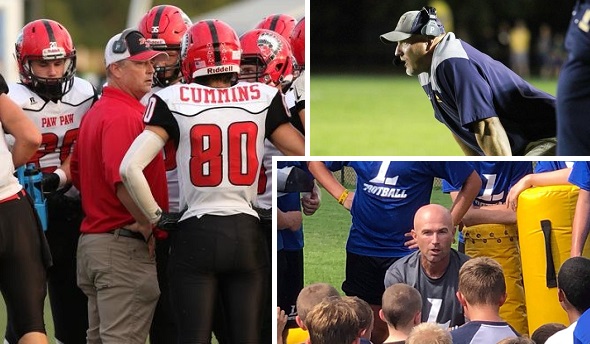
Ryan Brown, who teaches social studies and power training, is in his fifth year coaching Mattawan. Wade Waldrup, who teaches social studies and English, is the first-year head coach for Lawton. And Matt Stephens, a social studies teacher, is in his fourth year guiding the program at Paw Paw.
The coaches, who are also friends, do not have to worry about going head-to-head at any time.
“There’s no chance we’ll play against each other, not in the playoffs or anything,” Waldrup said.
That is because the schools vary in enrollment enough that, should they qualify, they will end up in different MHSAA playoff divisions when those are determined after Week 9. The three schools also play in different conferences, with Mattawan in the Southwest Michigan Athletic Conference West, Lawton in the Southwestern Athletic Conference and Paw Paw in the Wolverine.
 “I’m glad we don’t play each other because for me, I take my competition very personally and I think they’re both the same way,” Brown said. “It wouldn’t cause issues, certainly not professionally, but personally you’re not as close. You can’t share, and I would miss that.”
Added Stephens: “I appreciate the fact that I coach at a school where I come to work every day and don’t have to look at the athletes from Mattawan and know that I’m going to have to play against them.
“I think that allows me to have some comfort in that I can root for Mattawan and I can root for Lawton because I’m at a different level.”
Sharing is what the three often do, and all agree that they tap into each other’s strengths.
“Matt is more of an offensive guy,” Waldrup said. “I’m more of a defensive guy. Matt’s probably the more creative one and I think Ryan is really good at fundamentals and technique.”
Stephens said another advantage is understanding the ups and downs of the season.
“We’ve known each other for so long, honestly when one of us is down and one of us is up, it’s ‘We feel your pain,’” he said.
“It’s not this issue of we won and you didn’t. It’s more like, ‘We’ve been there before.’”
Although Lawton is 3-0 on the young season, “Matt is probably the top dog because Paw Paw (3-0) is ranked No. 1 in the state,” Waldrup said.
 Mattawan is 1-2, but like Paw Paw made the playoffs last season and opened this fall with an impressive win over Kalamazoo Central.
“Honestly, rankings are just media’s way of trying to keep people interested,” Stephens said. “We’re talking to our kids about what they’re going to do to earn it. Being No. 1 is great, but Plainwell doesn’t care if we’re No. 1 and neither do any of our other opponents.
“If you get a No. 1 ranking, that just fuels the fire for other teams. We feel fortunate, blessed to be given that credit, and it’s nice for the kids. But at the end of the day, it all boils down to how you perform.”
The trio’s coaching connection goes way beyond this season.
“There’s a little bit of a coaching tree with Ryan, myself and Wade and I guess it all filters under me, but not necessarily intentionally,” Stephens said.
“I was head coach at Mattawan, so Ryan worked under me quite a while and Wade worked under me for one year before going to Constantine.”
In addition, both Stephens and Brown played football at Vicksburg High School.
Stephens was an assistant under then-coach Denny Patzer while Brown was a player there.
Brown connected with Waldrup after starting his teaching career at Mattawan 19 years ago.
“Many moons ago, Wade was my student teacher,” Brown said. “That was a fantastic experience.
“He left and went to Constantine, then came back this way.”
Waldrup said he came late to education, joining the U.S. Marine Corps after graduating from Clawson High School near Detroit.
He spent nine years as a Marine, then decided to go into education after returning from three years in Okinawa during Desert Storm.
Before taking the job at Lawton this year, Waldrup was Brown’s defensive coordinator at Mattawan, making a splash at the first game last season.
 “Our first game last year, I always get coaches the pullovers, shorts, polos and hats, and Wade shows up wearing this gold hat and gold shirt and bright pants, and I was like ‘Where’s that from?’ Brown said, laughing.
“And he said ‘I’ve got my own stuff.’ I always tease him that he had to stand out. He was the golden child. He said he wanted the defensive guys to see him, which makes perfect sense. But at first it was like this bright yellow and I was like, ‘Whoa.’”
Stephens and Waldrup keep their teaching and coaching lives separate.
“When we’re here during the school day, we try very rarely to talk about the other schools that we coach at so we can be a fan of our kids,” said Waldrup, adding that they never wear gear from their football schools while teaching at Mattawan.
When Friday nights roll around, the three are rooting for each other, and they dissect the games on Monday.
“We throw ideas off each other absolutely all the time,” Stephens said.
Brown said there is a definite coaching connection between the three.
“There are some things only they get, only they understand,” he said. “They talk about the Presidents Club, the ex-presidents and how they’re so close after they leave office.
“That’s how I feel like with those guys. I can look at them and give them a look and they’re like, ‘Yeah, I know.’
“I always say I would want my kids to play for either one of those guys, to have that experience. They’re good men, and that’s the first mark of a good coach, I think.”
 Pam Shebest served as a sportswriter at the Kalamazoo Gazette from 1985-2009 after 11 years part-time with the Gazette while teaching French and English at White Pigeon High School. She can be reached at [email protected] with story ideas for Calhoun, Kalamazoo and Van Buren counties.
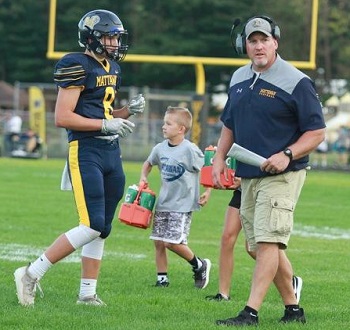
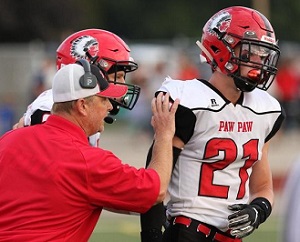
PHOTOS: (Top) Clockwise from left, Paw Paw’s Matt Stephens, Mattawan’s Ryan Brown and Lawton’s Wade Waldrup all teach at Mattawan during the day and coach local varsities after class is done. (Middle) From left, Brown, Stephens and Waldrup. (Middle below) Brown prepares to talk to his team during a break. (Below) Stephens sends players back onto the field during the team’s 3-0 start. (Mattawan photos by Haley Hagen/Paw Paw Courier-Leader. Paw Paw photos by Matthew Day/Hot Shotz Photography. Lawton photo courtesy of Wade Waldrup. Head shots by Pam Shebest.)