

New Math: Division & Multiplication Problems
July 25, 2017
By Jack Roberts
MHSAA Executive Director
This is the second part in a series on MHSAA tournament classification, past and present, that will be published over the next two weeks. This series originally ran in this spring's edition of MHSAA benchmarks.
High school tournament classifications went viral before there was social media and most of us knew what “viral” meant.
Much as a virus infects computers today or has created epidemics of disease around the world for centuries, high school tournament classification – once introduced – tends to spread uncontrollably. Once started, it tends to keep expanding and rarely contracts.
While we are still some distance from providing every team a trophy as a result of expanding high school tournament classification across the country, there is criticism nevertheless that we are headed in that direction – a philosophy which is supposed to exist only in local youth sports for our youngest children.
Michigan could be blamed for all this. Michigan is generally accepted as the first state to provide different classifications for season-ending tournaments for different sized schools. It started a century ago. Today, every state has various classifications for its tournaments in most if not all sports. And it is a bit ironic that Michigan – creator of the classification chaos – more than most other states has kept the number of tournament classes or divisions under control.
Yes, there is evidence that tournament classifications have expanded over the years in Michigan, especially with the relatively recent introduction of tournaments in football and the late 1990s’ move from classes to divisions in most MHSAA tournaments. But the MHSAA Representative Council has held true to its word when it expanded the playoffs for football from four classes to eight divisions: this is needed because of unique factors of football, factors that exist in no other sport; and all other sports should be capped at a maximum of four classes or divisions.
Kentucky is the preeminent defender of single-class basketball. All of its 276 high schools compete for the single state championship for each gender. In Indiana, there are still open wounds from its move in 1998 from one to four classes for its 400 schools in basketball.
Multi-class tournaments have tended to increase the number of non-public school champions, which some states are trying to lower through enrollment “multipliers,” and also tend to increase the number of repeat champions, which some states are trying to affect with “success factors” which lift smaller schools into classifications for larger schools if they take home too many trophies.
While there is considerable evidence that state tournaments do as much bad as good for educational athletics, state associations persist in providing postseason tournaments because, on balance, the experiences are supposed to be good for student-athletes. And once we reach that conclusion it is just a small leap to believe that if the tournaments are good for a few, they must be better for more – which leads to creating more and more tournament classifications. One becomes two classes, then three, then four and so forth.
While the argument is that more classifications or divisions provides more students with opportunities to compete and win, it is undeniable that the experience changes as the number of tournament classifications expands. It is not possible for state associations to provide the same level of support when tournament classifications expand to multiple venues playing simultaneously. For example, there is less audio and video broadcast potential at each venue, and less media coverage to each venue. Focus is diluted and fans diminished at each championship.
No one can argue reasonably that today's two-day MHSAA Football Finals of eight championship games has the same pizazz as the one-day, four-games event conducted prior to 1990.
In some states the number of divisions has grown so much that it is difficult to see much difference between the many season-ending state championship games and a regular-season event in the same sport.
It is a balancing act. And Michigan has been studying that balance longer than any other state, and charting a steadier course than most.
Addition by Division
The shift to Divisions for MHSAA Tournament play in numerous sports has added up to a greater number of champions for teams and individuals across the state. Following are the sports currently employing a divisional format, and the procedures for determining enrollment and classification.
In 23 statewide or Lower Peninsula tournaments, schools which sponsor the sport are currently divided into nearly equal divisions. They are:
- Baseball - 4 Divisions
- Boys Bowling - 4 Divisions
- Girls Bowling - 4 Divisions
- Girls Competitive Cheer - 4 Divisions
- LP Boys Cross Country - 4 Divisions
- LP Girls Cross Country - 4 Divisions
- LP Boys Golf - 4 Divisions
- LP Girls Golf - 4 Divisions
- Ice Hockey - 3 Divisions
- Boys Lacrosse - 2 Divisions
- Girls Lacrosse - 2 Divisions
- Boys Skiing - 2 Divisions
- Girls Skiing - 2 Divisions
- LP Boys Soccer - 4 Divisions LP
- Girls Soccer - 4 Divisions
- Girls Softball - 4 Divisions
- LP Boys Swimming & Diving - 3 Divisions
- LP Girls Swimming & Diving - 3 Divisions
- LP Boys Tennis - 4 Divisions
- LP Girls Tennis - 4 Divisions
- LP Boys Track & Field - 4 Divisions
- LP Girls Track & Field - 4 Divisions
- Wrestling - 4 Divisions
Lists of schools for each division of these 23 tournaments are posted on MHSAA.com approximately April 1. Listings of schools in Upper Peninsula tournaments for their sports are also posted on MHSAA.com. The lists are based on school memberships and sports sponsorships in effect or anticipated for the following school year, as known to the MHSAA office as of a date in early March.
In football, the 256 schools which qualify for MHSAA 11-player playoffs are placed in eight equal divisions annually on Selection Sunday. Beginning in 2017, the 8-player divisions will be determined in a like manner on Selection Sunday as well, with 32 qualifying schools placed in two divisions.
Schools have the option to play in any higher division in one or more sports for a minimum of two years.
The deadlines for "opt-ups" are as follows:
- Applications for fall sports must be submitted by April 15
- Applications for winter sports must be submitted by Aug. 15
- Applications for spring sports must be submitted by Oct. 15
Subsequent to the date of these postings for these tournaments, no school will have its division raised or lowered by schools opening or closing, schools adding or dropping sports, schools exercising the option to play in a higher division, or approval or dissolution of cooperative programs.
When the same sport is conducted for boys and girls in the same season (e.g., track & field and cross country), the gender that has the most sponsoring schools controls the division breaks for both genders.
Northern Schools Find Solution in NMFL
September 6, 2019
By Chris Dobrowolski
Special for Second Half
With 17 schools spread across 11 counties, the Northern Michigan Football League has created an indelible footprint since it was born into existence five years ago.
 The conference, made up of three divisions of schools in varying size, has been able to sustain and evolve despite an ever-changing football landscape up north that has made for a revolving door of membership from year to year.
“It continues to morph,” said Frankfort athletic director Dave Jackson, the conference’s commissioner and one of the founders of the league.
From the biggest schools in the Legends division — Benzie Central, Boyne City, Cheboygan, Grayling, Kalkaska, Kingsley and Traverse City St. Francis — to the smaller schools in the Leaders (Charlevoix, Elk Rapids, Frankfort, Mancelona and Maple City Glen Lake) and Legacy divisions (Harbor Springs, East Jordan, Inland Lakes, Johannesburg-Lewiston and St. Ignace) the NMFL has provided easy avenues for scheduling as well as good, competitive balance for the programs that call it home.
“The scheduling aspect is where I go back to it,” said Johannesburg-Lewiston football coach and athletic director Joe Smokevitch. “It’s just been huge for us. Going into 2020 and 2021 my schedule is full, basically with teams from within the conference. They’re not all division games. I am crossing over and playing those other schools. It’s really helped with scheduling. Not having to go far away to play somebody. You look at our schedule. We play some quality opponents. I think the conference is very strong from top to bottom.”
The idea for the league was hatched in 2012 between schools in the Lake Michigan and Northwest conferences. Both leagues were seeing problems from smaller schools trying to compete with larger ones, and neither side benefitting from the affiliation. So, the two merged as a 13-team league comprised of two divisions of similar-sized enrollments.
The league has rarely stayed intact from year to year, switching to the three-division alignment with the growth to 20 teams in 2016 when it absorbed the remaining teams in the Ski Valley Conference, as well as withstanding the loss of six schools to 8-player football in the span of four years.
“We’ve taken schools in the league that didn’t last very long,” said Jackson. “We took in Newberry and they lasted just a year, then suddenly they’re 8-man. We took in Gaylord St. Mary. We took in Central Lake. Those teams were just a year or two and suddenly they’re gone. Our constitution calls for a two-year process of getting out, but those teams that had to go 8-man, they’re out for the next year. So, suddenly you’re scrambling again, which is the one thing we were trying to keep from having to do because there is no planning when that last-minute 8-man decision comes along and schools decide to make that plunge. There’s nothing you can really do when a school says they’re going to do that. You can’t say, ‘Well, the constitution says … .’ They’re going to do what they need to do.”
 Fortunately for the league, it has been able to find suitable replacements at every turn. In fact, Ogemaw Heights and Sault Ste. Marie are set to join in 2020 to become part of the Legends division, bolstering the league to a robust 19 schools. Kalkaska and Boyne City will slide over to the Leaders division and Frankfort — one of the smallest 11-player football teams in the state — is moving to the Legacy division.
“It made sense to apply,” said Ogemaw Heights athletic director Jon Studley, noting four future conference foes already are on this year’s schedule. “We’re very excited about the opportunity to be a part of that. We’re going to be able to create some rivalries.
“I think fans of northern Michigan football benefit the most. They’re seeing competitive football week in and week out.”
As the NMFL has shown, the quality of football being played within the conference is at a high level, too. At least one team from the league has reached the Semifinal round of the MHSAA playoffs every season. Boyne City was a semifinalist in Division 6 in 2014, while St. Francis has represented the league in the Semifinals in 2015, 2017 and 2018. In 2016 two teams advanced that far — St. Ignace in Division 8 and Maple City Glen Lake in Division 6 — with Glen Lake reaching the Finals before falling to Jackson Lumen Christi 26-14.
“I think we’re really starting to get some respect,” said Glen Lake coach Jerry Angers. “I’ve talked to the teams downstate that we’ve played, they want to come up and play us. They’re not saying, ‘This is going to be an easy game.’ They’re saying, ‘This is going to be a fun game, and they’re going to give us something.’”
There remains the possibility the league will undergo more changes before it more comfortably stabilizes. Some schools have expressed interest in joining, and the threat of losing members to 8-player football remains for a few of the smallest schools. It’s nothing the league hasn’t dealt with before, however. Jackson said it comes down to maintaining a commitment to the schools that are in the conference and carefully examining any growth that could occur.
“We had our big meeting in December, and one thing we talked about is how we have to look out for each other,” said Jackson. “We’re trying to guarantee that the league will provide eight of your nine games. In most cases the league is providing all nine of the games. So, you know you’re going to have somebody to play and you’re not going to have to go looking. There’s a time we may control 11-man football for everything north of Lansing. I don’t know. It continues to grow because teams are looking for that stability and consistency year in and year out, so they know who their games are with and they know who they play.”
 Chris Dobrowolski has covered northern Lower Peninsula sports since 1999 at the Ogemaw County Herald, Alpena News, Traverse City Record-Eagle and currently as sports editor at the Antrim Kalkaska Review since 2016. He can be reached at [email protected] with story ideas for Manistee, Wexford, Missaukee, Roscommon, Ogemaw, Iosco, Alcona, Oscoda, Crawford, Kalkaska, Grand Traverse, Benzie, Leelanau, Antrim, Otsego, Montmorency, Alpena, Presque Isle, Cheboygan, Charlevoix and Emmet counties.
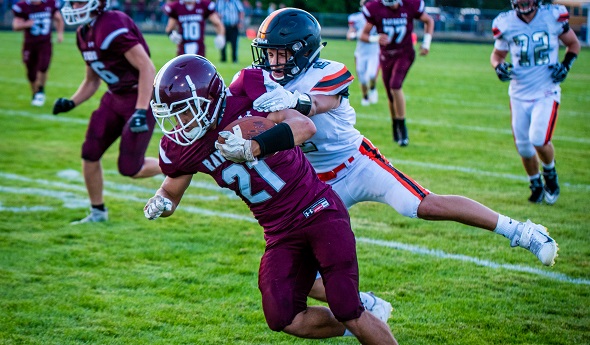
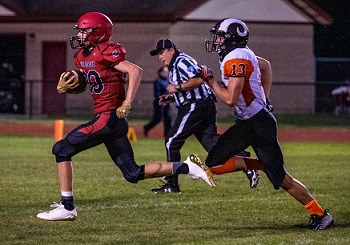
PHOTOS: (Top) Charlevoix, carrying the ball, opened this season with a 40-26 win over Elk Rapids. (Middle) East Jordan got a step on Harbor Springs on this play last week, but the Rams emerged with a slim 34-33 win. (Photos by Sports in Motion.)