


New Math: Division & Multiplication Problems
July 25, 2017
By Jack Roberts
MHSAA Executive Director
This is the second part in a series on MHSAA tournament classification, past and present, that will be published over the next two weeks. This series originally ran in this spring's edition of MHSAA benchmarks.
High school tournament classifications went viral before there was social media and most of us knew what “viral” meant.
Much as a virus infects computers today or has created epidemics of disease around the world for centuries, high school tournament classification – once introduced – tends to spread uncontrollably. Once started, it tends to keep expanding and rarely contracts.
While we are still some distance from providing every team a trophy as a result of expanding high school tournament classification across the country, there is criticism nevertheless that we are headed in that direction – a philosophy which is supposed to exist only in local youth sports for our youngest children.
Michigan could be blamed for all this. Michigan is generally accepted as the first state to provide different classifications for season-ending tournaments for different sized schools. It started a century ago. Today, every state has various classifications for its tournaments in most if not all sports. And it is a bit ironic that Michigan – creator of the classification chaos – more than most other states has kept the number of tournament classes or divisions under control.
Yes, there is evidence that tournament classifications have expanded over the years in Michigan, especially with the relatively recent introduction of tournaments in football and the late 1990s’ move from classes to divisions in most MHSAA tournaments. But the MHSAA Representative Council has held true to its word when it expanded the playoffs for football from four classes to eight divisions: this is needed because of unique factors of football, factors that exist in no other sport; and all other sports should be capped at a maximum of four classes or divisions.
Kentucky is the preeminent defender of single-class basketball. All of its 276 high schools compete for the single state championship for each gender. In Indiana, there are still open wounds from its move in 1998 from one to four classes for its 400 schools in basketball.
Multi-class tournaments have tended to increase the number of non-public school champions, which some states are trying to lower through enrollment “multipliers,” and also tend to increase the number of repeat champions, which some states are trying to affect with “success factors” which lift smaller schools into classifications for larger schools if they take home too many trophies.
While there is considerable evidence that state tournaments do as much bad as good for educational athletics, state associations persist in providing postseason tournaments because, on balance, the experiences are supposed to be good for student-athletes. And once we reach that conclusion it is just a small leap to believe that if the tournaments are good for a few, they must be better for more – which leads to creating more and more tournament classifications. One becomes two classes, then three, then four and so forth.
While the argument is that more classifications or divisions provides more students with opportunities to compete and win, it is undeniable that the experience changes as the number of tournament classifications expands. It is not possible for state associations to provide the same level of support when tournament classifications expand to multiple venues playing simultaneously. For example, there is less audio and video broadcast potential at each venue, and less media coverage to each venue. Focus is diluted and fans diminished at each championship.
No one can argue reasonably that today's two-day MHSAA Football Finals of eight championship games has the same pizazz as the one-day, four-games event conducted prior to 1990.
In some states the number of divisions has grown so much that it is difficult to see much difference between the many season-ending state championship games and a regular-season event in the same sport.
It is a balancing act. And Michigan has been studying that balance longer than any other state, and charting a steadier course than most.
Addition by Division
The shift to Divisions for MHSAA Tournament play in numerous sports has added up to a greater number of champions for teams and individuals across the state. Following are the sports currently employing a divisional format, and the procedures for determining enrollment and classification.
In 23 statewide or Lower Peninsula tournaments, schools which sponsor the sport are currently divided into nearly equal divisions. They are:
- Baseball - 4 Divisions
- Boys Bowling - 4 Divisions
- Girls Bowling - 4 Divisions
- Girls Competitive Cheer - 4 Divisions
- LP Boys Cross Country - 4 Divisions
- LP Girls Cross Country - 4 Divisions
- LP Boys Golf - 4 Divisions
- LP Girls Golf - 4 Divisions
- Ice Hockey - 3 Divisions
- Boys Lacrosse - 2 Divisions
- Girls Lacrosse - 2 Divisions
- Boys Skiing - 2 Divisions
- Girls Skiing - 2 Divisions
- LP Boys Soccer - 4 Divisions LP
- Girls Soccer - 4 Divisions
- Girls Softball - 4 Divisions
- LP Boys Swimming & Diving - 3 Divisions
- LP Girls Swimming & Diving - 3 Divisions
- LP Boys Tennis - 4 Divisions
- LP Girls Tennis - 4 Divisions
- LP Boys Track & Field - 4 Divisions
- LP Girls Track & Field - 4 Divisions
- Wrestling - 4 Divisions
Lists of schools for each division of these 23 tournaments are posted on MHSAA.com approximately April 1. Listings of schools in Upper Peninsula tournaments for their sports are also posted on MHSAA.com. The lists are based on school memberships and sports sponsorships in effect or anticipated for the following school year, as known to the MHSAA office as of a date in early March.
In football, the 256 schools which qualify for MHSAA 11-player playoffs are placed in eight equal divisions annually on Selection Sunday. Beginning in 2017, the 8-player divisions will be determined in a like manner on Selection Sunday as well, with 32 qualifying schools placed in two divisions.
Schools have the option to play in any higher division in one or more sports for a minimum of two years.
The deadlines for "opt-ups" are as follows:
- Applications for fall sports must be submitted by April 15
- Applications for winter sports must be submitted by Aug. 15
- Applications for spring sports must be submitted by Oct. 15
Subsequent to the date of these postings for these tournaments, no school will have its division raised or lowered by schools opening or closing, schools adding or dropping sports, schools exercising the option to play in a higher division, or approval or dissolution of cooperative programs.
When the same sport is conducted for boys and girls in the same season (e.g., track & field and cross country), the gender that has the most sponsoring schools controls the division breaks for both genders.
Center Leading Big Reds Back for More
September 4, 2019
By Tom Kendra
Special for Second Half
Muskegon High School’s offensive line sustained some BIG losses after last season.
 Four of the starting five offensive linemen from that MHSAA Division 3 runner-up team, totaling 1,245 pounds in weight – and including 6-foot-5, 360-pound right tackle Anthony Bradford, who is now playing at Louisiana State University – are gone.
The lone returning starter is senior center D’Andre Mills-Ellis, which makes it all the more impressive the way the Big Reds dominated two-time reigning Division 2 champion Warren De La Salle Collegiate, 41-7, during Friday’s Xenith Prep Kickoff Classic at Wayne State University.
“All summer long, we were hearing that we weren’t going to be anything with all of the big boys gone,” said Mills-Ellis, who is certainly a big boy himself at 6-0 and 305 pounds. “We’re not as big, but we’re more athletic.”
Mills-Ellis and the young Big Reds’ linemen certainly made a statement Friday, posting a 285-94 edge in rushing yards against the Pilots, who feature 6-7, 320-pound senior two-way lineman Grant Toutant, an Ohio State commit.
Muskegon (1-0) has no time to sit back and enjoy its big season-opening win, as the Big Reds face another long road trip and another monumental challenge this Friday night at Detroit Martin Luther King (0-1) – a rematch of last year’s Division 3 championship game, which King won, 41-25.
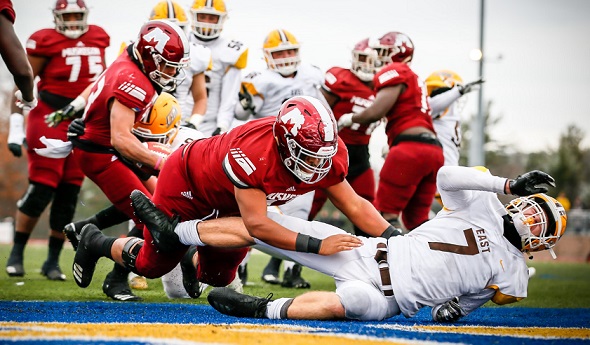
The Big Reds will be out for revenge, led by senior quarterback and returning MLive Michigan Player of the Year Cameron Martinez (6-0, 190), who also has verbally committed to Ohio State. Martinez carried the ball 21 times for 184 yards and three touchdowns against De La Salle, while completing 6-of-11 passes for 57 yards.
Martinez is the latest of an incredible stretch of quarterbacks at Muskegon – most recently bolstered by Kalil Pimpleton, now a starting slot receiver at Central Michigan, and then La’Darius Jefferson, now a major contributor at running back at Michigan State.
“We’ve been blessed with great quarterbacks here lately, but it all starts with D’Andre getting the ball to them,” said 10th-year Muskegon coach Shane Fairfield, who has guided the Big Reds to MHSAA Finals six times in the past seven years and led them to the Division 3 title in 2017.
Mills-Ellis said it’s an honor to block for such talented runners.
“The thing is, you don’t have to get pancakes with backs like that,” said Mills-Ellis, a college prospect who currently has offers from Judson (Ill.) and Northwood and wants to major in biology. “All those guys need is a little bit of room and they’re gonna go.”
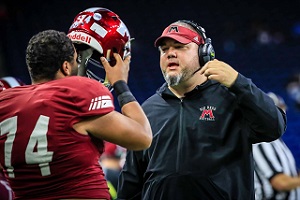 The center always plays a critical role on the offensive line, getting to the ball first, surveying the defense and making sure that everyone up front knows their assignments. Mills-Ellis is used to that job, but he has become much more vocal in it with two sophomores and one junior starting alongside him.
The only other senior up front for the Big Reds is left tackle Billie Roberts (6-3, 255), a converted tight end who Muskegon offensive line coach Matt Bolles says has Division I skills. Starting next to Roberts is junior guard Tayvid Elmore (5-11, 280), while the right side has a pair of sophomores in guard Jamarrius Dickerson (5-10, 295) and tackle Duane Anderson (6-1, 285).
“It’s different for him this year because now he’s our rock, our leader up there,” explained Fairfield. “He’s always kinda been the comedian, but he’s had to scale that back a little, so that when it’s time to get serious the other guys will listen to him.”
The senior is known for his steady snaps, as the Big Reds line up almost exclusively in the pistol formation, with Mills-Ellis initiating every play with a quick snap back to Martinez. While his center is pretty much automatic these days, Muskegon offensive coordinator Brent White said that wasn’t always true.
“We converted him from tackle, and he was a little rocky with his snaps at first,” said White, who gave credit for his improvement to snapping to Jefferson, who is nicknamed ‘Sippy’ because he’s from Mississippi. “Sippy didn’t like bad snaps and he had a way of letting him know that, so he got better in a hurry.”
Mills-Ellis, who is one of the strongest players in West Michigan with a squat of 675 pounds, is also starting for the first time this season at defensive tackle.
Fairfield said during the preseason that he believes his team will be much improved on defense, and it certainly appeared that way in the opener as tackles Mills-Ellis and Roberts completely stuffed any interior running plays.
Muskegon limited De La Salle to just one touchdown, but a bigger defensive challenge awaits this week against a Detroit King team packed with Division I prospects – notably battering-ram running back Peny Boone (committed to Maryland), receiver Rashawn Williams (Indiana) and freshman quarterback Dante Moore, who already has an offer from Michigan.
King shredded Muskegon through the air and on the ground in November’s championship game at Ford Field, but Mills-Ellis said the Big Reds are determined to not let that happen again.
“We couldn’t overlook De La Salle, because they have a great program, but deep down inside, the game we all want and that we’ve been talking about all summer is King,” said Mills-Ellis. “You have to understand, us seniors here aren’t used to losing. This is our chance to make up for that loss.”
 Tom Kendra worked 23 years at The Muskegon Chronicle, including five as assistant sports editor and the final six as sports editor through 2011. E-mail him at [email protected] with story ideas for Muskegon, Oceana, Mason, Lake, Oceola, Mecosta and Newaygo counties.
PHOTOS: (Top) Muskegon center D'Andre Mills-Ellis throws the key lead block as quarterback Cameron Martinez scores a touchdown during the Big Reds' 45-22 Division 3 Semifinal victory over Zeeland East last season at Grand Haven High School. (Middle) Mills-Ellis talks to Muskegon offensive line coach Matt Bolles during last year's Division 3 championship game at Ford Field. (Photos by Tim Reilly.)