

New Math: Division & Multiplication Problems
July 25, 2017
By Jack Roberts
MHSAA Executive Director
This is the second part in a series on MHSAA tournament classification, past and present, that will be published over the next two weeks. This series originally ran in this spring's edition of MHSAA benchmarks.
High school tournament classifications went viral before there was social media and most of us knew what “viral” meant.
Much as a virus infects computers today or has created epidemics of disease around the world for centuries, high school tournament classification – once introduced – tends to spread uncontrollably. Once started, it tends to keep expanding and rarely contracts.
While we are still some distance from providing every team a trophy as a result of expanding high school tournament classification across the country, there is criticism nevertheless that we are headed in that direction – a philosophy which is supposed to exist only in local youth sports for our youngest children.
Michigan could be blamed for all this. Michigan is generally accepted as the first state to provide different classifications for season-ending tournaments for different sized schools. It started a century ago. Today, every state has various classifications for its tournaments in most if not all sports. And it is a bit ironic that Michigan – creator of the classification chaos – more than most other states has kept the number of tournament classes or divisions under control.
Yes, there is evidence that tournament classifications have expanded over the years in Michigan, especially with the relatively recent introduction of tournaments in football and the late 1990s’ move from classes to divisions in most MHSAA tournaments. But the MHSAA Representative Council has held true to its word when it expanded the playoffs for football from four classes to eight divisions: this is needed because of unique factors of football, factors that exist in no other sport; and all other sports should be capped at a maximum of four classes or divisions.
Kentucky is the preeminent defender of single-class basketball. All of its 276 high schools compete for the single state championship for each gender. In Indiana, there are still open wounds from its move in 1998 from one to four classes for its 400 schools in basketball.
Multi-class tournaments have tended to increase the number of non-public school champions, which some states are trying to lower through enrollment “multipliers,” and also tend to increase the number of repeat champions, which some states are trying to affect with “success factors” which lift smaller schools into classifications for larger schools if they take home too many trophies.
While there is considerable evidence that state tournaments do as much bad as good for educational athletics, state associations persist in providing postseason tournaments because, on balance, the experiences are supposed to be good for student-athletes. And once we reach that conclusion it is just a small leap to believe that if the tournaments are good for a few, they must be better for more – which leads to creating more and more tournament classifications. One becomes two classes, then three, then four and so forth.
While the argument is that more classifications or divisions provides more students with opportunities to compete and win, it is undeniable that the experience changes as the number of tournament classifications expands. It is not possible for state associations to provide the same level of support when tournament classifications expand to multiple venues playing simultaneously. For example, there is less audio and video broadcast potential at each venue, and less media coverage to each venue. Focus is diluted and fans diminished at each championship.
No one can argue reasonably that today's two-day MHSAA Football Finals of eight championship games has the same pizazz as the one-day, four-games event conducted prior to 1990.
In some states the number of divisions has grown so much that it is difficult to see much difference between the many season-ending state championship games and a regular-season event in the same sport.
It is a balancing act. And Michigan has been studying that balance longer than any other state, and charting a steadier course than most.
Addition by Division
The shift to Divisions for MHSAA Tournament play in numerous sports has added up to a greater number of champions for teams and individuals across the state. Following are the sports currently employing a divisional format, and the procedures for determining enrollment and classification.
In 23 statewide or Lower Peninsula tournaments, schools which sponsor the sport are currently divided into nearly equal divisions. They are:
- Baseball - 4 Divisions
- Boys Bowling - 4 Divisions
- Girls Bowling - 4 Divisions
- Girls Competitive Cheer - 4 Divisions
- LP Boys Cross Country - 4 Divisions
- LP Girls Cross Country - 4 Divisions
- LP Boys Golf - 4 Divisions
- LP Girls Golf - 4 Divisions
- Ice Hockey - 3 Divisions
- Boys Lacrosse - 2 Divisions
- Girls Lacrosse - 2 Divisions
- Boys Skiing - 2 Divisions
- Girls Skiing - 2 Divisions
- LP Boys Soccer - 4 Divisions LP
- Girls Soccer - 4 Divisions
- Girls Softball - 4 Divisions
- LP Boys Swimming & Diving - 3 Divisions
- LP Girls Swimming & Diving - 3 Divisions
- LP Boys Tennis - 4 Divisions
- LP Girls Tennis - 4 Divisions
- LP Boys Track & Field - 4 Divisions
- LP Girls Track & Field - 4 Divisions
- Wrestling - 4 Divisions
Lists of schools for each division of these 23 tournaments are posted on MHSAA.com approximately April 1. Listings of schools in Upper Peninsula tournaments for their sports are also posted on MHSAA.com. The lists are based on school memberships and sports sponsorships in effect or anticipated for the following school year, as known to the MHSAA office as of a date in early March.
In football, the 256 schools which qualify for MHSAA 11-player playoffs are placed in eight equal divisions annually on Selection Sunday. Beginning in 2017, the 8-player divisions will be determined in a like manner on Selection Sunday as well, with 32 qualifying schools placed in two divisions.
Schools have the option to play in any higher division in one or more sports for a minimum of two years.
The deadlines for "opt-ups" are as follows:
- Applications for fall sports must be submitted by April 15
- Applications for winter sports must be submitted by Aug. 15
- Applications for spring sports must be submitted by Oct. 15
Subsequent to the date of these postings for these tournaments, no school will have its division raised or lowered by schools opening or closing, schools adding or dropping sports, schools exercising the option to play in a higher division, or approval or dissolution of cooperative programs.
When the same sport is conducted for boys and girls in the same season (e.g., track & field and cross country), the gender that has the most sponsoring schools controls the division breaks for both genders.
Schmitt Happily Home as St Johns Coach
By
Geoff Kimmerly
MHSAA.com senior editor
August 13, 2019
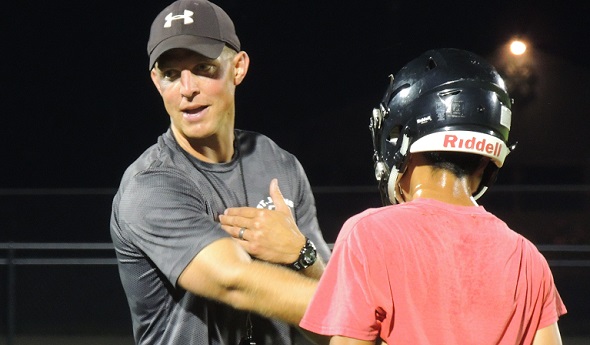
ST. JOHNS – The 50 or so students chanting “Schmitt! Schmitt! Schmitt!” during the earliest minutes of Monday morning know him mostly as a high school math teacher.
 Which makes sense – the oldest probably had just turned 3 when Andy Schmitt was locking down his local legend status as St. Johns’ history-making quarterback.
What they probably don’t remember, they’ve surely heard about – how he led unheralded St. Johns to the 2004 Division 3 championship game, its only appearance in an MHSAA Football Final, on the way to starring at Eastern Michigan University and earning a tryout from the Detroit Lions.
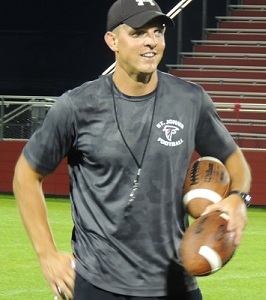
That fame he earned more than a decade ago still stands tall, just as the Redwings' first-year varsity head coach did by a few inches over the rest of his coaching staff and possibly all of his players as the team kicked off the 2019 season with a midnight practice on its home field.
While Schmitt’s experiences and successes surely could have led him down a variety of football coaching roads, he always was circling to come back home – with the hope of giving today's players opportunities to make memories like those that continue to resonate within him.
“It never mattered on opportunities. It was always a matter of trying to come back home,” said Schmitt late Sunday night, as St. Johns’ game clock behind him ticked down the seconds until football teams statewide were allowed to practice for the first time this fall. “My wife’s from here. I’m from here. I grew up with a lot of pride in this community. I saw myself, once I decided to get into education and coaching, I saw myself coming back to St. Johns.
"We had such a good experience playing here, made a couple of nice runs, and I just want to help this program do the same thing."
He began a busy journey as a mostly-unheralded high school junior in 2003. Unheralded, that is, until he led St. Johns to its first District football title that fall.
Schmitt then emerged the next season as the best from a historically-deep group of standout mid-Michigan quarterbacks, leading St. Johns to the Pontiac Silverdome. Although the Redwings lost that championship game to Lowell 38-17, Schmitt made a pair of long scrambling passes that helped St. Johns stay tied with the Red Arrows until the final minutes of the third quarter. And regardless of the defeat, the playoff run spoke volumes – Schmitt eventually was named Lansing State Journal All-Decade quarterback for the mid-Michigan area in 2010, prestige that lives on even for players who have seen him play only on YouTube.
“It’s all over the school. He’s got a banner in there, a picture in the weight room,” Redwings senior lineman Sam Hallead said. “It’s always there to motivate us.”
Schmitt went on to Eastern Michigan University, where after redshirting his first year he played 34 games with 30 starts before a knee injury ended his college career after the team’s third game of the 2009 season. All told, he threw for 5,867 yards and 33 touchdowns at EMU and holds four school passing records while ranking near the top in a number of other categories. He still shares the NCAA Division I record for single-game completions with 58 against Central Michigan in their 2008 meeting.
Schmitt came back from his injury to try out for the Lions in 2010, and then he turned toward his next career. He student taught at Williamston, then as a long-term substitute at Bay City John Glenn before taking his first fulltime teaching job at New Buffalo. Then it was on to Fowlerville and Ovid-Elsie Middle School before arriving back at St. Johns in 2015. Schmitt coached at all of the schools where he taught, and was a freshman coach the last three seasons under his former coach Dave Mariage, who retired from the head varsity job after last season. A week after Mariage resigned, Schmitt was promoted, and he’ll be surrounded this fall by all of the same staff – and with Mariage as his freshman coach.
It's where Schmitt always was meant to be, with qualities he began showing 20 years ago shining through.
“The same love of the game. The same enthusiasm. He loves the game, he knows the game, and he’s excited every day he comes out here,” Mariage said. “I didn’t know that’s what he was going to do (become a teacher and coach), but he’s a natural leader. He checks all the boxes. He’s going to do great.”
 Schmitt takes over a program that remains one of the most consistently successful in the Lansing area.
Mariage stepped away with a 124-72 record over his 19 seasons, and the Redwings haven’t finished below .500 for a season since 2005. They’ve won two more District titles since Schmitt graduated and are a regular league title contender.
St. Johns will begin its seventh season since building a football stadium after Schmitt starred on a field that certainly could be referred to as yesteryear. And Hallead said the varsity has 35 players out, with his class plenty familiar with the new coach after Schmitt coached them as freshmen.
Schmitt laughed when asked if his players know of his legendary status in town – “They don’t need to know” – but he admits there’s substantial buzz heading into this season. He’ll never forget how the community came out to support the team when he played, and that support was perhaps the heaviest driving force that brought he and his wife Teisha (Thelen), also a 2005 grad and three-sport standout, home again and home to stay.
“The amount of pride that I experienced going through the runs that we had junior and senior year, and again, watching this town come together and how supportive the town was, made football mean so much to me,” Schmitt said. “How a group of people can bring a lot of people together, seeing the support, seeing the pride made me want to come right back to St. Johns.
“This is home. There’s not going to be anywhere else. This is where we’re going to raise our kids. There’s no going anywhere from here.”
 Geoff Kimmerly joined the MHSAA as its Media & Content Coordinator in Sept. 2011 after 12 years as Prep Sports Editor of the Lansing State Journal. He has served as Editor of Second Half since its creation in Jan. 2012. Contact him at [email protected] with story ideas for the Barry, Eaton, Ingham, Livingston, Ionia, Clinton, Shiawassee, Gratiot, Isabella, Clare and Montcalm counties.
PHOTOS: (Top) St. Johns first-year head varsity coach Andy Schmitt works with his defensive backs during Monday morning’s “midnight madness” practice. (Middle) Schmitt formerly starred at quarterback for the Redwings, leading the program to its first District and Regional titles.