

New Math: Division & Multiplication Problems
July 25, 2017
By Jack Roberts
MHSAA Executive Director
This is the second part in a series on MHSAA tournament classification, past and present, that will be published over the next two weeks. This series originally ran in this spring's edition of MHSAA benchmarks.
High school tournament classifications went viral before there was social media and most of us knew what “viral” meant.
Much as a virus infects computers today or has created epidemics of disease around the world for centuries, high school tournament classification – once introduced – tends to spread uncontrollably. Once started, it tends to keep expanding and rarely contracts.
While we are still some distance from providing every team a trophy as a result of expanding high school tournament classification across the country, there is criticism nevertheless that we are headed in that direction – a philosophy which is supposed to exist only in local youth sports for our youngest children.
Michigan could be blamed for all this. Michigan is generally accepted as the first state to provide different classifications for season-ending tournaments for different sized schools. It started a century ago. Today, every state has various classifications for its tournaments in most if not all sports. And it is a bit ironic that Michigan – creator of the classification chaos – more than most other states has kept the number of tournament classes or divisions under control.
Yes, there is evidence that tournament classifications have expanded over the years in Michigan, especially with the relatively recent introduction of tournaments in football and the late 1990s’ move from classes to divisions in most MHSAA tournaments. But the MHSAA Representative Council has held true to its word when it expanded the playoffs for football from four classes to eight divisions: this is needed because of unique factors of football, factors that exist in no other sport; and all other sports should be capped at a maximum of four classes or divisions.
Kentucky is the preeminent defender of single-class basketball. All of its 276 high schools compete for the single state championship for each gender. In Indiana, there are still open wounds from its move in 1998 from one to four classes for its 400 schools in basketball.
Multi-class tournaments have tended to increase the number of non-public school champions, which some states are trying to lower through enrollment “multipliers,” and also tend to increase the number of repeat champions, which some states are trying to affect with “success factors” which lift smaller schools into classifications for larger schools if they take home too many trophies.
While there is considerable evidence that state tournaments do as much bad as good for educational athletics, state associations persist in providing postseason tournaments because, on balance, the experiences are supposed to be good for student-athletes. And once we reach that conclusion it is just a small leap to believe that if the tournaments are good for a few, they must be better for more – which leads to creating more and more tournament classifications. One becomes two classes, then three, then four and so forth.
While the argument is that more classifications or divisions provides more students with opportunities to compete and win, it is undeniable that the experience changes as the number of tournament classifications expands. It is not possible for state associations to provide the same level of support when tournament classifications expand to multiple venues playing simultaneously. For example, there is less audio and video broadcast potential at each venue, and less media coverage to each venue. Focus is diluted and fans diminished at each championship.
No one can argue reasonably that today's two-day MHSAA Football Finals of eight championship games has the same pizazz as the one-day, four-games event conducted prior to 1990.
In some states the number of divisions has grown so much that it is difficult to see much difference between the many season-ending state championship games and a regular-season event in the same sport.
It is a balancing act. And Michigan has been studying that balance longer than any other state, and charting a steadier course than most.
Addition by Division
The shift to Divisions for MHSAA Tournament play in numerous sports has added up to a greater number of champions for teams and individuals across the state. Following are the sports currently employing a divisional format, and the procedures for determining enrollment and classification.
In 23 statewide or Lower Peninsula tournaments, schools which sponsor the sport are currently divided into nearly equal divisions. They are:
- Baseball - 4 Divisions
- Boys Bowling - 4 Divisions
- Girls Bowling - 4 Divisions
- Girls Competitive Cheer - 4 Divisions
- LP Boys Cross Country - 4 Divisions
- LP Girls Cross Country - 4 Divisions
- LP Boys Golf - 4 Divisions
- LP Girls Golf - 4 Divisions
- Ice Hockey - 3 Divisions
- Boys Lacrosse - 2 Divisions
- Girls Lacrosse - 2 Divisions
- Boys Skiing - 2 Divisions
- Girls Skiing - 2 Divisions
- LP Boys Soccer - 4 Divisions LP
- Girls Soccer - 4 Divisions
- Girls Softball - 4 Divisions
- LP Boys Swimming & Diving - 3 Divisions
- LP Girls Swimming & Diving - 3 Divisions
- LP Boys Tennis - 4 Divisions
- LP Girls Tennis - 4 Divisions
- LP Boys Track & Field - 4 Divisions
- LP Girls Track & Field - 4 Divisions
- Wrestling - 4 Divisions
Lists of schools for each division of these 23 tournaments are posted on MHSAA.com approximately April 1. Listings of schools in Upper Peninsula tournaments for their sports are also posted on MHSAA.com. The lists are based on school memberships and sports sponsorships in effect or anticipated for the following school year, as known to the MHSAA office as of a date in early March.
In football, the 256 schools which qualify for MHSAA 11-player playoffs are placed in eight equal divisions annually on Selection Sunday. Beginning in 2017, the 8-player divisions will be determined in a like manner on Selection Sunday as well, with 32 qualifying schools placed in two divisions.
Schools have the option to play in any higher division in one or more sports for a minimum of two years.
The deadlines for "opt-ups" are as follows:
- Applications for fall sports must be submitted by April 15
- Applications for winter sports must be submitted by Aug. 15
- Applications for spring sports must be submitted by Oct. 15
Subsequent to the date of these postings for these tournaments, no school will have its division raised or lowered by schools opening or closing, schools adding or dropping sports, schools exercising the option to play in a higher division, or approval or dissolution of cooperative programs.
When the same sport is conducted for boys and girls in the same season (e.g., track & field and cross country), the gender that has the most sponsoring schools controls the division breaks for both genders.
Performance: Summerfield's Derek Clark
June 20, 2019
 Derek Clark
Petersburg Summerfield junior – Baseball
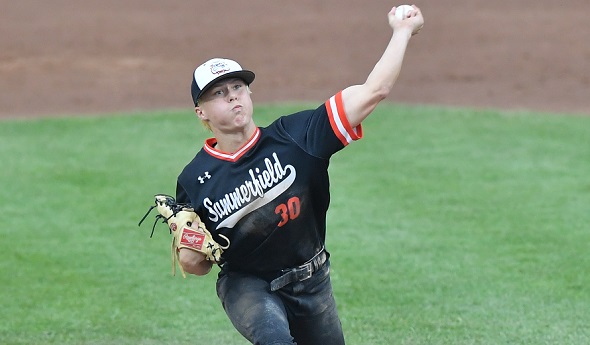
The Bulldogs closed one of the most dominating runs in MHSAA Baseball Tournament history with their first championship Saturday, and Clark turned in a performance to match. The pitcher/centerfielder threw a four-hit shutout in the 9-0 Division 4 Final win over Saginaw Nouvel, capping a run of 44 straight scoreless innings pitched to close his junior season as he earned the MHSAA “Performance of the Week.”
Clark’s pitching statistics this spring were jaw-dropping. He finished 13-0 with a 0.20 ERA – good for seventh lowest in MHSAA history. He had 116 strikeouts in 70 innings pitched, with 11 strikeouts in the championship game including for the season’s final out. He was 4-for-7 from the plate over the Semifinal and championship games to push his average to .500 for this spring, and he also finished with 48 runs scored and 52 stolen bases (tied for 19th most) on 54 attempts over 32 games. Summerfield defeated Gaylord St. Mary 5-0 in the Semifinal on the way to meeting Nouvel on Saturday, and finished with a combined scoring margin of 89-2 over eight postseason games. The championship was the school’s first at the Finals level in any boys sport. The Bulldogs also won the Tri-County Conference and finished 28-4 overall, capping a complete program turnaround – more on that below.
A three-sport athlete as a junior, Clark doesn’t plan to play football as a senior but will return as the point guard for a basketball team that won the league this past winter for the first time since 2011-12. He’s also a 3.6 student, part of National Honor Society and student council, and is leaning toward studying business or sports marketing when high school is done. He should have some interesting options to continue on the diamond as well – the left-hander made the Division 4 all-state first team this spring as a pitcher after earning the same as an outfielder in 2018.
Coach Travis Pant said: “He’s an ultra competitor. He hates to lose, and it shows in the way he plays the game. Derek’s energy and leadership fueled this historic weekend that we had as a program. He’s a humble leader who brings an enthusiasm to the field every single day that is unmatched. What people saw this weekend in the Finals is what I have watched for the past three seasons. He plays the game the right way and is very fun to watch. … He has been the face of the rebuild we had at Summerfield. When he was an eighth grader, we went 6-28. In his freshman year he quickly became the ace and a leader in the dugout. We have won at least 21 games in every year since. Derek has pitched us to two District championships, two Regional championships and a state championship. He wants the ball in big games and the team fuels off his confidence. … Derek’s junior season was nothing short of amazing. He broke the county record for ERA with a 0.20 and was within three of the county stolen base record with 52. To do what he does on the mound and at the plate for us at such a consistent rate is amazing. Derek never had a bad day on the mound. No matter what the situation, he showed up with his best stuff.”
Performance Point: “The community's been really great about it. I can't go anywhere without having somebody say congratulations. I've had people I've never seen in my life say ‘Congrats,’” Clark said. “It's really nice to have that back-up, so to say, with our community. … With the weekend, it was just so good. All of our hard work, it finally paid off, finally got (us) to our number one goal. It's really nice to accomplish something this big. … The last out, to strike him out for the game, I was telling my catcher, ‘If we get to two outs, we've got to strike him out.’ I think that was probably the best moment. I just felt like it was more ecstatic, had us all pumped up. Because we had the confidence, I don't think it was shocking, so to say. We were really confident in ourselves and in our play because we were playing really well at the time. I think it was just more of a relief.”
Talking turnaround: “I think it’s just having guys that can play. The junior class this year was really big. We started five freshmen my freshman year. So just having that, and having guys come out. Also just having confidence in each other and trusting in each other, because team chemistry is huge. If you don’t have that, talent doesn’t really mean anything. … We’ve always been a baseball group. There’s been football and basketball, but we’ve been more of a baseball grade. I think we’ve been all right coming up, and we’ve just hit a stride the last couple of years and (we’re) just getting better.”
 Taking the lead: “I just try to be a leader of everything, every sport I play. When it comes to basketball, I'm the point guard so you've gotta communicate, you've gotta use your words, you can't be quiet. You're the general of the floor – you've got to know what to do, what's going on at all times. That's kinda how I am with baseball. I just try to keep everybody engaged and try to get everybody looks and help everybody as much as I can.”
Title time: “It's just great to finally get it done. Our baseball program, Coach (Darrell) Polter built it up (before retiring in 2014 after nearly 40 seasons). He has 17 league titles at Summerfield, and just to finally get that state title meant a lot to us. Nobody's really ever been there to do that, in any sport, so (the community) made a really big deal. We came home after we won, and there was a big parade in town and it was just really surreal and awesome to be a part of.”
Never stop competing: “I think we're all just so competitive. We'll be in math class, doing something that's competitive, and if you lose it's hectic. Nobody wants to lose. I think that's got something to do with (our success). When we grew up, we didn't want to lose ever. That's how we've been since we were little. Some kids take it even into school, like ‘Ha ha, I have better grades than you.’ It gets wild. I’m not bad (academically), but our shortstop Brendan Dafoe has a 4-point, and Brayden Jewell has a 3.8 or 3.9 or something like that. We’re all in advanced class, so we get after each other in there.”
- Geoff Kimmerly, Second Half editor
Past 2018-19 honorees
June 13: Audrey Whiteside, East Grand Rapids lacrosse - Read
June 6: Kari Miller, Ann Arbor Pioneer tennis - Read
May 23: Keshaun Harris, Lansing Waverly track & field - Read
May 16: Gabbie Sherman, Millington softball - Read
May 9: Nathan Taylor, Muskegon Mona Shores golf - Read
May 2: Ally Gaunt, New Baltimore Anchor Bay soccer - Read
April 25: Kali Heivilin, Three Rivers softball - Read
March 28: Rickea Jackson, Detroit Edison basketball - Read
March 21: Noah Wiswary, Hudsonville Unity Christian basketball - Read
March 14: Cam Peel, Spring Lake swimming - Read
March 7: Jordan Hamdan, Hudson wrestling - Read
February 28: Kevon Davenport, Detroit Catholic Central wrestling - Read
February 21: Reagan Olli, Gaylord skiing - Read
February 14: Jake Stevenson, Traverse City Bay Reps hockey - Read
February 7: Molly Davis, Midland Dow basketball - Read
January 31: Chris DeRocher, Alpena basketball - Read
January 24: Imari Blond, Flint Kearsley bowling - Read
January 17: William Dunn, Quincy basketball - Read
November 29: Dequan Finn, Detroit Martin Luther King football - Read
November 22: Paige Briggs, Lake Orion volleyball - Read
November 15: Hunter Nowak, Morrice football - Read
November 8: Jon Dougherty, Detroit Country Day soccer - Read
November 1: Jordan Stump, Camden-Frontier volleyball - Read
October 25: Danielle Staskowski, Pontiac Notre Dame Prep golf - Read
October 18: Adam Bruce, Gladstone cross country - Read
October 11: Ericka VanderLende, Rockford cross country - Read
October 4: Kobe Clark, Schoolcraft football - Read
September 27: Jonathan Kliewer, Grand Rapids Forest Hills Northern soccer - Read
September 20: Kiera Lasky, Bronson volleyball - Read
September 13: Judy Rector, Hanover-Horton cross country - Read
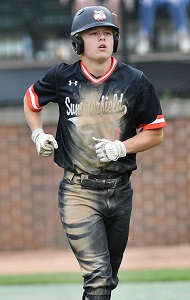
PHOTOS: (Top) Petersburg Summerfield's Derek Clark unloads a pitch during Saturday's Division 4 championship game win at McLane Stadium. (Middle) Clark heads back to his dugout after sliding in head-first to score in Friday's Semifinal.