

New Math: Division & Multiplication Problems
July 25, 2017
By Jack Roberts
MHSAA Executive Director
This is the second part in a series on MHSAA tournament classification, past and present, that will be published over the next two weeks. This series originally ran in this spring's edition of MHSAA benchmarks.
High school tournament classifications went viral before there was social media and most of us knew what “viral” meant.
Much as a virus infects computers today or has created epidemics of disease around the world for centuries, high school tournament classification – once introduced – tends to spread uncontrollably. Once started, it tends to keep expanding and rarely contracts.
While we are still some distance from providing every team a trophy as a result of expanding high school tournament classification across the country, there is criticism nevertheless that we are headed in that direction – a philosophy which is supposed to exist only in local youth sports for our youngest children.
Michigan could be blamed for all this. Michigan is generally accepted as the first state to provide different classifications for season-ending tournaments for different sized schools. It started a century ago. Today, every state has various classifications for its tournaments in most if not all sports. And it is a bit ironic that Michigan – creator of the classification chaos – more than most other states has kept the number of tournament classes or divisions under control.
Yes, there is evidence that tournament classifications have expanded over the years in Michigan, especially with the relatively recent introduction of tournaments in football and the late 1990s’ move from classes to divisions in most MHSAA tournaments. But the MHSAA Representative Council has held true to its word when it expanded the playoffs for football from four classes to eight divisions: this is needed because of unique factors of football, factors that exist in no other sport; and all other sports should be capped at a maximum of four classes or divisions.
Kentucky is the preeminent defender of single-class basketball. All of its 276 high schools compete for the single state championship for each gender. In Indiana, there are still open wounds from its move in 1998 from one to four classes for its 400 schools in basketball.
Multi-class tournaments have tended to increase the number of non-public school champions, which some states are trying to lower through enrollment “multipliers,” and also tend to increase the number of repeat champions, which some states are trying to affect with “success factors” which lift smaller schools into classifications for larger schools if they take home too many trophies.
While there is considerable evidence that state tournaments do as much bad as good for educational athletics, state associations persist in providing postseason tournaments because, on balance, the experiences are supposed to be good for student-athletes. And once we reach that conclusion it is just a small leap to believe that if the tournaments are good for a few, they must be better for more – which leads to creating more and more tournament classifications. One becomes two classes, then three, then four and so forth.
While the argument is that more classifications or divisions provides more students with opportunities to compete and win, it is undeniable that the experience changes as the number of tournament classifications expands. It is not possible for state associations to provide the same level of support when tournament classifications expand to multiple venues playing simultaneously. For example, there is less audio and video broadcast potential at each venue, and less media coverage to each venue. Focus is diluted and fans diminished at each championship.
No one can argue reasonably that today's two-day MHSAA Football Finals of eight championship games has the same pizazz as the one-day, four-games event conducted prior to 1990.
In some states the number of divisions has grown so much that it is difficult to see much difference between the many season-ending state championship games and a regular-season event in the same sport.
It is a balancing act. And Michigan has been studying that balance longer than any other state, and charting a steadier course than most.
Addition by Division
The shift to Divisions for MHSAA Tournament play in numerous sports has added up to a greater number of champions for teams and individuals across the state. Following are the sports currently employing a divisional format, and the procedures for determining enrollment and classification.
In 23 statewide or Lower Peninsula tournaments, schools which sponsor the sport are currently divided into nearly equal divisions. They are:
- Baseball - 4 Divisions
- Boys Bowling - 4 Divisions
- Girls Bowling - 4 Divisions
- Girls Competitive Cheer - 4 Divisions
- LP Boys Cross Country - 4 Divisions
- LP Girls Cross Country - 4 Divisions
- LP Boys Golf - 4 Divisions
- LP Girls Golf - 4 Divisions
- Ice Hockey - 3 Divisions
- Boys Lacrosse - 2 Divisions
- Girls Lacrosse - 2 Divisions
- Boys Skiing - 2 Divisions
- Girls Skiing - 2 Divisions
- LP Boys Soccer - 4 Divisions LP
- Girls Soccer - 4 Divisions
- Girls Softball - 4 Divisions
- LP Boys Swimming & Diving - 3 Divisions
- LP Girls Swimming & Diving - 3 Divisions
- LP Boys Tennis - 4 Divisions
- LP Girls Tennis - 4 Divisions
- LP Boys Track & Field - 4 Divisions
- LP Girls Track & Field - 4 Divisions
- Wrestling - 4 Divisions
Lists of schools for each division of these 23 tournaments are posted on MHSAA.com approximately April 1. Listings of schools in Upper Peninsula tournaments for their sports are also posted on MHSAA.com. The lists are based on school memberships and sports sponsorships in effect or anticipated for the following school year, as known to the MHSAA office as of a date in early March.
In football, the 256 schools which qualify for MHSAA 11-player playoffs are placed in eight equal divisions annually on Selection Sunday. Beginning in 2017, the 8-player divisions will be determined in a like manner on Selection Sunday as well, with 32 qualifying schools placed in two divisions.
Schools have the option to play in any higher division in one or more sports for a minimum of two years.
The deadlines for "opt-ups" are as follows:
- Applications for fall sports must be submitted by April 15
- Applications for winter sports must be submitted by Aug. 15
- Applications for spring sports must be submitted by Oct. 15
Subsequent to the date of these postings for these tournaments, no school will have its division raised or lowered by schools opening or closing, schools adding or dropping sports, schools exercising the option to play in a higher division, or approval or dissolution of cooperative programs.
When the same sport is conducted for boys and girls in the same season (e.g., track & field and cross country), the gender that has the most sponsoring schools controls the division breaks for both genders.
Performance: EGR's Audrey Whiteside
June 14, 2019
 Audrey Whiteside
East Grand Rapids senior – Lacrosse
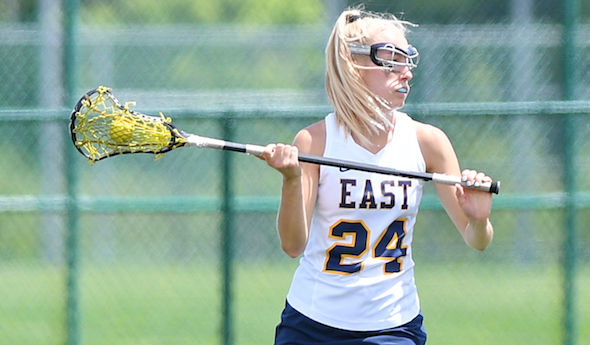
The Pioneers’ senior attack had seven goals and three assists as East Grand Rapids regained the Division 2 championship Saturday with 22-7 win over Bloomfield Hills Marian, earning Whiteside the MHSAA “Performance of the Week.” She finished this spring with 149 goals – second-most for one season in MHSAA history – and a record 208 points despite playing in what’s considered the toughest league in the state.
Whiteside was a freshman on EGR’s 2016 championship team and helped the Pioneers finish Division 2 runner-up in 2017 and reach the Semifinals a year ago. She also had 59 assists, 107 draw controls and 31 ground balls this season and finished her career with 409 goals and 114 assists for 523 points – her goals and points rank second all-time, and her assists are seventh most for a career. East Grand Rapids finished this season 24-2 and tied for the Ottawa-Kent Conference Tier 1 title with Rockford, the eventual MHSAA Division 1 champion for the seventh straight season.
This was a celebration-filled school year for Whiteside, who also helped the EGR cross country team to the Lower Peninsula Division 2 title in the fall with a 21st-place finish at Michigan International Speedway. She was named this winter as one of 32 MHSAA/Farm Bureau Scholar-Athlete Award winners and graduated with a 3.9 GPA to go with her athletic and other extracurricular successes. It’s difficult to talk about Whiteside without also discussing four-year varsity teammate and close friend Mary Schumar – Whiteside’s business partner as well as they direct a summer lacrosse training academy for younger players. Schumar is heading next to an established power in Marquette University, while Whiteside will continue her career at Central Michigan University for a program that just completed its fourth season – she picked the Chippewas in part for a chance to play a major role in that program’s ascension. Whiteside is considering studying to become a nutritionist or go into personal training and fitness, and she’s also interested in business and marketing.
Coach Rich Axtell said: “Audrey has since her freshman year been a leader by example on this team. She never takes a day, a drill or a play off. She goes hard all the time. She has won virtually all of the sprints and conditioning exercises that we have done over the past four years. She ran cross country each fall and then attended almost every offseason conditioning session that the team held. After losing to CK in the Finals in 2017 and to Okemos in the Semifinals in 2018, Audrey, Mary Schumar and the rest of the team committed themselves to doing what it takes to win another state title. Audrey switched from midfield to attack be able to work more closely with Mary and to increase their offensive productivity. Both players had a 40-percent increase in their offensive statistics this year. Despite all this success, Audrey and Mary have remained very modest, always being genuinely surprised when I told them their statistics. When our games were in hand, they frequently passed up scoring opportunities to allow their teammates a chance to shine. Their selflessness and humility have helped to produce one of the closest and happiest teams I have ever coached. Obviously, we will miss Audrey's offensive production, but we will miss her dedication and leadership even more.”
Performance Point: “It definitely is the best way to end my senior year,” Whiteside said. “Having been to the Cross Country Finals in the fall, I think I really wanted to end my senior year right with another state championship. Our team not making it to the (Lacrosse) Finals last year, that really inspired us to work harder this season, to finally go to the Finals and hopefully win. … Our mentality going into the playoffs was to have really fast starts, because we’re usually a second-half team. We wanted to set up strong from the first draw, but I think going in with that mentality really helped us. I think we really did have a different mindset going into the state Finals … it just all came together.”
One for all: “It’s hard to describe, but (winning the title is) honestly the best feeling. We had three incoming freshmen make it this year, and I think that helped us a lot with the intensity of the team. And I think I wanted to get it for those freshmen because I know what it is like, because when I was a freshman we won. It was just honestly the best feeling and I wanted them to have that – and also all the other sophomores that made it and juniors, just everyone together.”
 Back in business: “My friend Mary Schumar and I started a lacrosse clinic called EGR Lacrosse Academy last year. We’re trying to make it bigger this year. That’s the goal. We start in a couple weeks. I want to go into business in the future, so it’s a great experience to have to work with all the families and the kids. but I love working with kids so it makes it even better. … I’ve learned (business) takes a lot more time and work than I thought it would. And also, communicating with people is very essential to creating a great business and creating relationships. Creating bonds with people and connections is going to get you way farther than anything else – and also working harder.”
My friend Mary: “We have been friends since second grade – we went to different elementary schools but ended up being in the same friend group from middle school on to now. Playing with her freshman through senior year has been so amazing. She had a stellar freshman year – I think she got pulled up halfway and made (six) goals in the state championship game as a freshman, which is unbelievable. I got pulled up to being an attack this year with her to score more points and handle the offense with her, and that’s also been just amazing, working so well together. It just clicked this year. … We play each other (next season). Central’s first game is Marquette, and that’s going to be super surreal to play Mary next year. But we’re really excited.”
Scholar & Athlete: “I think about (being both) a lot. It’s really a motivator to work hard, and it inspires other students to work harder themselves. But also the team aspect – we have a team GPA, and I think all of us want to work harder to get that 4.0 average GPA, which I think we got a 3.7 which is amazing. Being a scholar-athlete, I know raised the bar, raised expectations on me, which I love because I love having pressure. I do better with pressure – especially in games and in the classroom.”
- Geoff Kimmerly, Second Half editor
Past 2018-19 honorees
June 6: Kari Miller, Ann Arbor Pioneer tennis - Read
May 23: Keshaun Harris, Lansing Waverly track & field - Read
May 16: Gabbie Sherman, Millington softball - Read
May 9: Nathan Taylor, Muskegon Mona Shores golf - Read
May 2: Ally Gaunt, New Baltimore Anchor Bay soccer - Read
April 25: Kali Heivilin, Three Rivers softball - Read
March 28: Rickea Jackson, Detroit Edison basketball - Read
March 21: Noah Wiswary, Hudsonville Unity Christian basketball - Read
March 14: Cam Peel, Spring Lake swimming - Read
March 7: Jordan Hamdan, Hudson wrestling - Read
February 28: Kevon Davenport, Detroit Catholic Central wrestling - Read
February 21: Reagan Olli, Gaylord skiing - Read
February 14: Jake Stevenson, Traverse City Bay Reps hockey - Read
February 7: Molly Davis, Midland Dow basketball - Read
January 31: Chris DeRocher, Alpena basketball - Read
January 24: Imari Blond, Flint Kearsley bowling - Read
January 17: William Dunn, Quincy basketball - Read
November 29: Dequan Finn, Detroit Martin Luther King football - Read
November 22: Paige Briggs, Lake Orion volleyball - Read
November 15: Hunter Nowak, Morrice football - Read
November 8: Jon Dougherty, Detroit Country Day soccer - Read
November 1: Jordan Stump, Camden-Frontier volleyball - Read
October 25: Danielle Staskowski, Pontiac Notre Dame Prep golf - Read
October 18: Adam Bruce, Gladstone cross country - Read
October 11: Ericka VanderLende, Rockford cross country - Read
October 4: Kobe Clark, Schoolcraft football - Read
September 27: Jonathan Kliewer, Grand Rapids Forest Hills Northern soccer - Read
September 20: Kiera Lasky, Bronson volleyball - Read
September 13: Judy Rector, Hanover-Horton cross country - Read
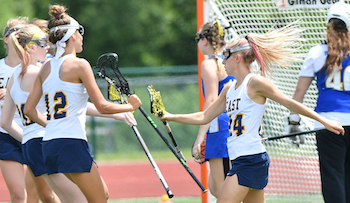
PHOTOS: (Top) East Grand Rapids' Audrey Whiteside considers her options during Saturday's Division 2 Final against Bloomfield Hills Marian. (Middle) Whiteside taps sticks with her teammates, including Mary Schumar (12).