

New Math: Division & Multiplication Problems
July 25, 2017
By Jack Roberts
MHSAA Executive Director
This is the second part in a series on MHSAA tournament classification, past and present, that will be published over the next two weeks. This series originally ran in this spring's edition of MHSAA benchmarks.
High school tournament classifications went viral before there was social media and most of us knew what “viral” meant.
Much as a virus infects computers today or has created epidemics of disease around the world for centuries, high school tournament classification – once introduced – tends to spread uncontrollably. Once started, it tends to keep expanding and rarely contracts.
While we are still some distance from providing every team a trophy as a result of expanding high school tournament classification across the country, there is criticism nevertheless that we are headed in that direction – a philosophy which is supposed to exist only in local youth sports for our youngest children.
Michigan could be blamed for all this. Michigan is generally accepted as the first state to provide different classifications for season-ending tournaments for different sized schools. It started a century ago. Today, every state has various classifications for its tournaments in most if not all sports. And it is a bit ironic that Michigan – creator of the classification chaos – more than most other states has kept the number of tournament classes or divisions under control.
Yes, there is evidence that tournament classifications have expanded over the years in Michigan, especially with the relatively recent introduction of tournaments in football and the late 1990s’ move from classes to divisions in most MHSAA tournaments. But the MHSAA Representative Council has held true to its word when it expanded the playoffs for football from four classes to eight divisions: this is needed because of unique factors of football, factors that exist in no other sport; and all other sports should be capped at a maximum of four classes or divisions.
Kentucky is the preeminent defender of single-class basketball. All of its 276 high schools compete for the single state championship for each gender. In Indiana, there are still open wounds from its move in 1998 from one to four classes for its 400 schools in basketball.
Multi-class tournaments have tended to increase the number of non-public school champions, which some states are trying to lower through enrollment “multipliers,” and also tend to increase the number of repeat champions, which some states are trying to affect with “success factors” which lift smaller schools into classifications for larger schools if they take home too many trophies.
While there is considerable evidence that state tournaments do as much bad as good for educational athletics, state associations persist in providing postseason tournaments because, on balance, the experiences are supposed to be good for student-athletes. And once we reach that conclusion it is just a small leap to believe that if the tournaments are good for a few, they must be better for more – which leads to creating more and more tournament classifications. One becomes two classes, then three, then four and so forth.
While the argument is that more classifications or divisions provides more students with opportunities to compete and win, it is undeniable that the experience changes as the number of tournament classifications expands. It is not possible for state associations to provide the same level of support when tournament classifications expand to multiple venues playing simultaneously. For example, there is less audio and video broadcast potential at each venue, and less media coverage to each venue. Focus is diluted and fans diminished at each championship.
No one can argue reasonably that today's two-day MHSAA Football Finals of eight championship games has the same pizazz as the one-day, four-games event conducted prior to 1990.
In some states the number of divisions has grown so much that it is difficult to see much difference between the many season-ending state championship games and a regular-season event in the same sport.
It is a balancing act. And Michigan has been studying that balance longer than any other state, and charting a steadier course than most.
Addition by Division
The shift to Divisions for MHSAA Tournament play in numerous sports has added up to a greater number of champions for teams and individuals across the state. Following are the sports currently employing a divisional format, and the procedures for determining enrollment and classification.
In 23 statewide or Lower Peninsula tournaments, schools which sponsor the sport are currently divided into nearly equal divisions. They are:
- Baseball - 4 Divisions
- Boys Bowling - 4 Divisions
- Girls Bowling - 4 Divisions
- Girls Competitive Cheer - 4 Divisions
- LP Boys Cross Country - 4 Divisions
- LP Girls Cross Country - 4 Divisions
- LP Boys Golf - 4 Divisions
- LP Girls Golf - 4 Divisions
- Ice Hockey - 3 Divisions
- Boys Lacrosse - 2 Divisions
- Girls Lacrosse - 2 Divisions
- Boys Skiing - 2 Divisions
- Girls Skiing - 2 Divisions
- LP Boys Soccer - 4 Divisions LP
- Girls Soccer - 4 Divisions
- Girls Softball - 4 Divisions
- LP Boys Swimming & Diving - 3 Divisions
- LP Girls Swimming & Diving - 3 Divisions
- LP Boys Tennis - 4 Divisions
- LP Girls Tennis - 4 Divisions
- LP Boys Track & Field - 4 Divisions
- LP Girls Track & Field - 4 Divisions
- Wrestling - 4 Divisions
Lists of schools for each division of these 23 tournaments are posted on MHSAA.com approximately April 1. Listings of schools in Upper Peninsula tournaments for their sports are also posted on MHSAA.com. The lists are based on school memberships and sports sponsorships in effect or anticipated for the following school year, as known to the MHSAA office as of a date in early March.
In football, the 256 schools which qualify for MHSAA 11-player playoffs are placed in eight equal divisions annually on Selection Sunday. Beginning in 2017, the 8-player divisions will be determined in a like manner on Selection Sunday as well, with 32 qualifying schools placed in two divisions.
Schools have the option to play in any higher division in one or more sports for a minimum of two years.
The deadlines for "opt-ups" are as follows:
- Applications for fall sports must be submitted by April 15
- Applications for winter sports must be submitted by Aug. 15
- Applications for spring sports must be submitted by Oct. 15
Subsequent to the date of these postings for these tournaments, no school will have its division raised or lowered by schools opening or closing, schools adding or dropping sports, schools exercising the option to play in a higher division, or approval or dissolution of cooperative programs.
When the same sport is conducted for boys and girls in the same season (e.g., track & field and cross country), the gender that has the most sponsoring schools controls the division breaks for both genders.
Flashback 1979: Detroit Dominates Diamonds
By
Ron Pesch
MHSAA historian
June 4, 2019
The MHSAA Baseball and Softball Finals will join girls soccer’s championship games in concluding the 2018-19 school year next weekend, June 13-15, at Michigan State University.
Forty years ago, baseball was concluding its ninth season with MHSAA playoffs, while softball was completing its fifth. The metro Detroit area emerged with six of the eight championships awarded, with the Detroit Catholic League earning four of those six titles as games were played at eight sites around the state.
Here’s a flashback to those 1979 championship rounds:
BASEBALL
Among the tournament surprises was the defeat of Birmingham Brother Rice (23-3), winner of the Detroit Catholic League title and favorite to win Class A. Rice blew a 3-0 lead and fell to Flint Carmen 5-3 in a Regional Semifinal. At the time, winners of Regionals immediately advanced to the MHSAA Semifinal round.
Twice beaten by Brother Rice during the regular season and runner-up to the Catholic League crown, Detroit Catholic Central posted wins over Center Line and then St. Clair Shores Lake Shore in Regional play to advance to the final round. A 7-4 victory over Adrian in the Semifinal meant the Shamrocks filled one side of the title-game bracket.
 On the other side, Port Huron Northern cut down Flint Carmen, 4-2, in the Regional Final, then slipped past East Kentwood on a game-saving catch by future Oakland A’s prospect Tony Moncrief. Trailing 2-1, East Kentwood loaded the bases in the seventh inning with only one out. A bunt, fielded by Northern pitcher Steve Campau and relayed to catcher Scott MacReady, forced the second out of the inning. After two quick strikes by Campau, Kentwood’s Jeff Bartoszek laced a shot to left-center, but Moncrief brought the crowd to their feet with a last-second diving catch to retire the side, and the Huskies advanced to the championship contest.
In the Final, DCC scored single runs in both the first and third innings off starter MacReady, then added two runs in both the fifth and sixth innings off reliever Norm Fretenborough for a 6-1 lead. Junior Chris Sabo, a future National League Rookie of the Year and three-time all-star with the Cincinnati Reds, had a triple and two singles and drove in a pair of runs for the Shamrocks. A seventh inning rally by Northern loaded the bases with nobody out. The Huskies scored three runs to pull within two, 6-4, before running out of steam.
Craig Herberholz, a late-round draft pick of the Kansas City Royals, entered the game for Catholic Central in the fourth inning after starter Jeff Evans was struck in the leg by a line drive. Herberholz earned the win, finishing the year with a 9-3 mark. The final round games were played at Battle Creek’s Bailey Park.
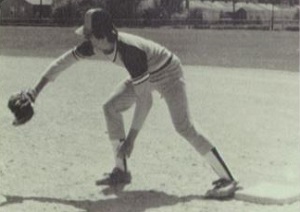
Southgate Aquinas’ all-state southpaw, Paul Assenmacher, allowed three hits and struck out nine as Aquinas grabbed a 5-1 victory over South Haven in Class B, hosted at Pontiac Northern High School. Runner-up in 1978, Aquinas ended the year 25-11. South Haven committed an uncharacteristic seven errors during the game, but the biggest blow came in the third inning when starting pitcher Paul Dulik was hit by a line drive just below the knee. A bruised shin meant he was done for the day. With the game scoreless through four innings, Aquinas scored three times in the fifth and twice in the sixth, while South Haven scored its lone run in the sixth.
Assenmacher, who went on to a 14-year MLB career as a relief pitcher, allowed 35 hits and seven earned runs over 86 innings that season, while striking out 113 batters. With the win, he ended the spring with a 10-3 record.
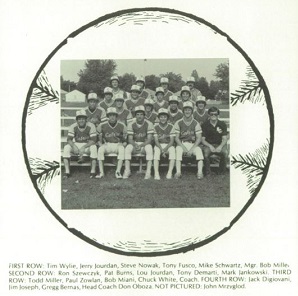
In Class C at Marshall High School, Allen Park Cabrini picked up its first MHSAA Finals baseball title behind the arms of righthander Pat Burns and Steve Nowak. Burns, a senior slinger, won five of the Monarchs’ seven tournament games including an 11-1 two-hit victory in the Semifinal over Lansing Catholic Central. Novak allowed four scattered hits and struck out eight in the title game, a 2-0 win over Clare, before a crowd of 400. The fourth inning provided all the scoring needed as Jerry Jourdan drove home Tim Wylie with a single to left, followed by Chuck White coming home on an error.
It was the third trip to the final rounds for Cabrini and coach Don Oboza. The team posted a 118-47 mark over the previous six seasons, falling in MHSAA Semifinals in 1976 and 1978.
In Class D, Pete Worchester went 3-for-3 in Grosse Pointe University Liggett’s 4-3 win over Frankfort, played at Wyoming. Kevin Wohlfield pitched five innings, while Jack Roberts tossed the final two for the winner.
SOFTBALL
In Class A at Southfield, coach Gary Bryce’s Royal Oak Dondero squad slipped past Grand Ledge 2-1 in extra innings. With the game scoreless through three, Grand Ledge’s Kelly Lawrence singled to open the fourth inning, then star pitcher Bonni Kinne doubled to left to drive in Lawrence, breaking the deadlock. Dondero’s left fielder Kathie Bell ran down a pair of fly balls, followed by a spectacular diving catch by second baseman Beth Fistler to close out the inning, stranding Kinne.
Fistler got Dondero on the scoreboard in the fifth with a single, stole second then advanced to third on a dropped third strike. She scored on a sacrifice to center by first baseman Mena Reyman, knotting the game at 1-1. Dondero’s Sue Larke reached second on an error in the ninth, then scored on another error for the win. It was the first state title for the Oaks since the fall of 1935 when the school, then known simply as Royal Oak, claimed a state title in football (according to media rankings; MHSAA Football Playoffs weren’t introduced until 1975).
Dondero’s Sandy Taylor dealt a four-hitter, picking up her 25th win against two defeats, and with catcher Diane Ashcraft earned all-state honors.
Bryce, who coached Dondero for five seasons, compiling a 130-36 mark, was named Coach of the Year. He is now in his 38th season as head coach of the softball program at Wayne State University.
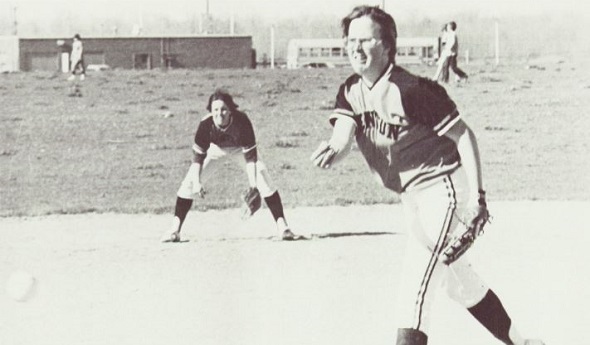
In a rematch of the 1978 title game, Fenton repeated as Class B champion, downing South Haven 10-4 in a game played at Ionia High School. Pitcher Barb Barclay upped her season mark to 25-2 with the win. She ended her high school career with a 61-5 record including a 45-game winning streak, four no-hitters, and mention in Sports Illustrated’s “Faces in the Crowd.” Dee Ann Moore went 5-for-5 in the contest, scoring four times and garnering five RBI. Pat Witt had a three-run homer for the winners. It was South Haven’s third consecutive runner-up finish. Fenton, under coach Dave Lazar, would pick up its third straight title in 1980.
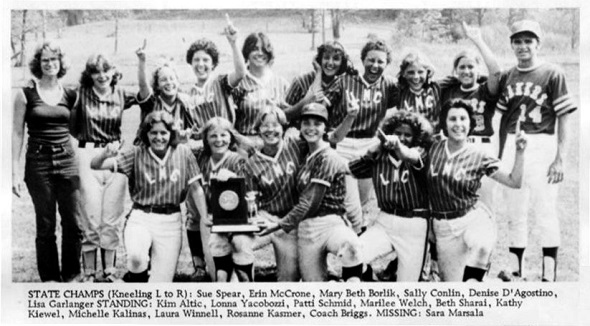
St. Joseph Lake Michigan Catholic scored three times in the eighth inning to grab a 7-4 win over Armada to earn the Class C crown, its first MHSAA Finals title in any sport. Catcher Mary Beth Borlik went 3-for-4 in the title game with three RBI. Catholic opened a first-inning 3-0 lead, featuring a triple by Borlik that pushed across two runs. Sophomore Beth Sharai picked up wins in both the semi and final contests, hosted at Clare.
In Class D, Ann Arbor Gabriel Richard’s Ellen O’Keefe tossed a two-hitter in the morning’s Semifinal, a 5-0 win over Mason County Eastern, and then held Morenci to four hits in its 4-2 title game win. O’Keefe swatted a three-run homer in the Semifinal, then doubled in a run in the championship game, played at Allendale. O’Keefe ended her college career as the winningest pitcher at Northwestern University, with 41 victories (including 16 shutouts). Today, her total ranks ninth in Wildcats history.
 Ron Pesch has taken an active role in researching the history of MHSAA events since 1985 and began writing for MHSAA Finals programs in 1986, adding additional features and "flashbacks" in 1992. He inherited the title of MHSAA historian from the late Dick Kishpaugh following the 1993-94 school year, and resides in Muskegon. Contact him at [email protected] with ideas for historical articles.
PHOTOS: (Top) Fenton’s Barb Barclay fires a pitch in 1979 for the eventual Class B champion. (Top middle) Southgate Aquinas’ Paul Assenmacher receives a throw at first base. (Middle) Allen Park Cabrini celebrated its first MHSAA title in baseball in its third trip to the final rounds. (Below) St. Joseph Lake Michigan Catholic softball earned the school’s first MHSAA Finals championship in any sport. (Photos gathered by Ron Pesch.)