

New Math: Division & Multiplication Problems
July 25, 2017
By Jack Roberts
MHSAA Executive Director
This is the second part in a series on MHSAA tournament classification, past and present, that will be published over the next two weeks. This series originally ran in this spring's edition of MHSAA benchmarks.
High school tournament classifications went viral before there was social media and most of us knew what “viral” meant.
Much as a virus infects computers today or has created epidemics of disease around the world for centuries, high school tournament classification – once introduced – tends to spread uncontrollably. Once started, it tends to keep expanding and rarely contracts.
While we are still some distance from providing every team a trophy as a result of expanding high school tournament classification across the country, there is criticism nevertheless that we are headed in that direction – a philosophy which is supposed to exist only in local youth sports for our youngest children.
Michigan could be blamed for all this. Michigan is generally accepted as the first state to provide different classifications for season-ending tournaments for different sized schools. It started a century ago. Today, every state has various classifications for its tournaments in most if not all sports. And it is a bit ironic that Michigan – creator of the classification chaos – more than most other states has kept the number of tournament classes or divisions under control.
Yes, there is evidence that tournament classifications have expanded over the years in Michigan, especially with the relatively recent introduction of tournaments in football and the late 1990s’ move from classes to divisions in most MHSAA tournaments. But the MHSAA Representative Council has held true to its word when it expanded the playoffs for football from four classes to eight divisions: this is needed because of unique factors of football, factors that exist in no other sport; and all other sports should be capped at a maximum of four classes or divisions.
Kentucky is the preeminent defender of single-class basketball. All of its 276 high schools compete for the single state championship for each gender. In Indiana, there are still open wounds from its move in 1998 from one to four classes for its 400 schools in basketball.
Multi-class tournaments have tended to increase the number of non-public school champions, which some states are trying to lower through enrollment “multipliers,” and also tend to increase the number of repeat champions, which some states are trying to affect with “success factors” which lift smaller schools into classifications for larger schools if they take home too many trophies.
While there is considerable evidence that state tournaments do as much bad as good for educational athletics, state associations persist in providing postseason tournaments because, on balance, the experiences are supposed to be good for student-athletes. And once we reach that conclusion it is just a small leap to believe that if the tournaments are good for a few, they must be better for more – which leads to creating more and more tournament classifications. One becomes two classes, then three, then four and so forth.
While the argument is that more classifications or divisions provides more students with opportunities to compete and win, it is undeniable that the experience changes as the number of tournament classifications expands. It is not possible for state associations to provide the same level of support when tournament classifications expand to multiple venues playing simultaneously. For example, there is less audio and video broadcast potential at each venue, and less media coverage to each venue. Focus is diluted and fans diminished at each championship.
No one can argue reasonably that today's two-day MHSAA Football Finals of eight championship games has the same pizazz as the one-day, four-games event conducted prior to 1990.
In some states the number of divisions has grown so much that it is difficult to see much difference between the many season-ending state championship games and a regular-season event in the same sport.
It is a balancing act. And Michigan has been studying that balance longer than any other state, and charting a steadier course than most.
Addition by Division
The shift to Divisions for MHSAA Tournament play in numerous sports has added up to a greater number of champions for teams and individuals across the state. Following are the sports currently employing a divisional format, and the procedures for determining enrollment and classification.
In 23 statewide or Lower Peninsula tournaments, schools which sponsor the sport are currently divided into nearly equal divisions. They are:
- Baseball - 4 Divisions
- Boys Bowling - 4 Divisions
- Girls Bowling - 4 Divisions
- Girls Competitive Cheer - 4 Divisions
- LP Boys Cross Country - 4 Divisions
- LP Girls Cross Country - 4 Divisions
- LP Boys Golf - 4 Divisions
- LP Girls Golf - 4 Divisions
- Ice Hockey - 3 Divisions
- Boys Lacrosse - 2 Divisions
- Girls Lacrosse - 2 Divisions
- Boys Skiing - 2 Divisions
- Girls Skiing - 2 Divisions
- LP Boys Soccer - 4 Divisions LP
- Girls Soccer - 4 Divisions
- Girls Softball - 4 Divisions
- LP Boys Swimming & Diving - 3 Divisions
- LP Girls Swimming & Diving - 3 Divisions
- LP Boys Tennis - 4 Divisions
- LP Girls Tennis - 4 Divisions
- LP Boys Track & Field - 4 Divisions
- LP Girls Track & Field - 4 Divisions
- Wrestling - 4 Divisions
Lists of schools for each division of these 23 tournaments are posted on MHSAA.com approximately April 1. Listings of schools in Upper Peninsula tournaments for their sports are also posted on MHSAA.com. The lists are based on school memberships and sports sponsorships in effect or anticipated for the following school year, as known to the MHSAA office as of a date in early March.
In football, the 256 schools which qualify for MHSAA 11-player playoffs are placed in eight equal divisions annually on Selection Sunday. Beginning in 2017, the 8-player divisions will be determined in a like manner on Selection Sunday as well, with 32 qualifying schools placed in two divisions.
Schools have the option to play in any higher division in one or more sports for a minimum of two years.
The deadlines for "opt-ups" are as follows:
- Applications for fall sports must be submitted by April 15
- Applications for winter sports must be submitted by Aug. 15
- Applications for spring sports must be submitted by Oct. 15
Subsequent to the date of these postings for these tournaments, no school will have its division raised or lowered by schools opening or closing, schools adding or dropping sports, schools exercising the option to play in a higher division, or approval or dissolution of cooperative programs.
When the same sport is conducted for boys and girls in the same season (e.g., track & field and cross country), the gender that has the most sponsoring schools controls the division breaks for both genders.

Preview: Don't Miss This Grand Finale
May 31, 2019
By Geoff Kimmerly
Second Half editor
Pick a division – any of seven Saturday – and you’re bound to find a senior standout finishing his career at the MHSAA Boys Track & Field Finals.
Michigan high schools regularly graduate star-loaded classes in this sport – but with reigning champions headlining lineups all over the Lower and Upper Peninsula this weekend, this grand finale guarantees to be memorable.
Below is a look at some of the teams and individuals to watch at Saturday’s boys meets. All events begin at 9 a.m. local time on both peninsulas.
Click for meet information including all qualifiers. Check out MHSAA.tv for live streaming of running events from both peninsulas, available with subscription and beginning at 10 a.m., and come back Saturday night for results as they come in and coverage of all seven meets on Second Half.
LP Division 1 at East Kentwood
Top Regional team scores: 1. Grosse Pointe South 142, 2. East Kentwood 139.5, 3. Alpena 130, 4. Plymouth 125, 5. Macomb Dakota 114.
Team forecast: East Kentwood has won the last two LPD1 championships and seven of the last 10. The Falcons look like significant favorites again with the fastest Regional times in the 400, 800 and 1,600 relays, top-five times in five individual races and contenders in at least three field events.
Detroit Renaissance’s Dylan Brown: The junior sprinter ran the top Regional time in the 200 (21.69) and second-fastest in the 100 (10.75) and also runs on two contending relays. He was part of the winning 800 relay and finished fifth in the 200 last season for Detroit Martin Luther King.
Ann Arbor Pioneer’s Nick Foster: The senior distance standout is looking to add to last season’s championships in the 3,200 and as part of the 3,200 relay. His 9:16.60 in the 3,200 was the third fastest in LPD1 Regionals this spring, and he ran the fastest 1,600 (4:12.87).
Lansing Waverly’s Keshaun Harris: The reigning 300 hurdles champion is seeking to sweep those races after finishing a close second as well in the 110 race last spring. He had the fastest LPD1 Regional time in the 110 (14.23) and sixth-fastest in the 300 (38.71).
Rockford’s Noah Stallworth: After coming in fifth in the 100 and eighth in the 200 as a junior, Stallworth had the fastest 100 (10.54) and second-fastest 200 (21.79) at LPD1 Regionals and runs on 400 and 1,600 relays that both were the third fastest in qualifying. He was part of the 400 relay champion in 2017.
LP Division 2 at Zeeland
Top Regional team scores: 1. Dearborn Divine Child 193, 2. Zeeland West 157, 3. Corunna 139.67, 4. Parma Western 130, 5. Yale 118.
Team forecast: The LPD2 Finals have seen 15 schools win the championship at least once over the last 16 seasons. Zeeland West might the favorite this time, after also winning in 2014, with big scoring possible in the hurdles, middle and distance races, long jump and at least three relays.
Otsego’s Alex Comerford: Last season’s 3,200 champ will look to finish his high school career with a pair of titles after running the second-fastest LPD2 Regional time in that race (9:25.94) and fastest in the 1,600 (4:18.41) – although he faces strong competition in Corunna senior Ben Jacobs and East Grand Rapids junior Evan Bishop.
Tecumseh’s Jacob Denison: The 400 winner last season as a junior had the sixth-fastest LPD2 Regional time in that race (50.25) but the second-fastest in the 200 (22.29) and also runs on an 800 relay that should contend.
Saginaw’s Tony Martin: The reigning long jump champion went over 26 feet during a regular-season meet, which would break the all-Finals record by two feet. He won his Regional at 21-10.25, the second-best jump in LPD2 Regional competition behind the 22-3.5 of Hudsonville Unity Christian junior Isaac TeSlaa.
Coldwater’s Dylan Targgart: Coming off a sweep of the throws last season as a sophomore, Targgart had the best tosses in both the shot put (61 feet) and discus (166-8) at LPD2 Regionals. He should make a run at the LPD2 Finals shot put record of 61-8 set by Ogemaw Heights’ Anthony Zettel in 2011.
LP Division 3 at Jenison
Top Regional team scores: 1. Berrien Springs 174.5, 2. Warren Michigan Collegiate 161, 3. Caro 148, 4. Adrian Madison 139.5, 5. Madison Heights Bishop Foley 134.
Team forecast: Similar to LPD2, this division has seen nine schools take turns winning the last nine championships (although three schools have come in second at least twice during that time). Berrien Springs was the runner-up a year ago and should put up some points – but keep an eye out for Pewamo-Westphalia and Saugatuck. P-W should contend in the throws, sprints, middle distance and at least two relays, while Saugatuck – the Division 4 champion or co-champion three of the last six seasons – has the favorites in both distance and hurdles races.
Saugatuck’s Brad Dunn: After taking third in the 110 and fifth in the 300 hurdles last season, Dunn had the top LPD3 Regional times in both this spring as a senior at 14.66 and 40.18 seconds, respectively.
Saugatuck’s Corey Gorgas: After sweeping the 1,600 and 3,200 last season as a junior, Gorgas is favored to do so with the top LPD3 Regional times of 4:19.24 and 9:43.98, respectively – although 800 favorite Jeremey Kloss from Harbor Springs should be right there with him in the 1,600, as should Caro star Yami Albrecht.
Grandville Calvin Christian’s Caleb Schutte: The senior sprinter won the 100 last year and was on the winning 400 relay as a sophomore. He enters this weekend with the second-fastest LPD3 Regional time in the 100 at 11.01 and the fastest in the 200 at 22.24.
Berrien Springs’ Sam Spaulding: The reigning high jump champ won his Regional at 6-2, which ties him for fifth among all LPD3 Regional performances. He’s gone 6-5 this senior season, which would put him one inch shy of the best qualifying mark.
Kent City’s Giovanni Weeks: Another reigning champion looking to go out on top is Weeks, who won the 200 last season and finished just behind Schutte in that race (22.34) and also in the 100 (11.08) at the Regional. His winning Regional long jump of 21-3.5 was fourth in the division for all Regionals.
LP Division 4 at Hudsonville Baldwin Middle School
Top Regional team scores: 1. Lutheran Westland 172, 2. Southfield Christian 158, 3. Addison 155.25, 4. Maple City Glen Lake 138, 5. Kalamazoo Hackett 135.
 Team forecast: Hackett won its first MHSAA Finals championship in this sport last season, and Addison could become a first-time champ with at least one competitor in all but one race and three of five field events. Hillsdale Academy could be that team this weekend too with favorites in at least three events and a solid contender in a fourth. Breckenridge is another possible first-time champion with the possibility of earning big points in the throws, distance races and sprint relays.
Kalamazoo Hackett’s Heath Baldwin: After winning the 110 hurdles and long jump last year, Baldwin will make a run at four championships in his last high school meet. He had the second-fastest LPD4 Regional times in the 110 (15.06) and 300 hurdles (40.63), tied for the fourth-highest high jump (6-3) and also won his long jump at 20-0.5.
Hale’s Patrick Harris: The champion in the 400 the last two years just missed qualifying in that race but will cap his high school career running the 200 and on a relay.
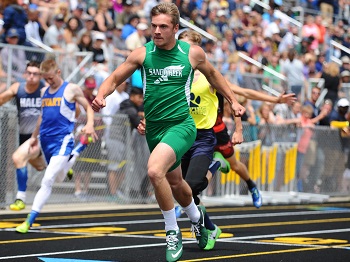
Sand Creek’s Alec Muck: The senior sprinter is one of the biggest stars competing, regardless of division, as he looks to add to his five championships including with a fourth straight in the 200. His 200 Regional time (22.85) came in fourth overall for LPD4 and his 100 time of 11.04 ranks second as he looks to win that title for the third straight season. He’s also part of the fastest 400 relay (44.44) coming off LPD4 Regional competition.
Carson City-Crystal’s Daniel Smith: The reigning shot put champ had the second-longest toss during LPD4 Regionals at 51-11.25, but again must contend with another senior, Breckenridge’s Brennan Waslusky (54-9.5) after finishing second to him at that meet two weeks ago.
UP Division 1 at Kingsford
Top Regional team scores: 1. Gladstone 79.5, 2. Ishpeming Westwood 56, 3. Marquette 55.5.
Team forecast: Gladstone will attempt to break Marquette’s four-year hold on Upper Peninsula Division 1 after coming in third a year ago. The Braves had 10 event champions at their Regional to Marquette’s four in the same meet.
Gladstone’s Adam Bruce: The 3,200 champion in 2017 as a sophomore, Bruce will try to finish his senior season with a distance sweep after posting the fastest 1,600 (4:40.73) and second-fastest 3,200 (10:29.38) at UPD1 Regionals.
Marquette’s Raphael Millado: The senior standout won both the long and high jumps last season and enters with the best UPD1 Regional showings in both at 19-11 and 6-2, respectively. He also had the fourth-fastest 200 qualifying time (24.12).
Escanaba’s Dayton Miron: The reigning pole vault champion enters this weekend’s meet tied with the second-highest vault at a UPD1 Regional (11-0), and he’ll also cap his junior season running on three relays.
Gladstone’s Calvin Thibault: The sophomore sprinter/hurdler could end up the star of this meet. He won the 110 and 300 hurdles last season and had the fastest UPD1 Regional times in those races two weeks ago at 15.40 and 41.25, respectively. He also paced the UPD1 qualifiers in the 100 (11.49) and 200 (23.64).
UP Division 2 at Kingsford
Top Regional team scores: 1. Newberry 74, 2. Ishpeming 65, 3. Norway 52.5.
Team forecast: Ishpeming is the reigning champion and has won four of the last five UPD2 titles, with Newberry defeating the runner-up Hematites to claim the championship in 2017. They competed in and won separate Regionals two weeks ago, but on paper Newberry appears to have the upper hand.
Manistique’s Schyler Andersen: The junior standout will make a run at four individual titles with the fastest UPD2 Regional time in the 400 (52.61), top discus throw (140-10), second-best shot put (43-0) and second-fastest 200 (23.70). His best at the 2018 Finals was a fourth place in shot put.
Gwinn’s David Duvall: After taking eighth in the 110 hurdles a year ago as a freshman, Duvall could make a big jump entering this weekend with the top UPD2 Regional times in the 100 (17.72) and 300 (45.35) and the second-best long jump (17-7.5).
Newberry’s Jaylen James: He’s ready to lead Newberry’s team title hunt after helping two relay champs a year ago. He enters with the best UPD2 Regional long jump (18-10), 100 (tie – 11.49), 200 (23.15) and running on the favored 800 relay (1:38.53).
Manistique’s Alex Misniakiewicz: The junior got close last season with two second places and a third in individual events. He enters this weekend as the top qualifier in the 800 (2:10.51), 1,600 (4:44.94) and second-best in the 3,200 (10:49.24).
UP Division 3 at Kingsford
Top Regional team scores: 1. Rapid River 105, 2. Bessemer 86, 3. Brimley 72.5.
Team forecast: Bessemer last season won its first championship in this sport since 1951 and should be in the mix again with the top performers from all UPD3 Regionals combined in nine events. Rapid River was the runner-up in 2018 after two straight titles in 2016 and 2017.
Bessemer’s Uriah Aili: The reigning champion in the 3,200 will make a run at winning at least three races as a senior with the top UPD3 Regional times in the 800 (2:02.41) and 3,200 (10:09.5) and second-fastest in the 1,600 (4:44.49). He also qualified in discus (103-3).
Cedarville’s Thomas Bohn: His 4:33.24 a year ago is the meet record, and he’s ahead of Aili in that race coming into this weekend at 4:43.81. Bohn, a junior, also will run the 3,200 (11:01.82) and 800 (2:07.84).
Bessemer’s Tyler Busch: The reigning shot put champion will look to repeat as a senior, entering with the best toss from UPD3 Regionals at 46-6.
Stephenson’s Montel Glover: The top UPD3 Regional performer in the 100 (11.30), 200 (23.85) and 400 (51.39) won all three of those races in UPD2 the last two seasons, and he’ll also run on a 1,600 relay with a chance at a title.
Bessemer’s Jamie Jett: He’ll look to add to his 2018 110 hurdles and 800 relay championships as a junior, entering this weekend with the top UPD3 Regional times in the 110 (16.76) and 300 (44.11). He’s also running the 200 (24.60) and competing in long jump (18-1.5).
PHOTOS: (Top) Stephenson’s Montel Glover, right, finishes just ahead of L’Anse’s Foster Miller in the 200 at last season’s UP Division 2 Finals. (Middle) Sand Creek’s Alec Muck powers through for one of his sprint championships in LP Division 4 last spring. (Click to see more from RunMichigan.com.)