

New Math: Division & Multiplication Problems
July 25, 2017
By Jack Roberts
MHSAA Executive Director
This is the second part in a series on MHSAA tournament classification, past and present, that will be published over the next two weeks. This series originally ran in this spring's edition of MHSAA benchmarks.
High school tournament classifications went viral before there was social media and most of us knew what “viral” meant.
Much as a virus infects computers today or has created epidemics of disease around the world for centuries, high school tournament classification – once introduced – tends to spread uncontrollably. Once started, it tends to keep expanding and rarely contracts.
While we are still some distance from providing every team a trophy as a result of expanding high school tournament classification across the country, there is criticism nevertheless that we are headed in that direction – a philosophy which is supposed to exist only in local youth sports for our youngest children.
Michigan could be blamed for all this. Michigan is generally accepted as the first state to provide different classifications for season-ending tournaments for different sized schools. It started a century ago. Today, every state has various classifications for its tournaments in most if not all sports. And it is a bit ironic that Michigan – creator of the classification chaos – more than most other states has kept the number of tournament classes or divisions under control.
Yes, there is evidence that tournament classifications have expanded over the years in Michigan, especially with the relatively recent introduction of tournaments in football and the late 1990s’ move from classes to divisions in most MHSAA tournaments. But the MHSAA Representative Council has held true to its word when it expanded the playoffs for football from four classes to eight divisions: this is needed because of unique factors of football, factors that exist in no other sport; and all other sports should be capped at a maximum of four classes or divisions.
Kentucky is the preeminent defender of single-class basketball. All of its 276 high schools compete for the single state championship for each gender. In Indiana, there are still open wounds from its move in 1998 from one to four classes for its 400 schools in basketball.
Multi-class tournaments have tended to increase the number of non-public school champions, which some states are trying to lower through enrollment “multipliers,” and also tend to increase the number of repeat champions, which some states are trying to affect with “success factors” which lift smaller schools into classifications for larger schools if they take home too many trophies.
While there is considerable evidence that state tournaments do as much bad as good for educational athletics, state associations persist in providing postseason tournaments because, on balance, the experiences are supposed to be good for student-athletes. And once we reach that conclusion it is just a small leap to believe that if the tournaments are good for a few, they must be better for more – which leads to creating more and more tournament classifications. One becomes two classes, then three, then four and so forth.
While the argument is that more classifications or divisions provides more students with opportunities to compete and win, it is undeniable that the experience changes as the number of tournament classifications expands. It is not possible for state associations to provide the same level of support when tournament classifications expand to multiple venues playing simultaneously. For example, there is less audio and video broadcast potential at each venue, and less media coverage to each venue. Focus is diluted and fans diminished at each championship.
No one can argue reasonably that today's two-day MHSAA Football Finals of eight championship games has the same pizazz as the one-day, four-games event conducted prior to 1990.
In some states the number of divisions has grown so much that it is difficult to see much difference between the many season-ending state championship games and a regular-season event in the same sport.
It is a balancing act. And Michigan has been studying that balance longer than any other state, and charting a steadier course than most.
Addition by Division
The shift to Divisions for MHSAA Tournament play in numerous sports has added up to a greater number of champions for teams and individuals across the state. Following are the sports currently employing a divisional format, and the procedures for determining enrollment and classification.
In 23 statewide or Lower Peninsula tournaments, schools which sponsor the sport are currently divided into nearly equal divisions. They are:
- Baseball - 4 Divisions
- Boys Bowling - 4 Divisions
- Girls Bowling - 4 Divisions
- Girls Competitive Cheer - 4 Divisions
- LP Boys Cross Country - 4 Divisions
- LP Girls Cross Country - 4 Divisions
- LP Boys Golf - 4 Divisions
- LP Girls Golf - 4 Divisions
- Ice Hockey - 3 Divisions
- Boys Lacrosse - 2 Divisions
- Girls Lacrosse - 2 Divisions
- Boys Skiing - 2 Divisions
- Girls Skiing - 2 Divisions
- LP Boys Soccer - 4 Divisions LP
- Girls Soccer - 4 Divisions
- Girls Softball - 4 Divisions
- LP Boys Swimming & Diving - 3 Divisions
- LP Girls Swimming & Diving - 3 Divisions
- LP Boys Tennis - 4 Divisions
- LP Girls Tennis - 4 Divisions
- LP Boys Track & Field - 4 Divisions
- LP Girls Track & Field - 4 Divisions
- Wrestling - 4 Divisions
Lists of schools for each division of these 23 tournaments are posted on MHSAA.com approximately April 1. Listings of schools in Upper Peninsula tournaments for their sports are also posted on MHSAA.com. The lists are based on school memberships and sports sponsorships in effect or anticipated for the following school year, as known to the MHSAA office as of a date in early March.
In football, the 256 schools which qualify for MHSAA 11-player playoffs are placed in eight equal divisions annually on Selection Sunday. Beginning in 2017, the 8-player divisions will be determined in a like manner on Selection Sunday as well, with 32 qualifying schools placed in two divisions.
Schools have the option to play in any higher division in one or more sports for a minimum of two years.
The deadlines for "opt-ups" are as follows:
- Applications for fall sports must be submitted by April 15
- Applications for winter sports must be submitted by Aug. 15
- Applications for spring sports must be submitted by Oct. 15
Subsequent to the date of these postings for these tournaments, no school will have its division raised or lowered by schools opening or closing, schools adding or dropping sports, schools exercising the option to play in a higher division, or approval or dissolution of cooperative programs.
When the same sport is conducted for boys and girls in the same season (e.g., track & field and cross country), the gender that has the most sponsoring schools controls the division breaks for both genders.
McBain Twins Geared Up for Last Finals
May 24, 2019
By Chris Dobrowolski
Special for Second Half
MCBAIN — It’s been said that records are made to be broken.
 McBain twins Keegan and Klaudia O’Malley seem to have taken that notion to heart.
The seniors’ names are all over the school record books for track & field as they wind down their standout careers. Klaudia holds the all-time marks for the 800 meters (2 minutes, 17 seconds), 1,600 (5:04), 3,200 (11:06) and as an integral part of the Ramblers’ 3,200 relay team (9:57), while Keegan broke a 42-year-old school record in the 3,200 earlier this season in a time of 9:33, shaving five seconds off what had been the longest-standing boys track & field record on the school’s board.
“They hold all those distance records,” said McBain boys track & field head coach Pat Maloney. “Going down in history, they’re going to be talked about. People will be compared to them for years to come.
“It’s a lot of hard work behind the scenes. People don’t see how many miles they put in year after year after year.”
The O’Malleys certainly come by their running prowess honestly. Their father, Tim, has been the cross country coach at Cadillac for the past 18 years and has spent the last seven years as an assistant track coach at McBain. Their mother, Tasha, coaches cross country at McBain. Both parents have been active in competitive running as well, with Tasha having competed in multiple Boston Marathons among myriad other races.
“Our life pretty much revolves around running — in a fun way, not in a bad way,” said Tim O’Malley. “My wife raced a lot. I would just take the kids and pace them in the 5Ks that they wanted to run. They seemed to like it.”
The O’Malley children – including Maggie, the twins’ younger sister by two years – didn’t know any differently than being immersed in a running lifestyle.
“I’ve grown up with running,” said Klaudia.
Tim O’Malley jokingly says Keegan and Klaudia’s running careers actually began with running as a form of babysitting. Even when they were as young as 7 years old, the O’Malley twins would tag along with their father to practice. They attended cross country camps with the team, would run right along with the group, and even get to compete in open races following meets.
“I loved it and his team was so supportive, so I just got into it,” said Keegan.
Not only did the twins enjoy running, but it became quickly apparent that they were good at it too. Really good, in fact. Keegan and Klaudia started establishing school records in elementary school, and that continued as they moved into middle school and then high school. No one was surprised to see them become dominant runners at the high school level, to say the least.
“They hold all those distance records,” said Maloney. “People have been waiting for them to shine, and they haven’t disappointed by any means.”
 Klaudia is the four-time Highland Conference champion in the 800 and 1,600, and a three-time winner of the 3,200 — she didn’t run that event this year. She has qualified for the MHSAA Lower Peninsula Division 3 Finals four times in the 1,600, three times with the 3,200 relay team, and twice each in the 800, 3,200 and with the 1,600 relay, earning all-state honors a total of six times across four events. She is qualified for the Finals in the 800, 1,600, 1,600 relay and 3,200 relay this season. Three of the four school records she holds came as a result of breaking her own record-setting times.
“Last year I didn’t feel as confident, but this year I feel a lot stronger and a lot more confident with my running,” said Klaudia. “It’s sweet to show, just because I’m from a small school, you can still have a lot of talent.”
Keegan is a three-time league champion in the 3,200 and twice has won the 1,600 and ran with the winning 3,200 relay. He also has four Regional crowns to his credit — twice winning the 3,200. He is qualified for the Finals in the 1,600, 3,200 and with the 3,200 relay. He battled an injury a year ago but has seemed to make up for any lost time with a dynamic senior season. That includes shattering Ron Eising’s school record in the 3,200 that had been around since 1977 with a stunning performance at the Shepherd Invitational that eclipsed Keegan’s personal best by 16 seconds.
“It was kind of like a dream come true because the guy who had the record (Eising) is very supportive of me,” said Keegan. “He came to the track and mentored me. Told me he wanted me to beat it. He wanted me to take after him. I put in a lot of training in the offseason, and I was really surprised when I got it, but I knew I could do it. I wasn’t terribly close. It was kind of a big PR (personal record).”
The twins will complete their high school careers at the Lower Peninsula Division 3 Finals at Jenison High School, then are taking their talents to Grand Valley State University in the fall. They say they are close and relish the idea of heading in the same direction for the next chapter of their careers.
“At first I didn’t really want to (go to the same school),” said Klaudia. “But senior year got going, and we got running together again. Now I’m glad I chose the same college as him. I’ll have a buddy there right away and I can still watch him and cheer him on at meets.”
Maloney has seen the work Keegan and Klaudia put into running, and he’s witnessed the records fall. He will be watching keenly to see how the O’Malleys perform at the collegiate level.
“They’re going to do a great job representing McBain, their family and northern Michigan runners,” he said. “I think they’ll be right in the heat of things for the next four years.”
 Chris Dobrowolski has covered northern Lower Peninsula sports since 1999 at the Ogemaw County Herald, Alpena News, Traverse City Record-Eagle and currently as sports editor at the Antrim Kalkaska Review since 2016. He can be reached at [email protected] with story ideas for Manistee, Wexford, Missaukee, Roscommon, Ogemaw, Iosco, Alcona, Oscoda, Crawford, Kalkaska, Grand Traverse, Benzie, Leelanau, Antrim, Otsego, Montmorency, Alpena, Presque Isle, Cheboygan, Charlevoix and Emmet counties.
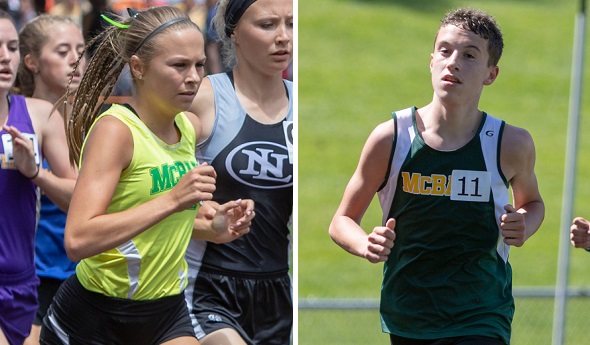
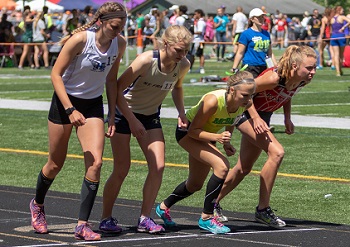
PHOTOS: (Top) The O’Malley twins, Klaudia and Keegan, run their respective events during last season’s Lower Peninsula Division 3 Finals. (Middle) Klaudia O’Malley, second from right, gets ready to start the 800. (Click to see more from RunMichigan.com.)