

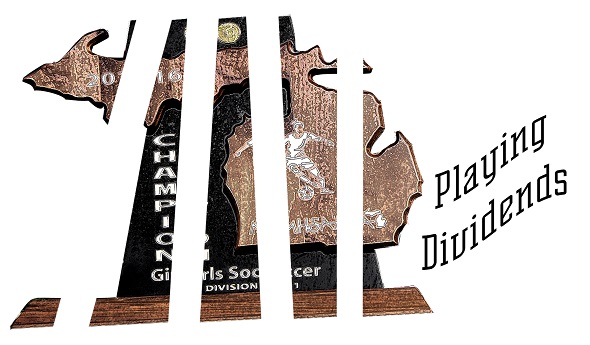
New Math: Division & Multiplication Problems
July 25, 2017
By Jack Roberts
MHSAA Executive Director
This is the second part in a series on MHSAA tournament classification, past and present, that will be published over the next two weeks. This series originally ran in this spring's edition of MHSAA benchmarks.
High school tournament classifications went viral before there was social media and most of us knew what “viral” meant.
Much as a virus infects computers today or has created epidemics of disease around the world for centuries, high school tournament classification – once introduced – tends to spread uncontrollably. Once started, it tends to keep expanding and rarely contracts.
While we are still some distance from providing every team a trophy as a result of expanding high school tournament classification across the country, there is criticism nevertheless that we are headed in that direction – a philosophy which is supposed to exist only in local youth sports for our youngest children.
Michigan could be blamed for all this. Michigan is generally accepted as the first state to provide different classifications for season-ending tournaments for different sized schools. It started a century ago. Today, every state has various classifications for its tournaments in most if not all sports. And it is a bit ironic that Michigan – creator of the classification chaos – more than most other states has kept the number of tournament classes or divisions under control.
Yes, there is evidence that tournament classifications have expanded over the years in Michigan, especially with the relatively recent introduction of tournaments in football and the late 1990s’ move from classes to divisions in most MHSAA tournaments. But the MHSAA Representative Council has held true to its word when it expanded the playoffs for football from four classes to eight divisions: this is needed because of unique factors of football, factors that exist in no other sport; and all other sports should be capped at a maximum of four classes or divisions.
Kentucky is the preeminent defender of single-class basketball. All of its 276 high schools compete for the single state championship for each gender. In Indiana, there are still open wounds from its move in 1998 from one to four classes for its 400 schools in basketball.
Multi-class tournaments have tended to increase the number of non-public school champions, which some states are trying to lower through enrollment “multipliers,” and also tend to increase the number of repeat champions, which some states are trying to affect with “success factors” which lift smaller schools into classifications for larger schools if they take home too many trophies.
While there is considerable evidence that state tournaments do as much bad as good for educational athletics, state associations persist in providing postseason tournaments because, on balance, the experiences are supposed to be good for student-athletes. And once we reach that conclusion it is just a small leap to believe that if the tournaments are good for a few, they must be better for more – which leads to creating more and more tournament classifications. One becomes two classes, then three, then four and so forth.
While the argument is that more classifications or divisions provides more students with opportunities to compete and win, it is undeniable that the experience changes as the number of tournament classifications expands. It is not possible for state associations to provide the same level of support when tournament classifications expand to multiple venues playing simultaneously. For example, there is less audio and video broadcast potential at each venue, and less media coverage to each venue. Focus is diluted and fans diminished at each championship.
No one can argue reasonably that today's two-day MHSAA Football Finals of eight championship games has the same pizazz as the one-day, four-games event conducted prior to 1990.
In some states the number of divisions has grown so much that it is difficult to see much difference between the many season-ending state championship games and a regular-season event in the same sport.
It is a balancing act. And Michigan has been studying that balance longer than any other state, and charting a steadier course than most.
Addition by Division
The shift to Divisions for MHSAA Tournament play in numerous sports has added up to a greater number of champions for teams and individuals across the state. Following are the sports currently employing a divisional format, and the procedures for determining enrollment and classification.
In 23 statewide or Lower Peninsula tournaments, schools which sponsor the sport are currently divided into nearly equal divisions. They are:
- Baseball - 4 Divisions
- Boys Bowling - 4 Divisions
- Girls Bowling - 4 Divisions
- Girls Competitive Cheer - 4 Divisions
- LP Boys Cross Country - 4 Divisions
- LP Girls Cross Country - 4 Divisions
- LP Boys Golf - 4 Divisions
- LP Girls Golf - 4 Divisions
- Ice Hockey - 3 Divisions
- Boys Lacrosse - 2 Divisions
- Girls Lacrosse - 2 Divisions
- Boys Skiing - 2 Divisions
- Girls Skiing - 2 Divisions
- LP Boys Soccer - 4 Divisions LP
- Girls Soccer - 4 Divisions
- Girls Softball - 4 Divisions
- LP Boys Swimming & Diving - 3 Divisions
- LP Girls Swimming & Diving - 3 Divisions
- LP Boys Tennis - 4 Divisions
- LP Girls Tennis - 4 Divisions
- LP Boys Track & Field - 4 Divisions
- LP Girls Track & Field - 4 Divisions
- Wrestling - 4 Divisions
Lists of schools for each division of these 23 tournaments are posted on MHSAA.com approximately April 1. Listings of schools in Upper Peninsula tournaments for their sports are also posted on MHSAA.com. The lists are based on school memberships and sports sponsorships in effect or anticipated for the following school year, as known to the MHSAA office as of a date in early March.
In football, the 256 schools which qualify for MHSAA 11-player playoffs are placed in eight equal divisions annually on Selection Sunday. Beginning in 2017, the 8-player divisions will be determined in a like manner on Selection Sunday as well, with 32 qualifying schools placed in two divisions.
Schools have the option to play in any higher division in one or more sports for a minimum of two years.
The deadlines for "opt-ups" are as follows:
- Applications for fall sports must be submitted by April 15
- Applications for winter sports must be submitted by Aug. 15
- Applications for spring sports must be submitted by Oct. 15
Subsequent to the date of these postings for these tournaments, no school will have its division raised or lowered by schools opening or closing, schools adding or dropping sports, schools exercising the option to play in a higher division, or approval or dissolution of cooperative programs.
When the same sport is conducted for boys and girls in the same season (e.g., track & field and cross country), the gender that has the most sponsoring schools controls the division breaks for both genders.
Jenison Reaches 1,000 Wins & Surging
May 23, 2019
By Dean Holzwarth
Special for Second Half
JENISON – The Jenison softball team wrapped up an Ottawa-Kent Conference Black outright title Tuesday night by sweeping Muskegon Reeths-Puffer.
 The championship shouldn’t come as much of a surprise because the Wildcats have racked up wins at a consistent pace for the past 45 years.
Jenison has experienced another successful campaign thus far, and reached a program milestone earlier in the season.
The Wildcats notched the program’s 1,000th win by beating Zeeland East in mid-April.
Longtime coach Kari Kossen has been a part of several of those victories, as a former player and now in her 19th season at the helm.
“Our players had an idea, and it was told to them at the beginning of the season that it was coming up,” Kossen said. “We really didn’t make it known, but for us coaches and the whole program it was a really cool thing. They knew about it, but not enough to count it down.”
Jenison began as a program in 1974 and emerged as a perennial powerhouse during the late 1980s and mid 1990s.
Under the direction of legendary coach Jerry Hoag, who collected 529 wins from 1981-1999, the Wildcats won six MHSAA Class A titles over a nine-year span.
They’ve appeared in seven Finals, also including a runner-up finish to Okemos in 1999. Only five teams in MHSAA history have played in more.
Jenison stockpiled state crowns with superb pitching and defense, posting five shutouts in its six championship game wins and allowing only one run overall.
Back then, Georgetown Little League opened up a new facility and was the feeder program.
 Kossen, a pitcher who helped the team win back-to-back titles in 1987 and 1988, said pitching guru Ray Sheler had a huge impact in producing a dominant pitching staff.
“He taught the windmill (style),” Kossen said. “Slingshot was well known, but we learned from him and he taught us how to pitch like that and that played a big role in Jenison’s success, just learning how to do the windmill pitching. A lot of other schools didn’t know how to do it back then.”
The Wildcats continue to seek their first Finals appearance since 1999, but have continued to churn out quality players and competitive teams.
A change during the past eight years has been the development of the Wildcat Pride Program, and it has paid dividends on the diamond over the last four.
While various travel teams are abundant throughout the state and include players from different high schools, the Wildcat Pride program is designed to keep girls playing together on the same team in the Jenison community.
“The parent support has really helped with this and has helped make an impact in our success the last two or three years,” Kossen said. “It was something everybody had to buy into eight years ago.
“My sister (Karla Wojtas) and I had a vision to just play together as a community and see if we can learn how to win together, because eventually they’re going to have to do that anyway in high school. We just wanted to come back as a community, and parents have helped coach these teams.”
The idea is to have the girls playing together for several years and creating a bond and trust, much like what occurred in the past.
“We just played so well together because we played together since we were 10 years old,” Kossen said. “In today’s culture girls are playing for different teams, so it feels good to go back to that.”
Former Jenison standout Alexis Hylarides, a 1991 grad and member of the 1990 Class A championship team, said elite coaching in little league with the likes of Ed Kiscorni and Sheler, and then in high school with Hoag, helped catapult the program into a dynasty.
“It starts with good coaching and Ray Sheler took it to a whole other level because without him then they don’t have all those great pitchers,” she said. “The whole goal growing up was to play for Jenison softball because they were the dynamo, and if you played for them then you made it to the big show. It was an honor to play for them, and they don’t make coaches like that anymore.”
 Hylarides wasn’t shocked to learn that the program had surpassed 1,000 wins.
“Not one bit,” she said. “This has been such a strong program for many years.”
Jenison produces elite talent as several girls have gone on to play at various levels in college, but fundamentals are the main focus of the current program.
“We’re scrappy, and we teach fundamentals,” Kossen said. “We do the little things that allow us to be that much better, and we do what we need to do to be in every ball game.”
The Wildcats improved to 30-3 with Tuesday’s wins and earned honorable mention in the latest Division 1 rankings.
Jenison has been led by seniors Evelyn Blood, Addison Hansen and Emily Mouat, juniors Kassidi Hill and Emily Siler and freshman Maria Griffore.
“I think we’ve been playing so well together as a group, and they know their roles,” Kossen said. “I can count on all of them to come in and get a hit when they need to or play good defense. They get along so well and are just fun. They want to win, and they have goals.”
 Dean Holzwarth covered primarily high school sports for the Grand Rapids Press and MLive for 16 years and more recently served as sports editor of the Ionia Sentinel and as a sports photojournalist for WZZM. Contact him at[email protected] with story ideas for Allegan, Kent and Ottawa counties.
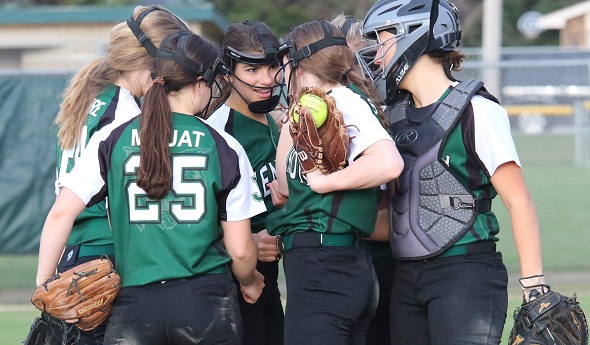
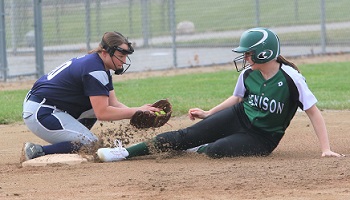
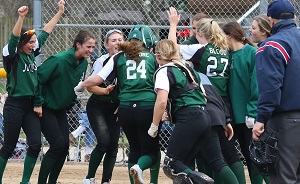
PHOTOS: (Top) Jenison players huddle on the field during a game this season. (Middle) A Jenison base runner slides safely into third base. (Below) The Wildcats welcome a teammate crossing the plate. (Photos courtesy of the Jenison athletic department.)