

New Math: Division & Multiplication Problems
July 25, 2017
By Jack Roberts
MHSAA Executive Director
This is the second part in a series on MHSAA tournament classification, past and present, that will be published over the next two weeks. This series originally ran in this spring's edition of MHSAA benchmarks.
High school tournament classifications went viral before there was social media and most of us knew what “viral” meant.
Much as a virus infects computers today or has created epidemics of disease around the world for centuries, high school tournament classification – once introduced – tends to spread uncontrollably. Once started, it tends to keep expanding and rarely contracts.
While we are still some distance from providing every team a trophy as a result of expanding high school tournament classification across the country, there is criticism nevertheless that we are headed in that direction – a philosophy which is supposed to exist only in local youth sports for our youngest children.
Michigan could be blamed for all this. Michigan is generally accepted as the first state to provide different classifications for season-ending tournaments for different sized schools. It started a century ago. Today, every state has various classifications for its tournaments in most if not all sports. And it is a bit ironic that Michigan – creator of the classification chaos – more than most other states has kept the number of tournament classes or divisions under control.
Yes, there is evidence that tournament classifications have expanded over the years in Michigan, especially with the relatively recent introduction of tournaments in football and the late 1990s’ move from classes to divisions in most MHSAA tournaments. But the MHSAA Representative Council has held true to its word when it expanded the playoffs for football from four classes to eight divisions: this is needed because of unique factors of football, factors that exist in no other sport; and all other sports should be capped at a maximum of four classes or divisions.
Kentucky is the preeminent defender of single-class basketball. All of its 276 high schools compete for the single state championship for each gender. In Indiana, there are still open wounds from its move in 1998 from one to four classes for its 400 schools in basketball.
Multi-class tournaments have tended to increase the number of non-public school champions, which some states are trying to lower through enrollment “multipliers,” and also tend to increase the number of repeat champions, which some states are trying to affect with “success factors” which lift smaller schools into classifications for larger schools if they take home too many trophies.
While there is considerable evidence that state tournaments do as much bad as good for educational athletics, state associations persist in providing postseason tournaments because, on balance, the experiences are supposed to be good for student-athletes. And once we reach that conclusion it is just a small leap to believe that if the tournaments are good for a few, they must be better for more – which leads to creating more and more tournament classifications. One becomes two classes, then three, then four and so forth.
While the argument is that more classifications or divisions provides more students with opportunities to compete and win, it is undeniable that the experience changes as the number of tournament classifications expands. It is not possible for state associations to provide the same level of support when tournament classifications expand to multiple venues playing simultaneously. For example, there is less audio and video broadcast potential at each venue, and less media coverage to each venue. Focus is diluted and fans diminished at each championship.
No one can argue reasonably that today's two-day MHSAA Football Finals of eight championship games has the same pizazz as the one-day, four-games event conducted prior to 1990.
In some states the number of divisions has grown so much that it is difficult to see much difference between the many season-ending state championship games and a regular-season event in the same sport.
It is a balancing act. And Michigan has been studying that balance longer than any other state, and charting a steadier course than most.
Addition by Division
The shift to Divisions for MHSAA Tournament play in numerous sports has added up to a greater number of champions for teams and individuals across the state. Following are the sports currently employing a divisional format, and the procedures for determining enrollment and classification.
In 23 statewide or Lower Peninsula tournaments, schools which sponsor the sport are currently divided into nearly equal divisions. They are:
- Baseball - 4 Divisions
- Boys Bowling - 4 Divisions
- Girls Bowling - 4 Divisions
- Girls Competitive Cheer - 4 Divisions
- LP Boys Cross Country - 4 Divisions
- LP Girls Cross Country - 4 Divisions
- LP Boys Golf - 4 Divisions
- LP Girls Golf - 4 Divisions
- Ice Hockey - 3 Divisions
- Boys Lacrosse - 2 Divisions
- Girls Lacrosse - 2 Divisions
- Boys Skiing - 2 Divisions
- Girls Skiing - 2 Divisions
- LP Boys Soccer - 4 Divisions LP
- Girls Soccer - 4 Divisions
- Girls Softball - 4 Divisions
- LP Boys Swimming & Diving - 3 Divisions
- LP Girls Swimming & Diving - 3 Divisions
- LP Boys Tennis - 4 Divisions
- LP Girls Tennis - 4 Divisions
- LP Boys Track & Field - 4 Divisions
- LP Girls Track & Field - 4 Divisions
- Wrestling - 4 Divisions
Lists of schools for each division of these 23 tournaments are posted on MHSAA.com approximately April 1. Listings of schools in Upper Peninsula tournaments for their sports are also posted on MHSAA.com. The lists are based on school memberships and sports sponsorships in effect or anticipated for the following school year, as known to the MHSAA office as of a date in early March.
In football, the 256 schools which qualify for MHSAA 11-player playoffs are placed in eight equal divisions annually on Selection Sunday. Beginning in 2017, the 8-player divisions will be determined in a like manner on Selection Sunday as well, with 32 qualifying schools placed in two divisions.
Schools have the option to play in any higher division in one or more sports for a minimum of two years.
The deadlines for "opt-ups" are as follows:
- Applications for fall sports must be submitted by April 15
- Applications for winter sports must be submitted by Aug. 15
- Applications for spring sports must be submitted by Oct. 15
Subsequent to the date of these postings for these tournaments, no school will have its division raised or lowered by schools opening or closing, schools adding or dropping sports, schools exercising the option to play in a higher division, or approval or dissolution of cooperative programs.
When the same sport is conducted for boys and girls in the same season (e.g., track & field and cross country), the gender that has the most sponsoring schools controls the division breaks for both genders.
Bollman Cousins Making Plenty of Noise as 'Wrecking Balls' for Surging Big Rapids
By
Tom Kendra
Special for MHSAA.com
October 9, 2025
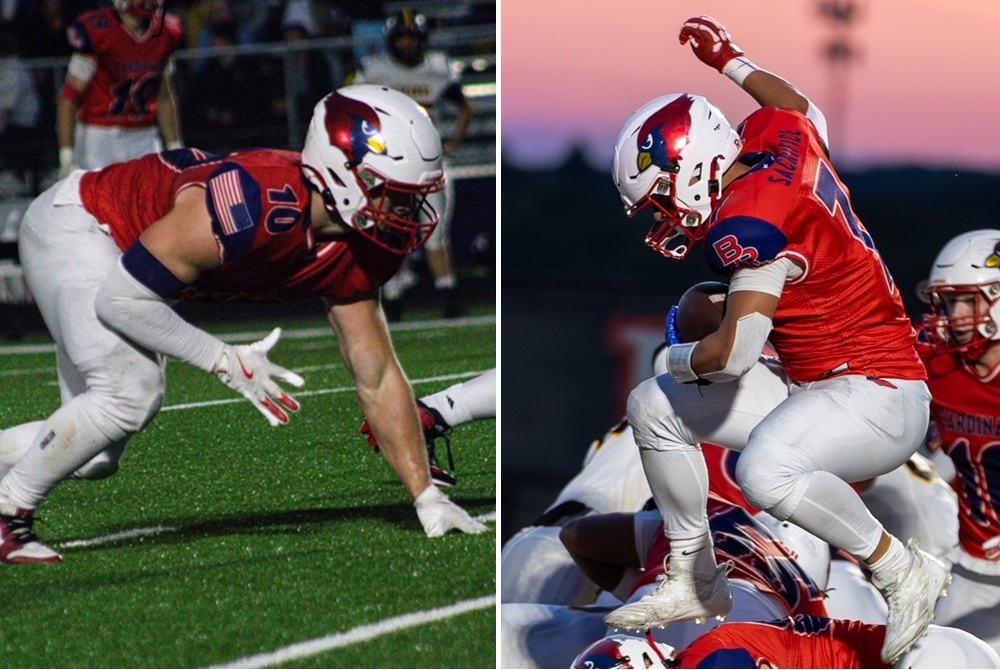
BIG RAPIDS – On Friday nights, the Bollman boys are always in the middle of the action, bringing the muscle and the fight and the power to the Big Rapids football team.
 But for the rest of the weekend, senior Jack Bollman and his first cousin, junior Max Bollman, are happiest when they are able to get away from it all at their family’s deer hunting ranch in nearby Canadian Lakes – appropriately named “The Sanctuary.”
“I just love being out there,” said Jack, a four-year starting running back for the Cardinals. “Our whole family works out there, and it’s just a great environment. It’s our second home, out in nature.”
The Bollmans haven’t spent much time at The Sanctuary lately, as they are laser-focused on what is becoming a special season for Big Rapids (6-0), which earned honorable mention in the latest Division 4 state rankings and heading into Friday’s game at Grant.
The Cardinals are known for their triple-option veer offense, operating out of the shotgun and often with four wideouts. But if the defense gets spread out too thin, the Bollmans will make it pay.
“Jack and I, we look at it as our job to bring the physicality on every play,” said Max, a 6-foot-1, 235-pound defensive end who also plays tight end, primarily in short-yardage and goal-line situations. “We want to be a problem for the other team. Other teams know that we can pass, but we can run over you, too.”
 The Bollmans are part of a golden era of Big Rapids football under 11th-year coach Mike Selzer. The Cardinals – who were 7-3 in 2022, 10-2 and Regional finalists in 2023 and 9-2 last season – are hoping to take a couple more steps this fall with a senior-laden roster.
“We have so much experience this year that our practices are not learning things, but just fine-tuning and adjusting,” said Selzer, who starts 10 seniors on offense and nine on defense. “That experience makes it much easier to make adjustments on the fly during games.”
Big Rapids has overwhelmed its first six opponents, with the closest game a 19-7 win at Paw Paw in the opener. The big Central States Athletic Association Red showdown against Reed City on Sept. 26 turned into a one-sided 40-13 win.
Senior quarterback Cole Haist has completed 59-of-90 passes for 947 yards and 11 touchdowns, and rushed for 249 yards and a team-high nine touchdowns. He throws the ball to a plethora of receivers on the edge, notably seniors Trenton Mossel, Owen Craven, Kurt Wilber and Wyatt Skiera.
But when it comes to short-yardage situations, Max Bollman will check in as a tight end and often lead the way for his cousin, Jack, who is the team’s leading rusher with 56 carries for 429 yards, an average of 7.7 per carry, and six touchdowns.
Big Rapids is looking forward to a big game Week 8 at perennial Division 3 playoff team Coopersville, before pursuing its ultimate goal of a Division 4 championship.
The Cardinals appear to be on a collision course with familiar rival Ludington, which is also unbeaten and features a senior-heavy team led by senior quarterback Cam Gunsell. Big Rapids nipped Ludington, 28-21, in last year’s playoff opener.
In preparation for this postseason, Selzer is working on team-building every Tuesday to try and give his a little edge. This past Tuesday, he brought in Saginaw Valley State assistant coach Jeremy Prudhomme for some trust and team bonding exercises.
“We’ve been climbing every year, and now we want to take those final steps,” said Haist, a three-sport athlete who is in his second year as the team’s starting quarterback. “We have the talent and the ability to go farther. Now we are working on that belief to know we can do it.”
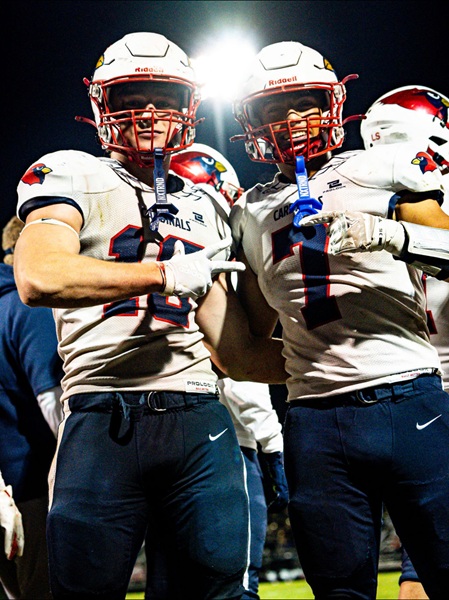
 One bond that is already unbreakable is between the Bollman boys, who have grown up together and played football together since they were little kids.
The duo is especially lethal on defense, as the leaders of a group that has allowed only 33 points all season – fewer than six per game.
Max Bollman, a third-year starter as a junior who already has a Division I college offer from Central Michigan, is the leader of that unit from his edge position, with 24 tackles, five tackles for loss and three sacks. Jack Bollman (5-11, 215) has 14 tackles from his linebacker spot, including four for loss and one sack.
“Max is an off-the-charts kid in terms of strength, and he demands a lot of attention – but he has a motor unlike any kid I have ever coached,” said Selzer, a Wayland native who coached for 11 years at Potterville before taking the Big Rapids job in 2015.
Jonathan Losinski, a senior middle linebacker, is the team’s leading tackler with 26 stops, while Bryce Selzer and Austin Brandt both have 18 tackles.
But the emotional leaders of the Cardinals’ defense are the Bollmans, who are double trouble for every opponent.
“We have a bond, that’s for sure,” said Jack, who is hoping to play college football next year. “We want to be dangerous and blow up plays. Other teams have told us after the game that it’s unbearable to try and block us both on the same play.
“I would say we are like two giant wrecking balls out there, plowing things over.”
 Tom Kendra worked 23 years at The Muskegon Chronicle, including five as assistant sports editor and the final six as sports editor through 2011. E-mail him at [email protected] with story ideas for Muskegon, Oceana, Mason, Lake, Oceola, Mecosta and Newaygo counties.
PHOTOS (Top) At left, Max Bollman lines up from at defensive end, while at right, Jack Bollman finds his way into the end zone against Howard City Tri County. (Middle) Junior Max Bollman (10) and his cousin, senior Jack Bollman (7). (Below) Mike Selzer is in his 11th year as head coach at Big Rapids. (Photos provided by the Big Rapids football program.)