

New Math: Division & Multiplication Problems
July 25, 2017
By Jack Roberts
MHSAA Executive Director
This is the second part in a series on MHSAA tournament classification, past and present, that will be published over the next two weeks. This series originally ran in this spring's edition of MHSAA benchmarks.
High school tournament classifications went viral before there was social media and most of us knew what “viral” meant.
Much as a virus infects computers today or has created epidemics of disease around the world for centuries, high school tournament classification – once introduced – tends to spread uncontrollably. Once started, it tends to keep expanding and rarely contracts.
While we are still some distance from providing every team a trophy as a result of expanding high school tournament classification across the country, there is criticism nevertheless that we are headed in that direction – a philosophy which is supposed to exist only in local youth sports for our youngest children.
Michigan could be blamed for all this. Michigan is generally accepted as the first state to provide different classifications for season-ending tournaments for different sized schools. It started a century ago. Today, every state has various classifications for its tournaments in most if not all sports. And it is a bit ironic that Michigan – creator of the classification chaos – more than most other states has kept the number of tournament classes or divisions under control.
Yes, there is evidence that tournament classifications have expanded over the years in Michigan, especially with the relatively recent introduction of tournaments in football and the late 1990s’ move from classes to divisions in most MHSAA tournaments. But the MHSAA Representative Council has held true to its word when it expanded the playoffs for football from four classes to eight divisions: this is needed because of unique factors of football, factors that exist in no other sport; and all other sports should be capped at a maximum of four classes or divisions.
Kentucky is the preeminent defender of single-class basketball. All of its 276 high schools compete for the single state championship for each gender. In Indiana, there are still open wounds from its move in 1998 from one to four classes for its 400 schools in basketball.
Multi-class tournaments have tended to increase the number of non-public school champions, which some states are trying to lower through enrollment “multipliers,” and also tend to increase the number of repeat champions, which some states are trying to affect with “success factors” which lift smaller schools into classifications for larger schools if they take home too many trophies.
While there is considerable evidence that state tournaments do as much bad as good for educational athletics, state associations persist in providing postseason tournaments because, on balance, the experiences are supposed to be good for student-athletes. And once we reach that conclusion it is just a small leap to believe that if the tournaments are good for a few, they must be better for more – which leads to creating more and more tournament classifications. One becomes two classes, then three, then four and so forth.
While the argument is that more classifications or divisions provides more students with opportunities to compete and win, it is undeniable that the experience changes as the number of tournament classifications expands. It is not possible for state associations to provide the same level of support when tournament classifications expand to multiple venues playing simultaneously. For example, there is less audio and video broadcast potential at each venue, and less media coverage to each venue. Focus is diluted and fans diminished at each championship.
No one can argue reasonably that today's two-day MHSAA Football Finals of eight championship games has the same pizazz as the one-day, four-games event conducted prior to 1990.
In some states the number of divisions has grown so much that it is difficult to see much difference between the many season-ending state championship games and a regular-season event in the same sport.
It is a balancing act. And Michigan has been studying that balance longer than any other state, and charting a steadier course than most.
Addition by Division
The shift to Divisions for MHSAA Tournament play in numerous sports has added up to a greater number of champions for teams and individuals across the state. Following are the sports currently employing a divisional format, and the procedures for determining enrollment and classification.
In 23 statewide or Lower Peninsula tournaments, schools which sponsor the sport are currently divided into nearly equal divisions. They are:
- Baseball - 4 Divisions
- Boys Bowling - 4 Divisions
- Girls Bowling - 4 Divisions
- Girls Competitive Cheer - 4 Divisions
- LP Boys Cross Country - 4 Divisions
- LP Girls Cross Country - 4 Divisions
- LP Boys Golf - 4 Divisions
- LP Girls Golf - 4 Divisions
- Ice Hockey - 3 Divisions
- Boys Lacrosse - 2 Divisions
- Girls Lacrosse - 2 Divisions
- Boys Skiing - 2 Divisions
- Girls Skiing - 2 Divisions
- LP Boys Soccer - 4 Divisions LP
- Girls Soccer - 4 Divisions
- Girls Softball - 4 Divisions
- LP Boys Swimming & Diving - 3 Divisions
- LP Girls Swimming & Diving - 3 Divisions
- LP Boys Tennis - 4 Divisions
- LP Girls Tennis - 4 Divisions
- LP Boys Track & Field - 4 Divisions
- LP Girls Track & Field - 4 Divisions
- Wrestling - 4 Divisions
Lists of schools for each division of these 23 tournaments are posted on MHSAA.com approximately April 1. Listings of schools in Upper Peninsula tournaments for their sports are also posted on MHSAA.com. The lists are based on school memberships and sports sponsorships in effect or anticipated for the following school year, as known to the MHSAA office as of a date in early March.
In football, the 256 schools which qualify for MHSAA 11-player playoffs are placed in eight equal divisions annually on Selection Sunday. Beginning in 2017, the 8-player divisions will be determined in a like manner on Selection Sunday as well, with 32 qualifying schools placed in two divisions.
Schools have the option to play in any higher division in one or more sports for a minimum of two years.
The deadlines for "opt-ups" are as follows:
- Applications for fall sports must be submitted by April 15
- Applications for winter sports must be submitted by Aug. 15
- Applications for spring sports must be submitted by Oct. 15
Subsequent to the date of these postings for these tournaments, no school will have its division raised or lowered by schools opening or closing, schools adding or dropping sports, schools exercising the option to play in a higher division, or approval or dissolution of cooperative programs.
When the same sport is conducted for boys and girls in the same season (e.g., track & field and cross country), the gender that has the most sponsoring schools controls the division breaks for both genders.

'Who Will Cheer for the Nimrods?' Peterson IV, Watersmeet Found Fans Worldwide
By
Jason Juno
Special for MHSAA.com
July 15, 2025
WATERSMEET — George Peterson IV talks to a lot of people through his job as a police officer in the Green Bay, Wis., area. When some of those folks are headed up north for the weekend, he tells them he’s from the Upper Peninsula.
 Many are expecting to hear about one of the bigger towns located a couple of hours drive from Green Bay, like Iron Mountain or Escanaba. But they usually know his hometown, too.
“There’s more people than I would have thought know exactly – ‘Oh Watersmeet, the Nimrods,’” Peterson said.
Some surely know the tiny town because it’s not light years away from Green Bay – only about three hours. But Watersmeet’s dot on the map got a little bigger when Peterson was in school two decades ago, thanks to a run of media exposure that all started with an ESPN commercial that wondered: Without sports, who would cheer for the Nimrods?
Peterson and his teammates can look back on a high school sports experience unlike pretty much anyone else’s, which included the popular ESPN commercial, an appearance on “The Tonight Show” with Jay Leno, and an eight-part miniseries and media exposure from print and television outlets throughout the country. All because of their quirky nickname that has come to be an insult but was chosen because the biblical figure Nimrod was a mighty hunter, and hunting is a big deal in the U.P.
That era also coincided with the best basketball Watersmeet has ever seen. The 2004-05 team, with Peterson was a junior, won its only MHSAA Regional championship and only U.P. small-school team of the year award.
“Great memories from that year,” Peterson said.
The first moments he mentions from his time in high school sports as a aren’t of going to Hollywood – although that certainly came up later – or of being on ESPN. He instead recalled the camaraderie with his teammates, the bus rides, and proving people wrong even in elementary school that Watersmeet could be good.
“The Watersmeet Nimrods weren't supposed to be good,” he said. “We weren’t supposed to win elementary tournaments; we were supposed to fall apart.”
They definitely didn’t do that, as one of the smallest high schools in the state enjoyed instead an unforgettable three-year run.
The cameras first showed up when Peterson was a sophomore. ESPN staff came to get footage early that season, during a December 2003 game against rival Bessemer. The cameras didn’t faze the Nimrods, who upset the rival Speedboys that night; Peterson remembers Bessemer putting 100 on them later that season.
No one told the Nimrods when the commercials were going to air. Then one came on one night when Peterson was watching ESPN.
“That was really cool, just little surprises you weren’t expecting,” Peterson said.
Watersmeet was featured in major newspapers, “CBS Sunday Morning” came to town, and Nimrods merchandise flew off the shelves.
They were even on “The Tonight Show.”
“I would say Jay Leno was probably the coolest experience,” Peterson said. “A small-town kid from Watersmeet, all of us that went, getting treated like we were important, something that a lot of people don’t get to experience. They flew us out, we had limos, we had a hotel right down the road – I think it was a Hilton.”
After the national attention died down during their very successful 2004-05 year – which included the run to the Class D Quarterfinals – the cameras were back for Peterson’s senior year. This time it was the Sundance Channel for an eight-part miniseries about life in his team’s small town.
Those cameras were around that entire season. But if something came up along the way – and it did – the team could just ask the filmmakers to go away while they hashed it out privately. Peterson said they didn’t pressure him to do anything, and the staff members were great to he and his teammates, while doing what they could to make them feel comfortable.
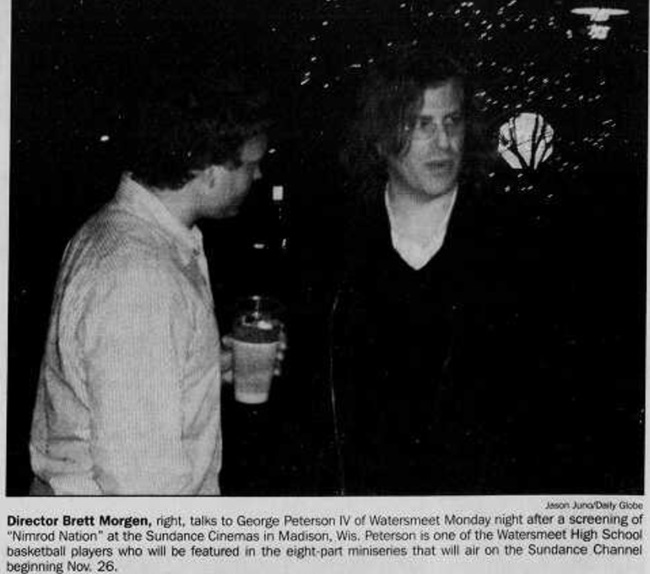
The buzz for the miniseries wasn’t quite the same as for the commercials. But Peterson enjoyed going to a screening ahead of its debut in Madison, Wis. And he can look back on scenes with his late grandfather.
“Now I can show my kids when they get older,” he said.
The basketball part of Peterson’s high school days was a pretty big deal as well.
Growing up, Peterson’s dad George Peterson III took him to the Regionals in Marquette each year. Rooting for area teams like Ewen-Trout Creek kept the fire going.
“I’d go back home, I’d shoot hoops and play ball,” Peterson IV said.
As he and his teammates entered in high school, the Nimrods finished well under .500 his freshman year. The next year, they flipped their regular-season record to 14-6, which included the early season upset of rival Bessemer with ESPN’s cameras recording commercial material.
“And then we were kind of like, ‘OK, we got something here,’” Peterson said.
They went to Michigan Tech’s basketball camp the following summer and won pretty much every game, including against the U.P.’s big schools like Marquette and Iron Mountain.
 The Nimrods also won constantly early in the 2004-05 season – until Baraga gave them another piece of humble pie. But that proved to be a quick bump in the road. They won their District tournament at home and then both Regional games by double figures.
Watersmeet then lost a heartbreaker in overtime in the Quarterfinal against Posen, but it didn’t diminish what they had accomplished.
For Peterson, he got to do it with his dad coaching, his brother Jordan playing with him and the whole community cheering for them. He still remembers the bus ride home and the reception they got going through Bruce Crossing, part of the E-TC school district.
“We got to experience something we never got to experience before,” Peterson said. “That was probably one of, if not my favorite, moments from my junior year.”
He learned a lot of lessons from that time in his life — just from playing sports but also from playing for his dad and with the kind of spotlight most small-school athletes don’t see.
“Being an athlete and working in law enforcement, a lot of the lessons learned go hand-in-hand with my profession, because you have to be teachable, you have to be coachable and you have to take the losses,” Peterson said. “Obviously in sports, every time you step foot on the court, we didn’t win. There’s some things in life that you don’t get what you want, but you just learn you gotta work harder for it and strive to be better. That helps me in my profession.”
His dad, who recently retired from coaching boys basketball after walking the sideline for more than three decades, taught his son many things like humility, how to be respectful, patience, and how to respond when things don’t work out.
“That doesn’t mean the door’s closed; you just gotta find a whole different way to get what you want,” Peterson IV said. “I remind myself of that every day when I’m at work.”
As for being in the spotlight, he took valuable lessons from that as well.
“It’s helped me learn to take a step back and not get too excited about certain things,” he said. “Like when I’m around a crowd or when I have stuff going on, like board meetings, or we just have a crowd where people could be mad or people could be in support. It’s helped me to learn to take a step back and mentally just prepare, take that deep breath and everything seems to run smooth.”
2025 Made In Michigan
July 10: Feeding 'Drive to Win,' Loy Norrix Grad Morgan Impresses with Strong USBC Showing - Report
July 9: After Blazing Multiple Volleyball Trails, Bastianelli Charting Next Career Path - Report
PHOTOS (Top) At left, George Peterson IV (12) puts up a jumper playing for Watersmeet in 2004. At right, Peterson holds his son George V while pictured with wife Elise and daughter Braelynn. (Middle) This Ironwood Daily Globe photo from 2007 shows Peterson talking with “Nimrod Nation” director Brett Morgan. (Past photos by Jason Juno; current photos courtesy of the Peterson family.)