

New Math: Division & Multiplication Problems
July 25, 2017
By Jack Roberts
MHSAA Executive Director
This is the second part in a series on MHSAA tournament classification, past and present, that will be published over the next two weeks. This series originally ran in this spring's edition of MHSAA benchmarks.
High school tournament classifications went viral before there was social media and most of us knew what “viral” meant.
Much as a virus infects computers today or has created epidemics of disease around the world for centuries, high school tournament classification – once introduced – tends to spread uncontrollably. Once started, it tends to keep expanding and rarely contracts.
While we are still some distance from providing every team a trophy as a result of expanding high school tournament classification across the country, there is criticism nevertheless that we are headed in that direction – a philosophy which is supposed to exist only in local youth sports for our youngest children.
Michigan could be blamed for all this. Michigan is generally accepted as the first state to provide different classifications for season-ending tournaments for different sized schools. It started a century ago. Today, every state has various classifications for its tournaments in most if not all sports. And it is a bit ironic that Michigan – creator of the classification chaos – more than most other states has kept the number of tournament classes or divisions under control.
Yes, there is evidence that tournament classifications have expanded over the years in Michigan, especially with the relatively recent introduction of tournaments in football and the late 1990s’ move from classes to divisions in most MHSAA tournaments. But the MHSAA Representative Council has held true to its word when it expanded the playoffs for football from four classes to eight divisions: this is needed because of unique factors of football, factors that exist in no other sport; and all other sports should be capped at a maximum of four classes or divisions.
Kentucky is the preeminent defender of single-class basketball. All of its 276 high schools compete for the single state championship for each gender. In Indiana, there are still open wounds from its move in 1998 from one to four classes for its 400 schools in basketball.
Multi-class tournaments have tended to increase the number of non-public school champions, which some states are trying to lower through enrollment “multipliers,” and also tend to increase the number of repeat champions, which some states are trying to affect with “success factors” which lift smaller schools into classifications for larger schools if they take home too many trophies.
While there is considerable evidence that state tournaments do as much bad as good for educational athletics, state associations persist in providing postseason tournaments because, on balance, the experiences are supposed to be good for student-athletes. And once we reach that conclusion it is just a small leap to believe that if the tournaments are good for a few, they must be better for more – which leads to creating more and more tournament classifications. One becomes two classes, then three, then four and so forth.
While the argument is that more classifications or divisions provides more students with opportunities to compete and win, it is undeniable that the experience changes as the number of tournament classifications expands. It is not possible for state associations to provide the same level of support when tournament classifications expand to multiple venues playing simultaneously. For example, there is less audio and video broadcast potential at each venue, and less media coverage to each venue. Focus is diluted and fans diminished at each championship.
No one can argue reasonably that today's two-day MHSAA Football Finals of eight championship games has the same pizazz as the one-day, four-games event conducted prior to 1990.
In some states the number of divisions has grown so much that it is difficult to see much difference between the many season-ending state championship games and a regular-season event in the same sport.
It is a balancing act. And Michigan has been studying that balance longer than any other state, and charting a steadier course than most.
Addition by Division
The shift to Divisions for MHSAA Tournament play in numerous sports has added up to a greater number of champions for teams and individuals across the state. Following are the sports currently employing a divisional format, and the procedures for determining enrollment and classification.
In 23 statewide or Lower Peninsula tournaments, schools which sponsor the sport are currently divided into nearly equal divisions. They are:
- Baseball - 4 Divisions
- Boys Bowling - 4 Divisions
- Girls Bowling - 4 Divisions
- Girls Competitive Cheer - 4 Divisions
- LP Boys Cross Country - 4 Divisions
- LP Girls Cross Country - 4 Divisions
- LP Boys Golf - 4 Divisions
- LP Girls Golf - 4 Divisions
- Ice Hockey - 3 Divisions
- Boys Lacrosse - 2 Divisions
- Girls Lacrosse - 2 Divisions
- Boys Skiing - 2 Divisions
- Girls Skiing - 2 Divisions
- LP Boys Soccer - 4 Divisions LP
- Girls Soccer - 4 Divisions
- Girls Softball - 4 Divisions
- LP Boys Swimming & Diving - 3 Divisions
- LP Girls Swimming & Diving - 3 Divisions
- LP Boys Tennis - 4 Divisions
- LP Girls Tennis - 4 Divisions
- LP Boys Track & Field - 4 Divisions
- LP Girls Track & Field - 4 Divisions
- Wrestling - 4 Divisions
Lists of schools for each division of these 23 tournaments are posted on MHSAA.com approximately April 1. Listings of schools in Upper Peninsula tournaments for their sports are also posted on MHSAA.com. The lists are based on school memberships and sports sponsorships in effect or anticipated for the following school year, as known to the MHSAA office as of a date in early March.
In football, the 256 schools which qualify for MHSAA 11-player playoffs are placed in eight equal divisions annually on Selection Sunday. Beginning in 2017, the 8-player divisions will be determined in a like manner on Selection Sunday as well, with 32 qualifying schools placed in two divisions.
Schools have the option to play in any higher division in one or more sports for a minimum of two years.
The deadlines for "opt-ups" are as follows:
- Applications for fall sports must be submitted by April 15
- Applications for winter sports must be submitted by Aug. 15
- Applications for spring sports must be submitted by Oct. 15
Subsequent to the date of these postings for these tournaments, no school will have its division raised or lowered by schools opening or closing, schools adding or dropping sports, schools exercising the option to play in a higher division, or approval or dissolution of cooperative programs.
When the same sport is conducted for boys and girls in the same season (e.g., track & field and cross country), the gender that has the most sponsoring schools controls the division breaks for both genders.
Carefelle Twins Bring 'High School Musical' to Life Starring on Field, Stage
By
Tom Kendra
Special for MHSAA.com
May 27, 2025
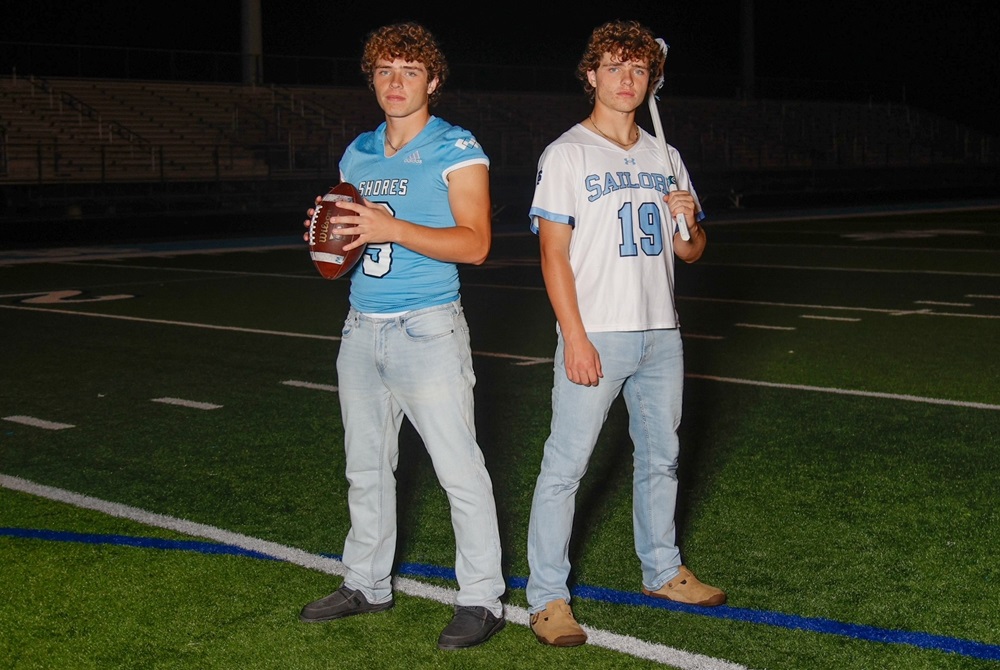
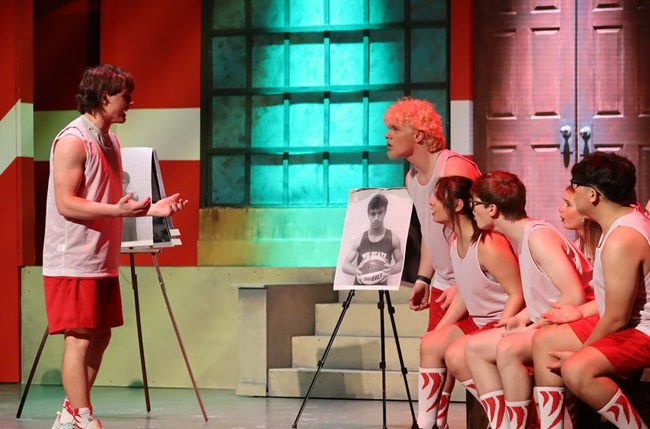
It’s appropriate that seniors Ezra and Micah Carefelle played two of the lead roles in the Muskegon Mona Shores production of “High School Musical” this spring.
 The show, in essence, is the story of their lives.
Ezra, the leading scorer on the red-hot Mona Shores boys lacrosse team and kicker on the football team, played the lead role of Troy Bolton.
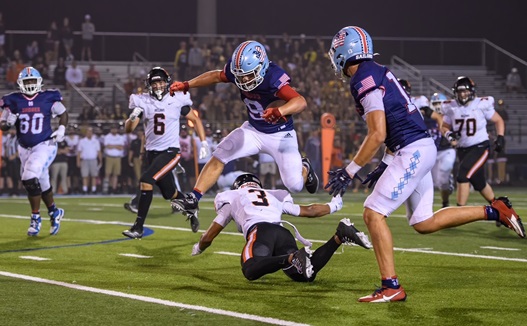
Micah, an all-area receiver on the Sailors’ football team and star face-off man in lacrosse, played Chad Danforth, Troy’s best friend and sports teammate.
“Their lives are the actual script of High School Musical,” said Molly Lawton, the longtime director of the Mona Shores spring production. “It’s not often that you get two athletic guys who can sing and dance – and aren’t afraid to do it.”
Fear is not a word in the extensive vocabulary of the Carefelle boys, who are now playing a leading role for the Sailors’ lacrosse team, which is 17-3 and riding a 12-game winning streak heading into Wednesday’s 6 p.m. showdown at Rockford (14-2) for a Division 1 Regional championship. Rockford was seeded first and Mona Shores second in the bracket.
The Sailors actually lost their first two matches of the season, but a big reason for that was because the Carefelles did not play, as those games fell at the same time as “High School Musical” performances.
With the high-energy, highly-skilled Carefelle twins in the lineup, Shores has won 17 of its last 18 games.
“Other coaches often tell me that we out-worked them or out-toughed them, and it all starts with Ezra and Micah,” said first-year Shores boys lacrosse coach Adam Zarotney. “They are very skilled, but what sets them apart is that they always give 100-percent effort, 100 percent of the time.”
Keep your head in the game
Much like the musical, the Carefelles spent a good deal of this spring racing back-and-forth between lacrosse practices and theater rehearsals.
“There were a couple of rehearsals where we literally sprinted from lacrosse and were completely drenched in sweat,” Micah said.
And it worked the other way around, as well.
 “I literally did my final audition for the play with my eye black on, because I had to get to lacrosse,” said Ezra with a laugh.
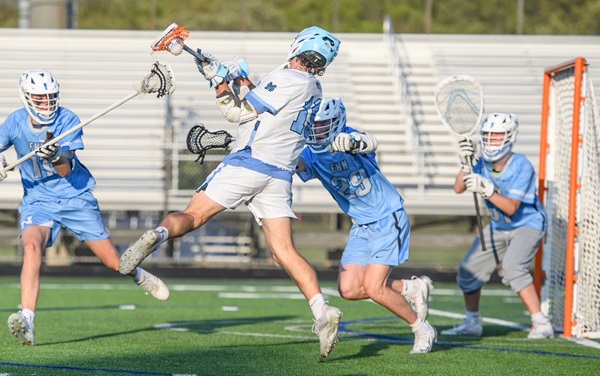
Ezra, who his coach said “has the ability to score from anywhere at any time against anybody,” leads the team with 66 goals and 44 assists for 110 points. Ezra is 5-foot-10 and 190 pounds, slightly smaller than his brother.
Micah does not have nearly as many points, with 20 goals and 19 assists for 39, but he makes his biggest contribution on face-offs. He has won 141 of his 237 face-offs (59 percent) on the season.
“When we need a goal, we have an offensive series where we just get out of their way and let them go,” said Zarotney, who is assisted by Curtis Pek and Chad Burton. “They can get to the middle of the field and do things that other kids can’t.”
While Zarotney would love for them to “leave it all on the field” (as coaches often say), Lawton wants her lead performers to save some of their boundless energy for the stage.
Lawton marveled at the way the twins were able to shift gears, immediately and seamlessly, and knock out their performances every time.
The biggest problem she had was that they looked too much alike on the stage. So, Ezra straightened his hair and Micah bleached his, added a little goatee and, voila, the twins became Troy and Chad.
“The word I would use to describe it is magical,” said Lawton, called the Carefelles two of the most polite gentlemen with whom she’s worked. “They are both very smart and memorized their lines long before I required it. The chemistry between them on stage is really something special.”
Beating the odds
Ezra and Micah both love their unique, Biblical names, which are fitting given the importance of faith to the Carefelle family.
Ezra means “helper,” while Micah means “like God,” and their mother, Tracy, insists that it was a miracle that the boys were born healthy.
Tracy and her husband, Adam, visited a specialist shortly after learning they were having twins. After the ultrasound, the doctor gave them sobering news: Because they were mono-amniotic (sharing the same “bag of waters”), he said there was only a 50-percent chance of survival.
 Tracy started going for an ultrasound every week and expected to have to give birth very prematurely by C-section, until an amazing, incredible – perhaps miraculous – event was discovered during the 28-week ultrasound.
“That ultrasound showed that each of them was now in their own sac,” said Tracy. “The doctor told us he had never seen a membrane form that late in a pregnancy.”
As a result, Tracy was able to go nearly to full term, delivering Ezra (6 pounds, 8 ounces) and then Micah (6 pounds, 4 ounces) by natural birth. They are considered mirror-image twins, which helps explain why Micah is right-handed and Ezra is left-handed, and why their hair naturally parts on different sides of their heads.
Micah and Ezra also have an older sister, Lydia (a 2024 Mona Shores graduate), and three younger sisters – Chloe (eighth grade), Selah (seventh grade) and Ava (kindergarten).
The Carefelles developed their singing voices and acting abilities growing up in the church choir. Ezra actually sang the national anthem at most of the Sailors’ home lacrosse matches this season, running up to the press box to sing into the headset and then running back down the bleachers to start the game.
Both will attend Hope College next year. Micah will play football and major in exercise science, with a goal of working as a chiropractor or in physical therapy. Ezra will play lacrosse and major in secondary education, with plans to become a high school teacher and coach.
“Our faith really energizes us and gives us confidence in everything we do,” said Ezra, who carries a 3.98 GPA, while Micah is right behind at 3.89. “We have learned to rely on our faith to get us through hard times and struggles.”
Start of something new
Ezra is extremely competitive but admits he’s almost subdued compared to his brother.
Micah’s feistiness and intensity are great things most of the time, but sometimes get the better of him – which was the case during last week’s Regional Semifinal win over Hudsonville, when he was ejected after leaving the sideline to defend a teammate during a tense moment on the field. Because of the ejection, he also must miss Wednesday’s game against the Rams.
 Zarotney points to his team’s depth and the fact many attackers have contributed to the team’s success, notably senior Conner Osterhart (a Hope College commit), junior Cullen Conrad and freshmen Jack Carlson and Payton Koziak.
The young defensive group also has improved steadily throughout the season, led by junior George Duggins and freshman Owen Terpstra.
But perhaps the hottest player on the team down the stretch has been senior goalie Ben Warren, who has saved 59 percent of shots on goal with a 79-percent clearing percentage.
“The whole team is playing with a lot of confidence right now,” said Zarotney. “These kids really play for each other. At the end of the day, I really think that separates us from other teams.”
If the Sailors prevail Wednesday, they will advance to Friday’s Division 1 Quarterfinals – which would be a great thing, but also create a big problem.
The Carefelles are scheduled to go on the choir’s season-ending trip to New York City this weekend, leaving Thursday night. While they were able to juggle lacrosse and theater all season, this weekend those two opportunities would be almost 800 miles apart.
“That would be a tough one,” Ezra admitted.
Historically, when you tell Ezra and Micah they can’t do something, they do it. So perhaps they will come up with something (i.e., fly out separately right after their lacrosse match and meet up with the choir group in NYC) to allow them to do both.
Sounds preposterous, but don’t put anything past the Carefelle boys.
 Tom Kendra worked 23 years at The Muskegon Chronicle, including five as assistant sports editor and the final six as sports editor through 2011. E-mail him at [email protected] with story ideas for Muskegon, Oceana, Mason, Lake, Oceola, Mecosta and Newaygo counties.
PHOTOS (Top) Micah Carefelle, left in his football jersey, and twin brother Ezra, right in his lacrosse jersey, pose for a photo at Sailor Stadium. (2) Ezra Carefelle, left, plays Troy Bolden, and Micah, right with dyed hair, plays Chad Danforth in the Mona Shores production of “High School Musical” in March. (3) Ezra Carefelle attacks during a recent lacrosse match. (4) Micah Carefelle hurdles a defender during a football game against Byron Center last fall. (Top photo by Joe Lane. Theater photo by Neeve Callaghan. Lacrosse/football action photos by Eric Sturr.)