

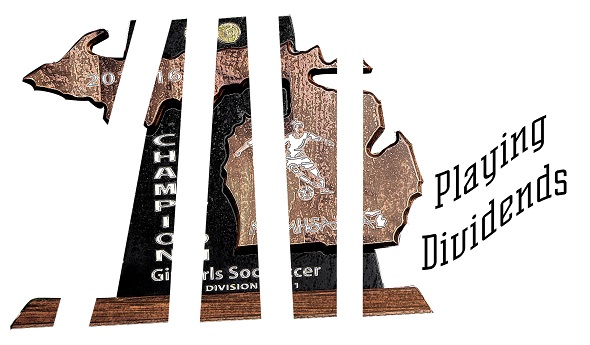
New Math: Division & Multiplication Problems
July 25, 2017
By Jack Roberts
MHSAA Executive Director
This is the second part in a series on MHSAA tournament classification, past and present, that will be published over the next two weeks. This series originally ran in this spring's edition of MHSAA benchmarks.
High school tournament classifications went viral before there was social media and most of us knew what “viral” meant.
Much as a virus infects computers today or has created epidemics of disease around the world for centuries, high school tournament classification – once introduced – tends to spread uncontrollably. Once started, it tends to keep expanding and rarely contracts.
While we are still some distance from providing every team a trophy as a result of expanding high school tournament classification across the country, there is criticism nevertheless that we are headed in that direction – a philosophy which is supposed to exist only in local youth sports for our youngest children.
Michigan could be blamed for all this. Michigan is generally accepted as the first state to provide different classifications for season-ending tournaments for different sized schools. It started a century ago. Today, every state has various classifications for its tournaments in most if not all sports. And it is a bit ironic that Michigan – creator of the classification chaos – more than most other states has kept the number of tournament classes or divisions under control.
Yes, there is evidence that tournament classifications have expanded over the years in Michigan, especially with the relatively recent introduction of tournaments in football and the late 1990s’ move from classes to divisions in most MHSAA tournaments. But the MHSAA Representative Council has held true to its word when it expanded the playoffs for football from four classes to eight divisions: this is needed because of unique factors of football, factors that exist in no other sport; and all other sports should be capped at a maximum of four classes or divisions.
Kentucky is the preeminent defender of single-class basketball. All of its 276 high schools compete for the single state championship for each gender. In Indiana, there are still open wounds from its move in 1998 from one to four classes for its 400 schools in basketball.
Multi-class tournaments have tended to increase the number of non-public school champions, which some states are trying to lower through enrollment “multipliers,” and also tend to increase the number of repeat champions, which some states are trying to affect with “success factors” which lift smaller schools into classifications for larger schools if they take home too many trophies.
While there is considerable evidence that state tournaments do as much bad as good for educational athletics, state associations persist in providing postseason tournaments because, on balance, the experiences are supposed to be good for student-athletes. And once we reach that conclusion it is just a small leap to believe that if the tournaments are good for a few, they must be better for more – which leads to creating more and more tournament classifications. One becomes two classes, then three, then four and so forth.
While the argument is that more classifications or divisions provides more students with opportunities to compete and win, it is undeniable that the experience changes as the number of tournament classifications expands. It is not possible for state associations to provide the same level of support when tournament classifications expand to multiple venues playing simultaneously. For example, there is less audio and video broadcast potential at each venue, and less media coverage to each venue. Focus is diluted and fans diminished at each championship.
No one can argue reasonably that today's two-day MHSAA Football Finals of eight championship games has the same pizazz as the one-day, four-games event conducted prior to 1990.
In some states the number of divisions has grown so much that it is difficult to see much difference between the many season-ending state championship games and a regular-season event in the same sport.
It is a balancing act. And Michigan has been studying that balance longer than any other state, and charting a steadier course than most.
Addition by Division
The shift to Divisions for MHSAA Tournament play in numerous sports has added up to a greater number of champions for teams and individuals across the state. Following are the sports currently employing a divisional format, and the procedures for determining enrollment and classification.
In 23 statewide or Lower Peninsula tournaments, schools which sponsor the sport are currently divided into nearly equal divisions. They are:
- Baseball - 4 Divisions
- Boys Bowling - 4 Divisions
- Girls Bowling - 4 Divisions
- Girls Competitive Cheer - 4 Divisions
- LP Boys Cross Country - 4 Divisions
- LP Girls Cross Country - 4 Divisions
- LP Boys Golf - 4 Divisions
- LP Girls Golf - 4 Divisions
- Ice Hockey - 3 Divisions
- Boys Lacrosse - 2 Divisions
- Girls Lacrosse - 2 Divisions
- Boys Skiing - 2 Divisions
- Girls Skiing - 2 Divisions
- LP Boys Soccer - 4 Divisions LP
- Girls Soccer - 4 Divisions
- Girls Softball - 4 Divisions
- LP Boys Swimming & Diving - 3 Divisions
- LP Girls Swimming & Diving - 3 Divisions
- LP Boys Tennis - 4 Divisions
- LP Girls Tennis - 4 Divisions
- LP Boys Track & Field - 4 Divisions
- LP Girls Track & Field - 4 Divisions
- Wrestling - 4 Divisions
Lists of schools for each division of these 23 tournaments are posted on MHSAA.com approximately April 1. Listings of schools in Upper Peninsula tournaments for their sports are also posted on MHSAA.com. The lists are based on school memberships and sports sponsorships in effect or anticipated for the following school year, as known to the MHSAA office as of a date in early March.
In football, the 256 schools which qualify for MHSAA 11-player playoffs are placed in eight equal divisions annually on Selection Sunday. Beginning in 2017, the 8-player divisions will be determined in a like manner on Selection Sunday as well, with 32 qualifying schools placed in two divisions.
Schools have the option to play in any higher division in one or more sports for a minimum of two years.
The deadlines for "opt-ups" are as follows:
- Applications for fall sports must be submitted by April 15
- Applications for winter sports must be submitted by Aug. 15
- Applications for spring sports must be submitted by Oct. 15
Subsequent to the date of these postings for these tournaments, no school will have its division raised or lowered by schools opening or closing, schools adding or dropping sports, schools exercising the option to play in a higher division, or approval or dissolution of cooperative programs.
When the same sport is conducted for boys and girls in the same season (e.g., track & field and cross country), the gender that has the most sponsoring schools controls the division breaks for both genders.

East Kentwood’s Brumels, Gull Lake’s Furlong, East Lansing’s Norris Selected for Bush Awards
By
Geoff Kimmerly
MHSAA.com senior editor
May 23, 2025
East Kentwood athletic director Blaine Brumels, Richland Gull Lake athletic director Karyn Furlong and East Lansing athletic director Nikki Norris are widely regarded as exemplary event hosts after decades of managing countless Michigan High School Athletic Association tournament competitions at their respective schools – and also thriving in leadership positions at the Finals championship level.
Their expertise in fulfilling this essential role in MHSAA postseason play is among several reasons Brumels, Furlong and Norris have been honored as the 2025 recipients of the MHSAA’s Allen W. Bush Award.
Al Bush served as executive director of the MHSAA for 10 years. The award honors individuals for past and continuing service to school athletics as a coach, administrator, official, trainer, doctor or member of the media. The award was developed to bring recognition to people who are giving and serving locally, regionally or statewide without a lot of attention. This is the 34th year of the award.
 For 20 years, Brumels has directed the athletic department for what is currently the largest (by enrollment) school in the MHSAA high school membership with nearly 3,000 students and 30 varsity athletic teams. This is his 34th year total with Kentwood schools and 40th in education.
Brumels came to his longtime district after six years at Fremont, where he taught and coached track & field, football and junior varsity basketball. He spent his first year in Kentwood at the middle school level before moving to the high school as a teacher, and he later assisted in managing athletic events before eventually becoming the athletic director.
Under Brumels’ leadership, East Kentwood has hosted several MHSAA postseason events including Track & Field and Soccer Finals; this season’s Lower Peninsula Division 1 Track & Field Finals will be competed there on May 31. Brumels also has served on several MHSAA committees over his tenure, assisting with selection of basketball and volleyball sites, competitive cheer judges and annual awards. He was named the Regional 4 Athletic Director of the Year in 2016 by the Michigan Interscholastic Athletic Administrators Association (MIAAA).
Brumels has filled several more roles at East Kentwood, including as department chair and MEAP coordinator for mathematics, curriculum council representative, intramural and KIDS program director and senior class advisor, and he has also served on the board for Byron Center Christian School. Brumels earned his bachelor’s degree in mathematics with an emphasis on education from Hope College in 1985 and his master’s in educational leadership from Grand Valley State University in 1992.
“Blaine Brumels is a consummate professional who embraces the philosophy of educational athletics as well as any athletic director in the state – that sports can provide lifelong lessons whether students are state champions or role players on a team,” MHSAA Executive Director Mark Uyl said. “Blaine has been a significant part of passing on those lessons not just through athletics but in several roles as a champion of Kentwood Public Schools and loyal member of the Kentwood community for more than three decades.”
 Furlong has served as athletic director at Richland Gull Lake High School for 11 years and has contributed to her district for nearly three decades, as she also served as varsity volleyball coach for 19 seasons before stepping down after the 2014 season.
As athletic director, Furlong has served on several MHSAA committees including those for officials and site selection for various sports, and she’s part of the administrative teams at the Girls Volleyball and Team Wrestling Finals. She’s currently serving as the MIAAA Region 5 representative, and she’s served as Southwestern Michigan Athletic Conference (SMAC) chairperson for volleyball, competitive cheer, golf, wrestling and basketball. Furlong was named Michigan Wrestling Coaches Athletic Director of the Year in 2023 and Region 5 Athletic Director of the Year by the MIAAA in 2024.
As a coach, Furlong was named Wolverine Conference Coach of the Year multiple seasons and twice Regional Coach of the Year by the Michigan Interscholastic Volleyball Coaches Association (MIVCA). She also has been a registered official the last two school years, currently in volleyball, cross country and track & field.
Prior to taking over at Gull Lake, Furlong served as director of volleyball for nearly 12 years at Courthouse Athletic Center in Kalamazoo and was an event coordinator for the Gull Lake athletic department for two years. She has helped coordinate youth wrestling and basketball programs in the Gull Lake community and worked with the Gull Lake Area Rotary on several events. She earned her bachelor’s degree in finance and business law in 1997 and master’s in sport and fitness administration management in 2003, both from Western Michigan University.
“Karyn Furlong genuinely cares about enriching her community and the kids growing up in Gull Lake. Whether it’s in the building of facilities or managing of programs or hiring of personnel, she always has the end goal of helping students in her school become better people,” Uyl said. “She’s also become a go-to voice in the athletic director community, especially in southwestern Michigan, on how to host events and provide great hospitality to visiting teams and their spectators. It’s that dedication and care that has made her an admired leader locally and across the state.”
 Norris is completing her seventh year as athletic director at East Lansing High School after eight in that position for Corunna Public Schools. She previously taught for six years at Carson City-Crystal and then 11 at Corunna before taking over the Cavaliers’ athletic department during the summer of 2010. She also coached volleyball at multiple levels over more than 15 years including Corunna’s varsity for seven seasons over two tenures, and coached high school basketball for a combined eight years during her time at the two schools where she taught. Additionally, she has served as an MHSAA registered volleyball official for a total of 15 years.
Her schools have hosted various MHSAA Tournament events in multiple sports, and she’s served on every type of MHSAA Committee, providing input on a variety of sports and selection of tournament sites, officials and Scholar-Athlete Award honorees. She also annually contributes as a tournament administrator at the Girls Volleyball and Softball/Baseball/Girls Soccer Finals.
Norris served as MIAAA president in 2021 and 2022 and was named Region 7 Athletic Director of the Year in 2016. She has received “Certified Athletic Administrator” designation from the National Interscholastic Athletic Administrators Association (NIAAA) and was honored with the MHSAA Women In Sports Leadership Award in 2020.
A 1987 graduate of Ithaca High School, Norris received her bachelor’s degree in biology from Alma College and then earned master’s degrees in biological sciences from Michigan State University and educational leadership from American College of Education.
“Nikki Norris is the ultimate utility player in athletic administration. She knows the ins and outs of every sporting event and understands which problems are unique to high school athletics and how to solve them,” Uyl said. “She’s a school-first, sports-second type of athletic director who prioritizes the development of the whole student, and that philosophy and knowledge have made her very well-respected in her field.”
The MHSAA is a private, not-for-profit corporation of voluntary membership by more than 1,500 public and private senior high schools and junior high/middle schools which exists to develop common rules for athletic eligibility and competition. No government funds or tax dollars support the MHSAA, which was the first such association nationally to not accept membership dues or tournament entry fees from schools. Member schools which enforce these rules are permitted to participate in MHSAA tournaments, which attract more than 1.4 million spectators each year.