

New Math: Division & Multiplication Problems
July 25, 2017
By Jack Roberts
MHSAA Executive Director
This is the second part in a series on MHSAA tournament classification, past and present, that will be published over the next two weeks. This series originally ran in this spring's edition of MHSAA benchmarks.
High school tournament classifications went viral before there was social media and most of us knew what “viral” meant.
Much as a virus infects computers today or has created epidemics of disease around the world for centuries, high school tournament classification – once introduced – tends to spread uncontrollably. Once started, it tends to keep expanding and rarely contracts.
While we are still some distance from providing every team a trophy as a result of expanding high school tournament classification across the country, there is criticism nevertheless that we are headed in that direction – a philosophy which is supposed to exist only in local youth sports for our youngest children.
Michigan could be blamed for all this. Michigan is generally accepted as the first state to provide different classifications for season-ending tournaments for different sized schools. It started a century ago. Today, every state has various classifications for its tournaments in most if not all sports. And it is a bit ironic that Michigan – creator of the classification chaos – more than most other states has kept the number of tournament classes or divisions under control.
Yes, there is evidence that tournament classifications have expanded over the years in Michigan, especially with the relatively recent introduction of tournaments in football and the late 1990s’ move from classes to divisions in most MHSAA tournaments. But the MHSAA Representative Council has held true to its word when it expanded the playoffs for football from four classes to eight divisions: this is needed because of unique factors of football, factors that exist in no other sport; and all other sports should be capped at a maximum of four classes or divisions.
Kentucky is the preeminent defender of single-class basketball. All of its 276 high schools compete for the single state championship for each gender. In Indiana, there are still open wounds from its move in 1998 from one to four classes for its 400 schools in basketball.
Multi-class tournaments have tended to increase the number of non-public school champions, which some states are trying to lower through enrollment “multipliers,” and also tend to increase the number of repeat champions, which some states are trying to affect with “success factors” which lift smaller schools into classifications for larger schools if they take home too many trophies.
While there is considerable evidence that state tournaments do as much bad as good for educational athletics, state associations persist in providing postseason tournaments because, on balance, the experiences are supposed to be good for student-athletes. And once we reach that conclusion it is just a small leap to believe that if the tournaments are good for a few, they must be better for more – which leads to creating more and more tournament classifications. One becomes two classes, then three, then four and so forth.
While the argument is that more classifications or divisions provides more students with opportunities to compete and win, it is undeniable that the experience changes as the number of tournament classifications expands. It is not possible for state associations to provide the same level of support when tournament classifications expand to multiple venues playing simultaneously. For example, there is less audio and video broadcast potential at each venue, and less media coverage to each venue. Focus is diluted and fans diminished at each championship.
No one can argue reasonably that today's two-day MHSAA Football Finals of eight championship games has the same pizazz as the one-day, four-games event conducted prior to 1990.
In some states the number of divisions has grown so much that it is difficult to see much difference between the many season-ending state championship games and a regular-season event in the same sport.
It is a balancing act. And Michigan has been studying that balance longer than any other state, and charting a steadier course than most.
Addition by Division
The shift to Divisions for MHSAA Tournament play in numerous sports has added up to a greater number of champions for teams and individuals across the state. Following are the sports currently employing a divisional format, and the procedures for determining enrollment and classification.
In 23 statewide or Lower Peninsula tournaments, schools which sponsor the sport are currently divided into nearly equal divisions. They are:
- Baseball - 4 Divisions
- Boys Bowling - 4 Divisions
- Girls Bowling - 4 Divisions
- Girls Competitive Cheer - 4 Divisions
- LP Boys Cross Country - 4 Divisions
- LP Girls Cross Country - 4 Divisions
- LP Boys Golf - 4 Divisions
- LP Girls Golf - 4 Divisions
- Ice Hockey - 3 Divisions
- Boys Lacrosse - 2 Divisions
- Girls Lacrosse - 2 Divisions
- Boys Skiing - 2 Divisions
- Girls Skiing - 2 Divisions
- LP Boys Soccer - 4 Divisions LP
- Girls Soccer - 4 Divisions
- Girls Softball - 4 Divisions
- LP Boys Swimming & Diving - 3 Divisions
- LP Girls Swimming & Diving - 3 Divisions
- LP Boys Tennis - 4 Divisions
- LP Girls Tennis - 4 Divisions
- LP Boys Track & Field - 4 Divisions
- LP Girls Track & Field - 4 Divisions
- Wrestling - 4 Divisions
Lists of schools for each division of these 23 tournaments are posted on MHSAA.com approximately April 1. Listings of schools in Upper Peninsula tournaments for their sports are also posted on MHSAA.com. The lists are based on school memberships and sports sponsorships in effect or anticipated for the following school year, as known to the MHSAA office as of a date in early March.
In football, the 256 schools which qualify for MHSAA 11-player playoffs are placed in eight equal divisions annually on Selection Sunday. Beginning in 2017, the 8-player divisions will be determined in a like manner on Selection Sunday as well, with 32 qualifying schools placed in two divisions.
Schools have the option to play in any higher division in one or more sports for a minimum of two years.
The deadlines for "opt-ups" are as follows:
- Applications for fall sports must be submitted by April 15
- Applications for winter sports must be submitted by Aug. 15
- Applications for spring sports must be submitted by Oct. 15
Subsequent to the date of these postings for these tournaments, no school will have its division raised or lowered by schools opening or closing, schools adding or dropping sports, schools exercising the option to play in a higher division, or approval or dissolution of cooperative programs.
When the same sport is conducted for boys and girls in the same season (e.g., track & field and cross country), the gender that has the most sponsoring schools controls the division breaks for both genders.
Youngest Brother Bryan Closing Convertini Family's Memorable 13-Year Run at MCC
By
Tom Kendra
Special for MHSAA.com
May 8, 2025
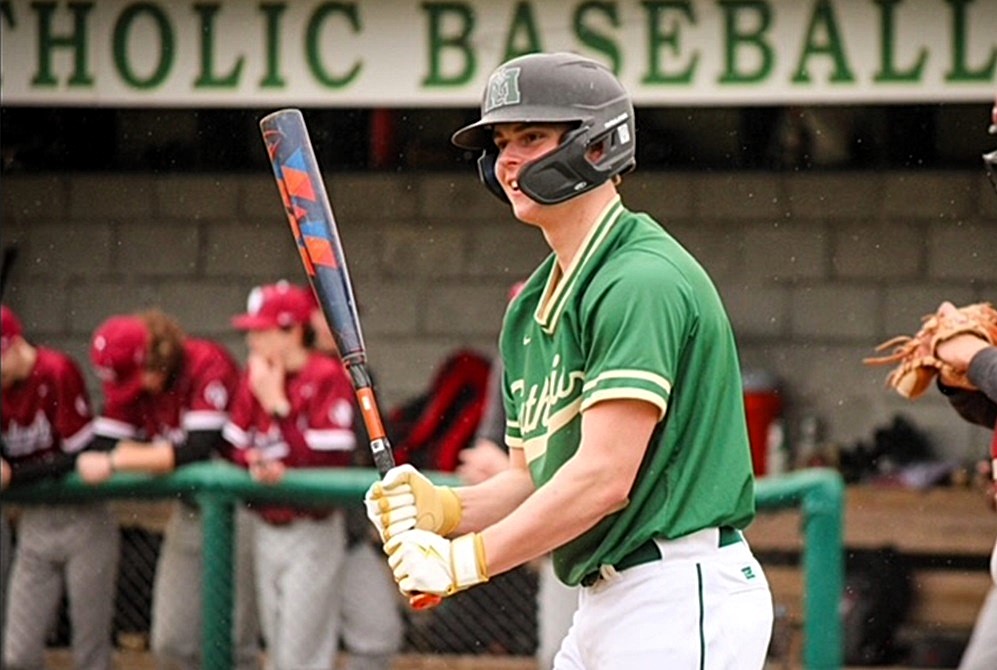
Bryan Convertini is nearing the end of an amazing four-year athletic career for Muskegon Catholic Central, but this swan song is not just about him.
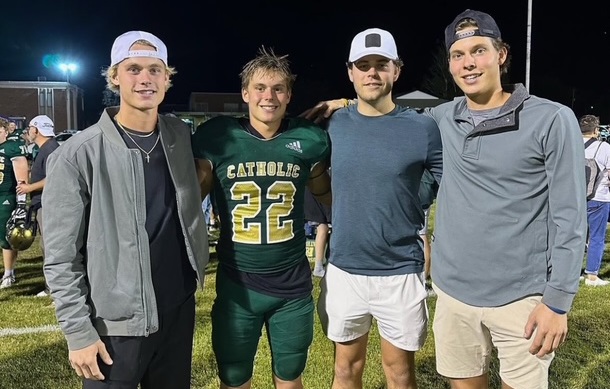
 Bryan is the last of the four “Convertini boys” at MCC, who collectively have provided Crusaders fans with plenty of big plays and thrilling wins – doing it all with their humble, no-nonsense leadership style – over the past 13 years.
“The Convertinis have really become the first family of Muskegon Catholic Central,” said MCC baseball coach Steve Schuitema, noting their father, Kolin, is an assistant varsity football coach and their mother, Jene, has served as the team mom for baseball and football for years.
“It will be different and a little sad to not have a Convertini out there for MCC anymore. All of them were leaders and a coach’s dream and really an extension of the coach on the field.”
Mason, 26, graduated in 2017 and set the sports tone for his three brothers, playing football, hockey as part of MCC’s cooperative team with Muskegon Reeths-Puffer, and baseball.
Nolan, 23, graduated in 2020 and, at 6-foot-2, is the tallest of the brothers. He played the same three sports as Mason, and was the most versatile of the boys, playing almost every position in football, including starting two games at quarterback.
Sam, 21, graduated in 2022, and also played football, hockey and baseball, but he opted to play basketball his senior year so he could play with his younger brother, Bryan.
Bryan, 18, will graduate June 1 after a standout, three-sport career, including the past three years as the starting varsity quarterback, before beginning college this fall at Grand Valley State.
“My memories at MCC go way back to when I was like 6 or 7 and the waterboy in football and the batboy in baseball,” said Bryan with a smile.
“The first word that comes to mind when I think about it is family. The whole school is like a big family that pushes and supports each other.”
Grandpa’s boys
The Convertini boys come from good stock, starting with their grandfathers.
On their mother’s side is Grandpa Bryan McLay who, at the age of 87, is still considered “Mr. Hockey” in Muskegon.
 McLay, a Kenora, Ontario, native who first came to Muskegon in 1960 (the same year that the downtown hockey arena opened), tallied more than 1,000 points over his 13 seasons with the Muskegon Zephyrs and later, the Mohawks.
McLay moved in with the family after his wife, Peggy, died four years ago, and regularly regales his grandsons with his “old-time hockey” stories.
Jene picked up her father’s passion for sports and has been a natural in the Crusaders’ “team mom” role – organizing meals, carpools, fundraisers and sending out emails for game and schedule changes, among other things.
On their father’s side is Grandpa Fred Convertini, a California native who played in the 1966 Rose Bowl as an offensive lineman at Michigan State – as part of what is considered the top offensive line in MSU history.
Kolin certainly inherited his father’s athletic ability, making first-team all-state in football (running back), wrestling and track & field (pole vault) during his senior year of 1989-1990. He went on to play defensive back at Eastern Michigan University.
He also picked up his father’s humility and toughness, the latter which was put to the test in 2014 when he was diagnosed with cancer.
“Kolin’s cancer really brought us together as a family,” explained Jene. “We didn’t know how long we had, and we decided we weren’t going to do travel sports any more. I didn’t want to be in Chicago and Kolin in Detroit for the weekend and then we say hi on the way out the door to work on Monday morning. We decided to spend more time together.”
Like their grandfathers and father, all four of the Convertini boys were known for their dependability, rarely if ever missing games due to sickness or injury.
In fact, Bryan suffered an injury in the opening football game of his junior season, then played the remaining 10 games on what was later determined to be a broken left ankle – and, by the way, he earned first-team all-state as a defensive back with five interceptions.
“It hurt so bad,” Bryan said, shaking his head. “But I needed to be out there. My team needed me to be out there.”
Home cooking
The Convertini house in Norton Shores has been a gathering place for MCC athletes for years.
It all started when the boys were little, wrestling between the couches and shooting pucks at the walls in the basement.
 Later on, that basement became the annual meeting spot for the MCC football team for “Selection Sunday,” when the team would learn its draw for the postseason playoffs.
Mason and Nolan, the two older boys, certainly enjoyed the most team success. Mason was part of three straight Division 8 championship football teams from 2014 to 2016. Nolan, meanwhile, played in three national championship games (with two titles) as a member of the Hope College men’s club hockey team.
The two younger boys had less team success, in large part because MCC really started struggling with numbers, but Sam and Bryan certainly did all they could and were rewarded with individual accolades.
Sam was the first of the brothers to make first-team all-state, earning the honor as a tight end in 2021. Bryan did one better, making all-state twice – after his junior year as a defensive back and his senior year as an “athlete” for his contributions all over the field.
Bryan also made first-team all-state last year in baseball, batting .478 as an outfielder.
In football, he rose above his broken ankle as a junior to rush for more than 800 yards and 11 touchdowns. In a win over Benton Harbor, he had a rushing TD, a passing TD, a receiving TD and returned an interception for yet another TD. This past fall as a senior, he threw for 880 yards and rushed for 621, while making a team-high 81 tackles in his first year at linebacker.
But when asked about the individual highlight of his football career, he doesn’t hesitate.
“That would have to be my freshman year, when I threw a halfback pass to my brother (Sam) for a touchdown,” recalled Bryan, noting a play that occurred in a victory over Muskegon Heights Academy during what ended as the 500th win in MCC football history.
Going out with a bang
Bryan hopes to tack on some additional highlights over the next month of baseball season, effectively writing a happy ending to the Convertini novel.
The Crusaders’ baseball team is off to an 11-4 start after a home sweep of Byron Center Zion Christian on Tuesday, during which MCC pitchers allowed just one run over two games.
 Bryan is currently batting .375 while playing the critical position of shortstop, out of need, since he is a natural outfielder.
He would love to have a repeat of his freshman year, when he batted leadoff and helped the Crusaders to District and Regional championships. MCC had won 11 straight Districts before falling short last spring, so he said avenging that District loss is a major priority.
That would also be an appropriate ending after an uncharacteristic football season when the young Crusaders (who started three 14-year-old freshmen on the offensive line) finished 1-7.
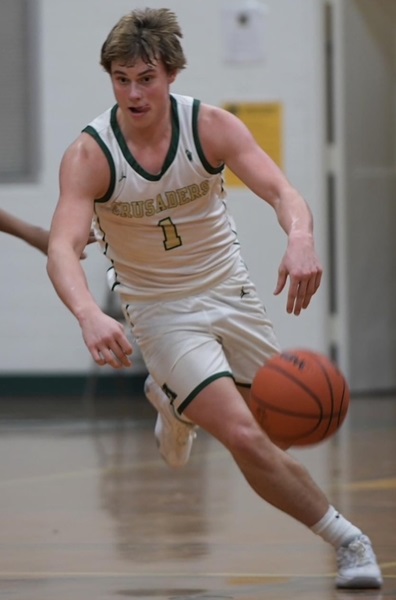
Things went much better in basketball, as Bryan teamed with all-stater Bradley Richards to help MCC to an 11-10 record, its first winning season in six years.
Through winning or losing, MCC football coach Steve Czerwon said the strong Catholic faith of the Convertini family is always front and center.
The family will gather to celebrate in early September, when Mason and his fiancée, Sophie, get married at St. Michael’s Church in Muskegon. That is about the same time that Bryan will be off to Grand Valley, and Czerwon and the MCC football program will begin the post-Convertini era.
“Bryan and all of his brothers have an inner strength which sets them apart,” said Czerwon, who took over as MCC’s head coach in 2013, which was Mason’s freshman year. “All of them respect authority and they want to learn and get better, which is all that you can ask.
“It’s been a pleasure working with their family. We are all going to miss them.”
 Tom Kendra worked 23 years at The Muskegon Chronicle, including five as assistant sports editor and the final six as sports editor through 2011. E-mail him at [email protected] with story ideas for Muskegon, Oceana, Mason, Lake, Oceola, Mecosta and Newaygo counties.
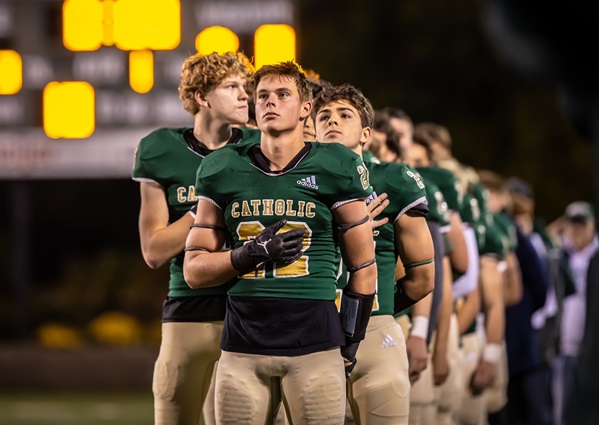
PHOTOS (Top) Muskegon Catholic Central’s Bryan Convertini takes a look down the third-base line during a baseball at bat. (2) The four Convertini boys take a photo together after one of Bryan’s football games in 2023. From left: Sam, Bryan, Mason and Nolan. (3) Convertini brings the ball upcourt during basketball season. (4) Convertini (22), stands for the national anthem this past fall. (Baseball and basketball photos by Michael Banka. Football photo by Tim Reilly. Family photo courtesy of Jene Convertini.)