

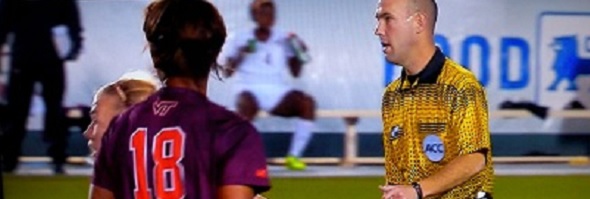
All in the Details
December 3, 2015
By Brent Sorg
Collegiate official & MHSAA coach
In my experience as both an official and coach, my partners or officials assigned to work my match are judged the moment we meet and make contact. That is human nature.
What is important is to make that first impression a positive one. At first contact, when greeting an administrator, coach or fellow official, look the person in the eye when shaking hands and be sincere in your greeting. When the person speaks, look them in the eye and listen. Sounds simple, yet I’ve seen many fail at this task and thus set themselves up for a difficult match.
The next moment of impact is the conversations that take place. It is totally acceptable to have a laugh and a joke, but be sure the environment and timing is right. You may ask, “Who is to judge when the time is correct?” It is all a feeling – a sort of sixth sense. I have witnessed on numerous occasions during the pregame check-in where officials “dig their own grave” by telling the players how they are going to call the game. Then they continue with how they will only talk to the captain. That is nonsense! In the business of managing people, it is imperative to deal with everyone involved in the game.
Once the match begins, the next task to strive for is not looking at the ball the entire time. From the first class I took on officiating, I was told the ball never commits a foul. In my 25 years, this is still true. Look ahead, scan the field, watch the players battling for position prior to the ball arriving. If one of the backs has the ball at his feet and is under zero pressure, there is no need to watch him pass the ball. Look instead at the forward checking back who is tightly marked by an opposing defender.
The game continues to evolve with faster, smarter, and more creative players. The coaches are implementing tactics to create every advantage possible. As you go about the game as the center official, don’t just judge fouls/non-foul moments, but expand your knowledge. What are the tendencies of certain players on the field? Are teams looking to build up or are they using a more direct style of play? This will help with your positioning and anticipating movement.
Almost every match has at least one defining moment that you as the referee must have the courage to deal with. It is often referred to as the “moment of truth.” It could mean you rule it is not a foul and don’t even have to blow the whistle, but you must deal with dissent. Or it could mean a stern talking to the player, issuing a caution, or showing the red card. Reflecting on the mentors I have had over the years and those I still look up today, I think about a consistent theme heard from all: Make sure you get something out of each caution or send-off.
Be brave. Make the tough decisions. Remember, the players are the ones who commit fouls forcing us to make certain decisions.
Many of you watch professional games on television, and I think we can all learn from them. In particular, I think the EPL (English Premier League) referees do an excellent job of isolating the guilty player, explaining the decision, and then showing the card. All while looking the player square in the eyes.
Your mindset to a match should be one of teamwork and one that fosters harmony with the players on the pitch. Not an “us vs. them” mentality.
Finally, be willing to admit a mistake. You are not perfect! You are a human being. It is OK to admit an error, but be genuine about it. Be sympathetic when appropriate. Be firm yet fair.
Most importantly, enjoy.
Sorg is a former National Referee and current NISOA Referee (ACC, Big Ten, Big East, Horizon, Conference USA, MAC); he also is a high school boys head coach who recently concluded his 11th season.
What's My Why: Official Jenna Schroeder
September 9, 2026
Jenna Schroeder, Berkley
Jenna Schroeder has been an NBA referee since 2020 and previously worked in the NBA-G League. Prior to officiating, she played basketball at Oakland University and Saginaw Valley State University.
She was an MHSAA-registered basketball official in 2003-04, 2005-06, and then from 2010-18, and also officiated girls lacrosse for four seasons. She's Clio's all-time leading girls basketball scorer and participated in the MHSAA Officials Legacy Program.
I got into it because I played basketball my entire life. I graduated college in 2009, during the housing crisis and no job prospects, so I tried refereeing and got bit by the bug and I’ve been obsessed with it ever since then.
“What’s My Why” is a weekly feature telling the stories of MHSAA-registered officials in their own words. If you’re an MHSAA official and would like to share your reason why, please submit a 15 to 45-second video, taken horizontally, to director of officials Sam Davis at [email protected].
What's My Why
Sept. 2: Joey Crawford, Newton Square, Pa. - Watch
Aug. 26: Ron Torbert, Hanover, Md. - Watch
Aug. 19: Kari Seitz, Mill Valley, Calif. - Watch
Aug. 13: Mike Pereira, Sacramento, Calif. - Watch
Aug. 5: Dino Paganelli, Wyoming - Watch
Aug. 3: Stacy Smith, Caledonia - Watch
July 22: Jason Nickleby, Lake Elmo, Minn. - Watch
July 15: Sam Davis, Lansing - Watch
July 9: Candace Cox, Quincy - Watch
July 1: Robert Williams, Redford - Watch
June 24: Will Godfrey, Jackson - Watch
June 19: Jarrett Skorup, Midland - Watch
June 12: Brady Driver, Sturgis - Watch
June 8: Cindy Tyzo, West Bloomfield - Watch
June 3: Jeff Spedoske, DeWitt - Watch
June 1: Mike Carrier, Commerce Township - Watch
May 27: Stan Wright, Warren - Watch
May 26: Murray Rose, Zeeland - Watch
May 22: Mike VanLaan, Alto - Watch
May 18: Clint Abbott, Newaygo - Watch