

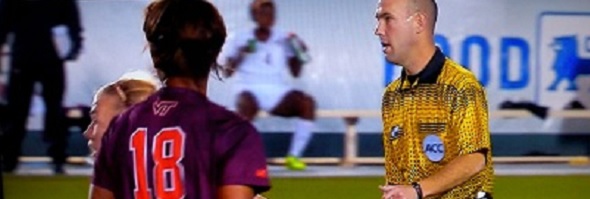
All in the Details

December 3, 2015

By Brent Sorg
Collegiate official & MHSAA coach

In my experience as both an official and coach, my partners or officials assigned to work my match are judged the moment we meet and make contact. That is human nature.

What is important is to make that first impression a positive one. At first contact, when greeting an administrator, coach or fellow official, look the person in the eye when shaking hands and be sincere in your greeting. When the person speaks, look them in the eye and listen. Sounds simple, yet I’ve seen many fail at this task and thus set themselves up for a difficult match.

The next moment of impact is the conversations that take place. It is totally acceptable to have a laugh and a joke, but be sure the environment and timing is right. You may ask, “Who is to judge when the time is correct?” It is all a feeling – a sort of sixth sense. I have witnessed on numerous occasions during the pregame check-in where officials “dig their own grave” by telling the players how they are going to call the game. Then they continue with how they will only talk to the captain. That is nonsense! In the business of managing people, it is imperative to deal with everyone involved in the game.

Once the match begins, the next task to strive for is not looking at the ball the entire time. From the first class I took on officiating, I was told the ball never commits a foul. In my 25 years, this is still true. Look ahead, scan the field, watch the players battling for position prior to the ball arriving. If one of the backs has the ball at his feet and is under zero pressure, there is no need to watch him pass the ball. Look instead at the forward checking back who is tightly marked by an opposing defender.   

The game continues to evolve with faster, smarter, and more creative players. The coaches are implementing tactics to create every advantage possible. As you go about the game as the center official, don’t just judge fouls/non-foul moments, but expand your knowledge. What are the tendencies of certain players on the field? Are teams looking to build up or are they using a more direct style of play? This will help with your positioning and anticipating movement.

Almost every match has at least one defining moment that you as the referee must have the courage to deal with. It is often referred to as the “moment of truth.” It could mean you rule it is not a foul and don’t even have to blow the whistle, but you must deal with dissent. Or it could mean a stern talking to the player, issuing a caution, or showing the red card. Reflecting on the mentors I have had over the years and those I still look up today, I think about a consistent theme heard from all: Make sure you get something out of each caution or send-off.

Be brave. Make the tough decisions. Remember, the players are the ones who commit fouls forcing us to make certain decisions.

Many of you watch professional games on television, and I think we can all learn from them. In particular, I think the EPL (English Premier League) referees do an excellent job of isolating the guilty player, explaining the decision, and then showing the card. All while looking the player square in the eyes.

Your mindset to a match should be one of teamwork and one that fosters harmony with the players on the pitch. Not an “us vs. them” mentality.

Finally, be willing to admit a mistake. You are not perfect! You are a human being. It is OK to admit an error, but be genuine about it. Be sympathetic when appropriate. Be firm yet fair.

Most importantly, enjoy.

Sorg is a former National Referee and current NISOA Referee (ACC, Big Ten, Big East, Horizon, Conference USA, MAC); he also is a high school boys head coach who recently concluded his 11th season.

The Right Stuff at the Right Time

October 19, 2012

By Rob Kaminski
MHSAA benchmarks editor

MHSAA Championship history is filled with unforgettable moments for participants and spectators alike. Every now and then, the contest on the biggest stage delivers the cliche’ finish of everyone's dreams: close game, final seconds, trophy on the line, someone’s gotta win, someone’s gotta lose.

For the three teams out there, it’s as exciting as it gets. Yes, three teams. For every classic crunch-time moment, there are officials who have earned the right to share that moment with the participants.

Following, benchmarks reflects on two such moments from the viewpoints of those in stripes.

Ford Field, Detroit, Nov. 24, 2006
Muskegon (13-0) vs. Warren DeLaSalle (11-2)
At Stake: MHSAA Division 2 Football Title

Officials: Referee Charles Sprang (3rd MHSAA Final); Umpire Mike Wallace (1st); Linesman Troy Miller (2nd); Line Judge Reginald Smith (1st); Back Judge Trenton Withrow (1st)

THE MOMENT: DeLaSalle trails 32-30 with time running out, when QB Brian Lewis completes a slant pass to Don Fowler. Fowler is into the clear and headed for the end zone when he is hit by Muskegon’s Ronald Johnson at the 4-yard line, and stretches for the end zone. The ball pops loose, Fowler’s knee goes down, and Muskegon’s Bobby Miller recovers the ball in the end zone within a few furious seconds. The Big Reds get the ball, the undefeated season, and the championship.

Withrow: “They were in a hurry-up on the last drive and the game, which was fast-paced the entire time, got even faster. When the receiver got into the open, I knew I had to get back to the goal line and keep my eyes on the play. That was the first thing on my mind; if I don’t get to the goal line, I can’t make that call.

“Immediately after I made the call (correctly, a fumble and touchback), I just remember chills down my spine, the DeLaSalle kids trying to argue that he was down, and hoping I got it right. We don’t have the luxury of replay. It was a bang-bang call; knee coming down, lost ball, goal line right there.”

Smith: “As the play took place, I was telling myself not to rush, but be precise in my call. Just move in to box the play with Trent and watch for the ball at all times as the play developed.”

Sprang:  “I did not see the fumble as I was about 60 yards up field.  I got to Trent and said, ‘What do you have?’  Trent said, ‘Touchback.’ Mike Wallace asked, ‘Are you sure?’ Trent never wavered and said, ‘He never got in the end zone with the ball. It was out at the 1.’ I asked again, ‘Are you sure?’ Trent said, ‘No doubt.’ Trent, as I saw on film, was in perfect position.  That call was the game and he nailed it.”

Miller: “It was great that Reggie and Trent spent very little time communicating and they had the same ruling. Being on the Warren DeLaSalle sideline, I explained to the head coach what we had and there was really no reaction, as I believe he saw exactly what Trent had seen, and knew that Trent was in great position.”

Wallace: “I just remember seeing the play from a distance as I was the umpire. I  saw the call and just said to myself, ‘I hope that was the right call.’  I didn't have any doubt,  but just didn't want a call missed at that point in the game.  The call was so smooth, as if he had made the call a hundred times.

“Moments afterward I just remember telling him ‘That was a heck-of-a-call,’ and I was not even sure if he got it right or not.”

Withrow: “I’ll never forget when Mike came running down the field, he said, ‘That’s why I’m glad I’m the umpire; so I don’t have to make that call.’

“Chuck and I discussed it, and he just wanted to make sure of what I saw; I told him exactly what happened, and then he repeated the signal.”

Sprang: “At every opportunity, we talked about ‘staying in the game.’ Muskegon had a two touchdown lead twice in the game and DeLaSalle fought back each time to either tie or go ahead. I am not sure if Mike Wallace had a crystal ball, but he said, ‘One play is gonna win this game, be ready.’”

Miller: “I remember walking up the tunnel going back to the locker room and walking past a reporter from one of the Detroit papers and having him say, ‘Nice job guys, that was a great call.’”

Sprang: “I knew at that point Trent had it right and the replay only confirmed it.  When I saw the replay, it sure was a great feeling to see that ball pop out at the 1-yard line and Trent on the goal line with his bean bag.  He made four other guys on the field that day look very, very good.”

Withrow: “Looking at the replay, I was surprised my bean bag came out, because I didn't remember that during the play. It’s a reaction, and I just relied on mechanics. If you do all the right things mechanically, you’ll be in position to make the calls, and it certainly paid off at that moment.”

Wallace: “In the locker room it felt like we just went 15 rounds with Apollo Creed and we were still standing.  We knew that we all worked hard, concentrated and nailed it.  Maybe it was just that one  call, but it was an incredible feeling of success that you strive for when you officiate.”


Breslin Center, East Lansing, March 27, 1999
Muskegon Western Michigan Christian (25-2) vs. Detroit City (22-3)
At Stake: MHSAA Class D Boys Basketball Title

Officials: Dick Kalahar (4th MHSAA Boys Final),  Mike Robillard (2nd), Tim Belt (1st)

THE MOMENT:  Game tied, clock ticking down, as  Muskegon Western Michigan Christian’s Nick Bultema uses a screen and goes airborne to launch a last-second three-point shot. The ball is tipped by Detroit City’s Michael Williams, but momentum takes his body into Bultema’s before the shooter reaches the floor. Foul. 0:00 on the clock. Bultema makes the second free throw, and secures the title.

Kalahar: “I was the trail official, and as the clock  was winding down I was looking for a three-point shot, as Detroit City’s defense on the inside was very good. As the player (Bultema) attempted the shot, a very big Detroit City player tried to block the shot. The WMC shooter was still in the air after releasing the ball, when the Detroit City player contacted the shooter and drove him into the table at press row.

“I made a foul call on the Detroit City player just before the horn went off. Before I went to the table to report the foul, I met with Mike and Tim to confirm the foul was called before time ran out. We all agreed there would be three shots given to the WMC player.”

Robillard: “I knew going into the game I was with two outstanding officials, and we would handle any situations that might occur. As the game was getting into the final minutes I was hoping for overtime because both teams had competed so hard and the game had such a great flow.”

Kalahar: “I reported the foul and explained to the table what we were going to do. I also called both head coaches together to explain what the call was and how we would proceed. Both coaches were gentlemen.”

Robillard: “As the end of the game approached, our crew communication was outstanding. We knew we had to be out on the perimeter and protect the shooters. So when the left-handed shooter pulled up behind the three-point arc, both Dick and I had him booked in. It was Dick's primary, but I was doubling back to protect the backside of the shooter. As soon as the defender ran into the shooter, Dick nailed the whistle.”

Kalahar: “Experience always helps. Trying to anticipate what might happen as well as good concentration in a game like this comes with experience. Having two good partners is also a key.

“As we entered the locker room, much to my surprise, Jack Roberts, Nate Hampton and Tom Minter of the MHSAA office were there. I will always remember their support. Our crew then talked about the game, and felt we gave the teams a good game. Mike or Tim told me they thought the last call took courage and they were proud to be a part of this crew.

“I had some very anxious moments the first time I saw the replay. As officials, we always want to get the call right, especially in a game like this. I've seen it many times, and to this day I believe the right and fair call was made.”

PHOTOS: (Top) Warren DeLaSalle's Don Fowler loses control of the ball just before reaching the goalline during the 2006 Division 2 Final at Ford Field. (Middle) Muskegon Western Michigan Christian's Nick Bultema is about to be engulfed by a teammate moments after sinking the winning free throw during the 1999 Class D Final at the Breslin Center. 

NOTE: This is the fourth installment in the series "Making – and Answering – the Call" detailing the careers and service of MHSAA officials. Click the links below to view the others.