

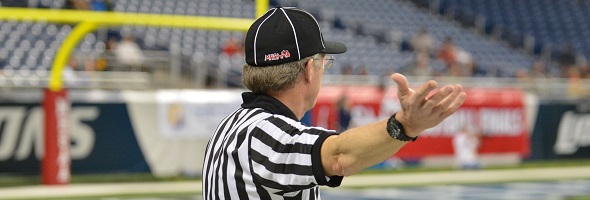
Be the Referee: Automatic 1st Downs
October 16, 2014
This week, MHSAA assistant director Mark Uyl explains the differences between high school and college and pro football when it comes to awarding automatic first downs.
"Be the Referee" is designed to help educate people on the rules of different sports, to help them better understand the art of officiating and to recruit officials. The segment can be heard on Mondays, Wednesdays and Fridays during the school year on The Drive With Jack Ebling on WVFN-AM, East Lansing.
Below is this week's segment - Automatic First Downs - Listen
Today we are going to talk about one of the biggest rule difference areas in high school football from those rules used in college and pro games and that deals with automatic first downs.
When watching that college game on Saturday or the pro game on Sunday, all of us know there are several defensive fouls that give the offense an automatic first down. However, under high school rules, the opposite is true most of the time.
The only high school fouls that result in an automatic first down for the offense are the roughing fouls - roughing the passer, the kicker, the holder and the long snapper. Fouls such as defensive pass interference or any other personal foul do not bring an automatic first down under high school rules.
Past editions
Oct. 8 - Officials & Injuries - Listen
Oct. 1 - Overtime - Listen
Sept. 25 - Field Goals - Listen
Sept. 18 - Tackle Box - Listen
Sept. 11 - Pass Interference - Listen
Aug. 25 - Targeting - Listen
What's My Why: Official Mike Carrier
June 1, 2026
Mike Carrier, Commerce Township
Carrier has served as an MHSAA-registered wrestling official for the last six seasons, and eight years total.
As a former athlete and coach, I understand the importance of having high-quality officials to help work our contests.
As an educator, I believe sports to be an extension of the classroom, and they teach our student-athletes valuable life lessons.
It simply couldn’t happen without good officials.
“What’s My Why” is a weekly feature telling the stories of MHSAA-registered officials in their own words. If you’re an MHSAA official and would like to share your reason why, please submit a 15 to 45-second video, taken horizontally, to director of officials Sam Davis at [email protected].
Don't miss Officiate Michigan Day 2026, July 25 in Grand Rapids! Check out MHSAA.com/OMD to register and learn more.
What's My Why
May 27: Stan Wright, Warren - Watch
May 26: Murray Rose, Zeeland - Watch
May 22: Mike VanLaan, Alto - Watch
May 18: Clint Abbott, Newaygo - Watch