


Be the Referee: Basketball Announcers
February 4, 2015
This week, MHSAA assistant director Mark Uyl explains the proper role of high school basketball public address announcers.
Be The Referee is a series of short messages designed to help educate people on the rules of different sports, to help them better understand the art of officiating, and to recruit officials.
Below is this week's segment - Basketball PA Announcers - Listen
Whenever there are rules changes in any sport, we usually think of the three groups that are most affected by those changes – obviously, the players, the coaches and the referees. This year in basketball, an additional group is receiving some attention from the rules makers, and those are the public address announcers.
At the college and pro levels, the P.A. Announcers are almost taking on a life of their own. They are seen in their communities and their towns as the home team’s biggest fan.
At the high school level, a good P.A. Announcer gives attention to both teams – the kids from both the home team and the visiting team – that do things that are noteworthy during the game. A P.A. Announcer should be there first to inform – not to entertain – and keeping sportsmanship at the forefront of every game.
Past editions
Jan. 26 - Wrestling Health Concerns - Listen
Jan. 19 - Basketball Physical Contact - Listen
Jan. 12 - Video Review Part 2 - Listen
Dec. 29 - Video Review Part 1 - Listen
Dec. 17 - Registration Part 2 - Listen
Dec. 10 - Registration Part 1 - Listen
Dec. 3 - Legacy Program - Listen
Nov. 26 - Sideline Management - Listen
Nov. 19 - 7-Person Mechanics - Listen
Nov. 12 - Blocking Below the Waist - Listen
Nov. 5 - Tournament Selection - Listen
Oct. 29 - Uncatchable Pass - Listen
Oct. 22 - Preparation for Officials - Listen
Oct. 15 - Automatic First Downs - Listen
Oct. 8 - Officials & Injuries - Listen
Oct. 1 - Overtime - Listen
Sept. 25 - Field Goals - Listen
Sept. 18 - Tackle Box - Listen
Sept. 11 - Pass Interference - Listen
Aug. 25 - Targeting - Listen
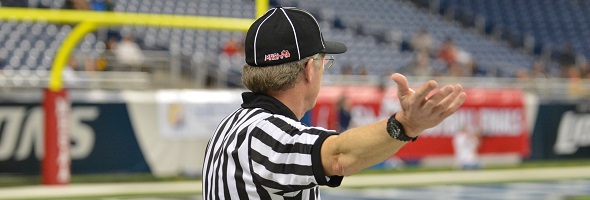
Be the Referee: Missed Field Goal
August 27, 2015
This week, MHSAA assistant director Mark Uyl kicks off the second season of "Be the Referee" with a "You Make the Call" on what happens after a missed field goal rolls out of bounds.
Be The Referee is a series of short messages designed to help educate people on the rules of different sports, to help them better understand the art of officiating, and to recruit officials.
Below is this week's segment - Missed Field Goal - Listen
Let’s get everyone in “football game shape” with the following You Make The Call.
One team has the chance to kick a 50-yard field goal just before halftime. As the kicker approaches the ball being held at the 40-yard line, his plant leg slips and the kick comes up well short and wide as it rolls out of bounds at the 4-yard line. Under high school rules, where will the team that forced the bad kick next snap the ball?
Believe it or not, under high school rules, missed field goals that roll out of bounds before reaching the goal line are treated just like a punt! The new offense will put the ball in play, first and 10, from the 4-yard line.