

Be the Referee: Bat Safety
June 1, 2015
This week, MHSAA assistant director Mark Uyl explains how bats have been altered the last few seasons to make baseball safer for pitchers and infielders.
Be The Referee is a series of short messages designed to help educate people on the rules of different sports, to help them better understand the art of officiating, and to recruit officials.
Below is this week's segment - Bat Safety - Listen
The biggest change in the world of amateur baseball over the last five years has been the new standards for non-wood, or what most of us refer to as aluminum, bats.
Prior to these changes, it was quite common to see high school and college baseball scores in double digits on a regular basis.
The new bat standards first sought to address player safety. And now these new aluminum bats match the ball exit speed ratio – or in other words, the speed that the ball comes off the bat – for a non-wood bat with what it would be coming off a wood bat; making the amateur game safer for pitchers and infielders.
Past editions
May 25 - Balks - Listen
May 18 - Baseball Pace of Play - Listen
May 11 - Fair or Foul Ball? - Listen
May 4 - Non-Glare Helmets - Listen
April 27 - Vern L. Norris Award - Listen
March 23 - Deciding the Game - Listen
March 16 - Block/Charge Call - Listen
March 9 - Dive on the Floor - Listen
March 2 - Primary Areas - Listen
Feb. 23 - Too Much TV - Listen
Feb. 16 - Video Clip Library - Listen
Feb. 9 - Cheer Safety - Listen
Feb. 2 - Basketball PA Announcers - Listen
Jan. 26 - Wrestling Health Concerns - Listen
Jan. 19 - Basketball Physical Contact - Listen
Jan. 12 - Video Review Part 2 - Listen
Dec. 29 - Video Review Part 1 - Listen
Dec. 17 - Registration Part 2 - Listen
Dec. 10 - Registration Part 1 - Listen
Dec. 3 - Legacy Program - Listen
Nov. 26 - Sideline Management - Listen
Nov. 19 - 7-Person Mechanics - Listen
Nov. 12 - Blocking Below the Waist - Listen
Nov. 5 - Tournament Selection - Listen
Oct. 29 - Uncatchable Pass - Listen
Oct. 22 - Preparation for Officials - Listen
Oct. 15 - Automatic First Downs - Listen
Oct. 8 - Officials & Injuries - Listen
Oct. 1 - Overtime - Listen
Sept. 25 - Field Goals - Listen
Sept. 18 - Tackle Box - Listen
Sept. 11 - Pass Interference - Listen
Aug. 25 - Targeting - Listen
Nearly 1,000 Officials Converge in Grand Rapids for Officiate Michigan Day
By
Geoff Kimmerly
MHSAA.com senior editor
August 5, 2026
GRAND RAPIDS – Nearly 1,000 MHSAA-registered officials – and some of the biggest names in officiating nationwide – attended Officiate Michigan Day on July 25 at DeVos Place.
Attendees enjoyed opportunities to hear football rules analyst and longtime official Mike Pereira and World Cup and Olympic soccer official Kari Seitz during the opening and closing addresses, respectively. They also took part in training sessions throughout the day including four that were sport-specific, with clinicians including several of the state’s highest-regarded officials at the high school level and some of the best-known at the collegiate and professional levels nationwide who grew up or reside in our state.
Above are highlights from the event and insights from several accomplished officials. Click for photos from throughout the day, from Adam Sheehan.
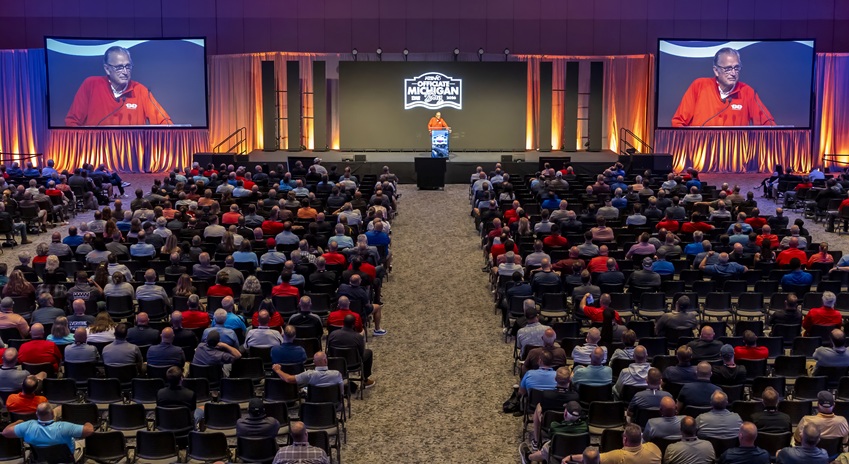
PHOTO Football rules analyst Mike Pereira speaks during the opening address at Officiate Michigan Day. (Photo by Adam Sheehan.)