

Be the Referee: Because They Love It
February 13, 2019
This week, MHSAA assistant director Brent Rice explains why officials take up the avocation despite frequent criticism of their best efforts.
Be The Referee is a series of short messages designed to help educate people on the rules of different sports, to help them better understand the art of officiating, and to recruit officials.
Below is this week's segment – Because They Love It - Listen
After the uproar about officiating in a recent pro football game, an online article appeared with the headline “Why in the world would anyone want to be a referee?” It’s a good question.
While everyone in the game – players, coaches and officials – strive for perfection, only the officials are ultimately expected to reach that standard. And that’s simply not fair. So why would anyone want to be a referee?
Every referee will give you three little words: “I love it!” They love it because they know how important it is – no matter the level of play. And they want to be right all the time – and most of the time they are. And like a lot of other things in sports, the friendships and relationships built, the memories – they can’t be beat. So we’ll always encourage people to join us as referees, and for those who can’t – or won’t – to stay in their lane when at the game.
Past editions
February 7: Coach/Official Communication - Listen
January 31: Backcourt Violation? - Listen
January 24: Required Hockey Equipment - Listen
January 17: You Make the Call: 10-Second Clock - Listen
January 10: Tripping in Hockey - Listen
January 3: Sliding in Basketball - Listen
December 27: Stalling in Wrestling - Listen
December 20: Basketball: You Make the Call - Listen
December 13: Basketball Uniform Safety - Listen
December 6: Coaching Box Expansion - Listen
November 29: Video Review, Part 2 - Listen
November 22: Video Review, Part 1 - Listen
November 15: You Make the Call - Sleeper Play - Listen
November 8: 7-Person Football Crews - Listen
November 1: Overtime Differences - Listen
October 25: Trickery & Communication - Listen
October 18: Punts & Missed Field Goals - Listen
October 11: What Officials Don't Do - Listen
October 4: Always 1st-and-Goal - Listen
September 27: Unique Kickoff Option - Listen
September 20: Uncatchable Pass - Listen
September 13: Soccer Rules Change - Listen
September 6: You Make the Call: Face Guarding - Listen
August 30: 40-Second Play Clock - Listen
August 23: Football Rules Changes - Listen
West Michigan Mourns Longtime Mentor
By
Geoff Kimmerly
MHSAA.com senior editor
June 25, 2019
As quickly as June has come to an end, summer soon will give way to another highly-anticipated football season in the Grand Rapids area – but also one that undoubtedly will feel like someone is missing for the many officials who learned from Carl Paganelli.
The longtime high school, college and professional official died May 21 at age 82 after fighting cancer, and was laid to rest May 29 in Wyoming, near Grand Rapids, where he lived most of his life.
Paganelli’s most high-profile on-field work likely came during his time in the former USFL, World Football League and Arena Football League. More of his 58 years in the game came as supervisor of officials in the Mid-American Conference, Arena League and during the initial campaign of the XFL. His three sons Carl Jr., Perry and Dino all have gone on to officiate in NFL Super Bowls.
Those impressive notes were mentioned most when Carl Sr. died. But his influence on the high school game was similarly substantial and should continue through those he mentored during nearly 60 years as part of the West Michigan Officials Association – which referred to him as “one of the founding fathers of officiating in West Michigan” in announcing his passing.
Paganelli was an MHSAA registered official for 36 football seasons through fall 1998, and also for 24 basketball seasons through winter 1987-88. Also during the 1990s, Caledonia native Mark Uyl began a multi-sport officiating career that would carry him in part to two baseball College World Series. He got to know Paganelli well through wearing the stripes and while also serving as athletic director at his alma mater and then Middleville Thornapple Kellogg on the way to becoming an MHSAA assistant and now executive director.
“Carl was one of the greatest officiating mentors that there’s ever been, and what made Carl most unique in that area was the fact he would go out and watch a junior high game Thursday in Grand Rapids, see a new official, and give that official the same time and care and detail that he would when he was supervisor of officials for the MAC or evaluating NFL officials,” Uyl said.
“To him, an official was an official. He was there, and he wanted to help you get better.”
As noted in his obituary, Paganelli was considered the “godfather of Grand Rapids area officials” and has been credited by numerous NFL officials for his guidance over the years. He was inducted into the Arena Football Hall of Fame and also into the Grand Rapids Sports Hall of Fame twice – solo in 2008 and with his three sons as the “Paganelli Team” in 2018.
Carl Sr. with his sons was among presenters when more than 1,200 officials from across the state poured into Grand Rapids during July 2013 for the first Officiate Michigan Day. His local footprint also includes a substantial presence at Grand Rapids Community College, where the foyer of the Gerald R. Ford Fieldhouse is named after the family and a scholarship in their name is presented annually to a student-athlete. Paganelli Sr. had attended Grand Rapids Junior College in 1954 and 1955. He also served in the U.S. Navy during the Korean War, and later sat on the Wyoming City Council.
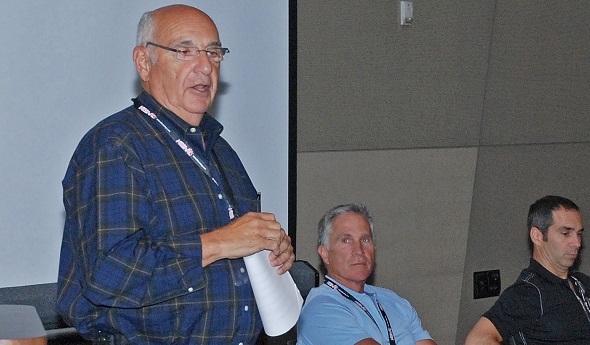
PHOTO: Carl Paganelli speaks to an audience during Officiate Michigan Day in 2013 as part of a roundtable with his three sons.