

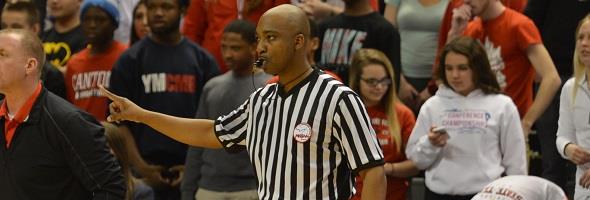
Be the Referee: Calling Intentional Fouls
February 1, 2018
In this week's edition, assistant director Mark Uyl discusses when basketball officials should call an intentional foul.
Be The Referee is a series of short messages designed to help educate people on the rules of different sports, to help them better understand the art of officiating, and to recruit officials.
Below is this week's segment – Calling Intentional Fouls - Listen
At the end of any close basketball game, it’s an accepted part of basketball strategy for the team that’s behind to foul and send the team in the lead to the foul line.
This year there is a point of emphasis nationally dealing with intentional fouls. Intentional fouls should be called whenever a player obviously neutralizes an opponent’s obvious advantage, or when contact occurs with an opponent who is clearly not in the play, or when that contact is not an attempt to play the ball.
Certainly excessive contact remains as one of the types of intentional fouls. A team merely trying to foul on purpose does not make it an intentional foul.
Past editions
January 25: Points at the Edge of the Mat - Listen
January 18: Behavior Warning - Listen
January 11: Ice Hockey Safe & Sound - Listen
January 4: Why No Shot Clock - Listen
December 21: Coaches Responsible for Equipment - Listen
December 14: Mentoring New Officials - Listen
December 7: Dive on the Floor - Listen
November 30: Wrestling Weight Monitoring - Listen
November 23: Ejections - Listen
November 16: Toughest Call - Listen
November 9: Hurdling - Listen
November 2: The Survey Says - Listen
October 26: Helmet Comes Off - Listen
October 19: Goal Line Rules - Listen
October 12: No 1st-Year Fee - Listen
October 5: Athletic Empty Nesters - Listen
September 28: Misunderstood Football Rules: Kicking - Listen
September 21: Preparation for Officials - Listen
September 14: Always Stay Registered - Listen
September 7: Other Football Rules Changes - Listen
August 31: Pop-Up Onside Kicks - Listen
August 24: Blindside Blocks - Listen
What's My Why: Official Ron Torbert
August 26, 2026
Ron Torbert, Hanover, Md.
Ron Torbert is a current NFL referee who worked Super Bowls LVI (2022) and LIX (2025). He has been on the NFL staff since 2010, starting as a side judge before being promoted to referee in 2014.
Prior to his time in the NFL, Ron worked in the Big Ten, MAC and GLIAC, and was an MHSAA-registered football official from 1989-2001. He is a graduate of Michigan State University and Harvard Law School and also the current chair of the National Association of Sports Officials (NASO) Board.
Nobody else in the stadium feels what we feel, and there’s something kinda special about being part of that small-knit community.
That’s what kept me coming back and coming back. I don’t play golf, but somebody said it’s like hitting that one golf shot – you’re not a very good golfer but you hit that one shot that brings you back for the next round. Being out on the field brings me back for the next game,
Once I figured out what it took to get good at it, now I want more, and that’s what keeps me coming back. It’s always a challenge of being better next week than I was last week.
“What’s My Why” is a weekly feature telling the stories of MHSAA-registered officials in their own words. If you’re an MHSAA official and would like to share your reason why, please submit a 15 to 45-second video, taken horizontally, to director of officials Sam Davis at [email protected].
What's My Why
Aug. 19: Kari Seitz, Mill Valley, Calif. - Watch
Aug. 13: Mike Pereira, Sacramento, Calif. - Watch
Aug. 5: Dino Paganelli, Wyoming - Watch
Aug. 3: Stacy Smith, Caledonia - Watch
July 22: Jason Nickleby, Lake Elmo, Minn. - Watch
July 15: Sam Davis, Lansing - Watch
July 9: Candace Cox, Quincy - Watch
July 1: Robert Williams, Redford - Watch
June 24: Will Godfrey, Jackson - Watch
June 19: Jarrett Skorup, Midland - Watch
June 12: Brady Driver, Sturgis - Watch
June 8: Cindy Tyzo, West Bloomfield - Watch
June 3: Jeff Spedoske, DeWitt - Watch
June 1: Mike Carrier, Commerce Township - Watch
May 27: Stan Wright, Warren - Watch
May 26: Murray Rose, Zeeland - Watch
May 22: Mike VanLaan, Alto - Watch
May 18: Clint Abbott, Newaygo - Watch