

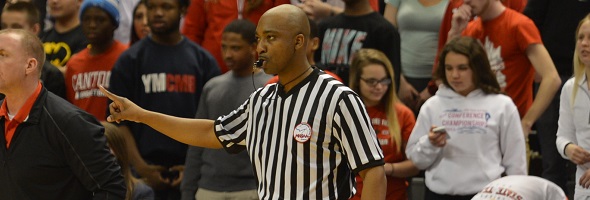
Be the Referee: Excessive Contact
December 10, 2015
This week, MHSAA assistant director Mark Uyl explains rules new this basketball season designed to limit physical contact with ball-handlers.
Be The Referee is a series of short messages designed to help educate people on the rules of different sports, to help them better understand the art of officiating, and to recruit officials.
Below is this week's segment - Basketball Excessive Contact - Listen
The game of basketball is a game of finesse and skill. The basketball playing rules' emphasis and focus for this year continue to work at getting the unnecessary rough and physical play out of basketball.
The acts that constitute a foul when committed against a ball-handler are when a defender…..a) places two hands on the ball handler; b) places an extended arm bar on the ball handler; c) places and keeps a hand on the ball handler; and d) contacts the ball handler more than once with the same hand or alternating hands.
Officials will deem these as automatic fouls, and consistent enforcement will keep the game of basketball a game of skill, not brute force.
Past editions:
Nov. 26: Pregame Communication - Listen
Nov. 19: Trick Plays - Listen
Nov. 12: 7-Person Football Mechanics - Listen
Nov. 5: Make the Call: Personal Fouls - Listen
Oct. 29: Officials Demographics - Listen
Oct. 15: Make the Call: Intentional Grounding - Listen
Oct. 8: Playoff Selection - Listen
Oct. 1: Kick Returns - Listen
Sept. 24: Concussions - Listen
Sept. 17: Automatic First Downs - Listen
Sept. 10: Correcting a Down - Listen
Sept 3: Spearing - Listen
Aug. 27: Missed Field Goal - Listen
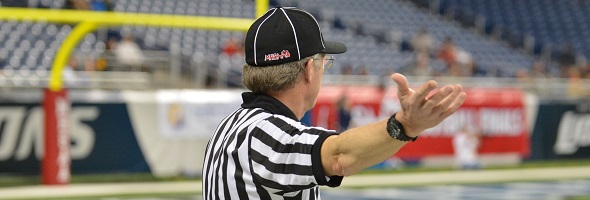
Be the Referee: Video Review - Part 2
January 15, 2015
This week, MHSAA assistant director Mark Uyl explains further the use of video replay during MHSAA tournament events and why it is difficult to expand use at the high school level.
Be The Referee is a series of short messages designed to help educate people on the rules of different sports, to help them better understand the art of officiating, and to recruit officials.
Below is this week's segment - Video Review Part 2 - Listen
In last week’s segment, we talked about the expanded use of instant replay for officials at both the collegiate and professional levels. The question is often asked of the MHSAA, “When are you going to use more instant replay at the high school level?”
Currently, there are a number of obstacles that prevent this, the first dealing with volume. With over 700 member schools in the MHSAA, hundreds of games and contests are played on virtually every night of the week. The second deals with cost and camera angles. At the high school level, most games are typically filmed or videoed using only a single camera from a set location, which precludes the use of various angles that would assist in getting the call correct.
Past editions
Dec. 29 - Video Review Part 1 - Listen
Dec. 17 - Registration Part 2 - Listen
Dec. 10 - Registration Part 1 - Listen
Dec. 3 - Legacy Program - Listen
Nov. 26 - Sideline Management - Listen
Nov. 19 - 7-Person Mechanics - Listen
Nov. 12 - Blocking Below the Waist - Listen
Nov. 5 - Tournament Selection - Listen
Oct. 29 - Uncatchable Pass - Listen
Oct. 22 - Preparation for Officials - Listen
Oct. 15 - Automatic First Downs - Listen
Oct. 8 - Officials & Injuries - Listen
Oct. 1 - Overtime - Listen
Sept. 25 - Field Goals - Listen
Sept. 18 - Tackle Box - Listen
Sept. 11 - Pass Interference - Listen
Aug. 25 - Targeting - Listen