

Be the Referee: Fair or Foul Ball?
May 14, 2015
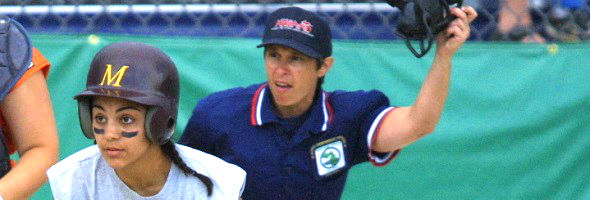
This week, MHSAA assistant director Mark Uyl explains how baselines come into play when deciding if a batted ball is fair or foul in baseball and softball.
Be The Referee is a series of short messages designed to help educate people on the rules of different sports, to help them better understand the art of officiating, and to recruit officials.
Below is this week's segment - Fair or Foul Ball? - Listen
Today’s segment is going to start with a quick “You Make The Call” question.
Baseball batter up at bat hits a line drive directly back toward the pitcher’s mound. The ball hits off the pitching rubber or the pitching plate, and rebounds directly into the first base dugout.
Fair or Foul Ball?
Baseball and Softball are unique in that these are two sports where the lines are actually considered to be in play. A ball hitting the chalk line in Baseball or Softball is a Fair Ball, to where in a basketball game, that player would be considered out of bounds.
Now back to our question – that would be considered a Foul Ball because the ball never settled or passed first base or third base in fair territory.
Past editions
May 4 - Non-Glare Helmets - Listen
April 27 - Vern L. Norris Award - Listen
March 23 - Deciding the Game - Listen
March 16 - Block/Charge Call - Listen
March 9 - Dive on the Floor - Listen
March 2 - Primary Areas - Listen
Feb. 23 - Too Much TV - Listen
Feb. 16 - Video Clip Library - Listen
Feb. 9 - Cheer Safety - Listen
Feb. 2 - Basketball PA Announcers - Listen
Jan. 26 - Wrestling Health Concerns - Listen
Jan. 19 - Basketball Physical Contact - Listen
Jan. 12 - Video Review Part 2 - Listen
Dec. 29 - Video Review Part 1 - Listen
Dec. 17 - Registration Part 2 - Listen
Dec. 10 - Registration Part 1 - Listen
Dec. 3 - Legacy Program - Listen
Nov. 26 - Sideline Management - Listen
Nov. 19 - 7-Person Mechanics - Listen
Nov. 12 - Blocking Below the Waist - Listen
Nov. 5 - Tournament Selection - Listen
Oct. 29 - Uncatchable Pass - Listen
Oct. 22 - Preparation for Officials - Listen
Oct. 15 - Automatic First Downs - Listen
Oct. 8 - Officials & Injuries - Listen
Oct. 1 - Overtime - Listen
Sept. 25 - Field Goals - Listen
Sept. 18 - Tackle Box - Listen
Sept. 11 - Pass Interference - Listen
Aug. 25 - Targeting - Listen
Soccer Hall of Famer Seitz, NFL Analyst Pereira Headline Officiate Michigan Day 2026
By
Geoff Kimmerly
MHSAA.com senior editor
July 14, 2026
Officiate Michigan Day 2026 will welcome more than 1,000 Michigan High School Athletic Association-registered game officials July 25 to DeVos Place in Grand Rapids, where they will receive knowledge and instruction from several high-profile voices headlined by recent National Soccer Hall of Fame inductee Kari Seitz – a Brighton High School graduate – and one of television’s most recognizable rules analysts, Mike Pereira.
Officiate Michigan Day is designed to benefit officials with any level of experience, veteran to beginner. High-profile clinicians representing several sports and all levels including the NFL, NBA, MLB, NCAA, FIFA and the National Women’s Soccer League (NWSL) will provide face-to-face training during four sport-specific breakout sessions throughout the conference.
Pereira, a past collegiate and NFL football official who also has served as the NFL’s vice president of officiating, will present the opening address at 9 a.m. He has provided his knowledge during FOX Sports football broadcasts since 2010, explaining rules scenarios on-air as situations unfold in-game.
Seitz, also a graduate of Michigan State University, refereed Women’s World Cups in 1999, 2003, 2007 and 2011 and Olympics tournaments in 2004, 2008 and 2012, and will deliver the conference’s closing message. She’s currently the vice president of refereeing for U.S. Soccer and formerly served as FIFA’s heading of refereeing.
This will be the third Officiate Michigan Day, joining events in 2013 and 2018. OMD 2026 will accompany the annual National Association of Sports Officials (NASO) Summit that will take place July 26-28, also at DeVos Place.
Officials may continue to register on the Officials page. Cost is $50. Additional details, including the full lineup of speakers and clinicians, also is available at that link.