

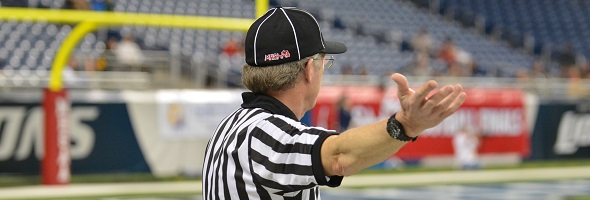
Be the Referee: Field Goals
September 24, 2014
This week, MHSAA assistant director Mark Uyl explains a rule unique to high school football – what results at our level after a missed field goal attempt.
"Be the Referee" is designed to help educate people on the rules of different sports, to help them better understand the art of officiating and to recruit officials. The segment can be heard on Mondays, Wednesdays and Fridays during the school year on The Drive With Jack Ebling on WVFN-AM, East Lansing.
Below is this week's segment - Field Goals - Listen
Today we are going to talk about one of the most unique rules to high school football, and it deals with field goals; in particular, what happens after a missed field goal.
Under high school rules, field goals are really treated just like punts. The only difference for the kicking team is that you can score three points if the ball goes through the uprights.
On a missed field goal that comes up well short, let’s say at the 5-yard line, and the ball either comes to a rest or rolls out of bounds at the 5, the new offense will take over first down and 10 at that 5-yard line. The only time the offense would take over at the 20 is if that missed field goal does break the plane of the goal line.
Never under high school rules would the team take over where the ball was kicked or originally snapped.
Past editions
Aug. 25 - Targeting - Listen
Sept. 4 - Concussions - Listen
Sept. 11 - Pass Interference - Listen
Sept 18 - Tackle Box - Listen
Lansing Hosts 'Officiate Michigan Day II'
July 30, 2018
By Geoff Kimmerly
Second Half editor
More than 800 sports officials hailing from both peninsulas and all over the state are expected to attend the Michigan High School Athletic Association’s “Officiate Michigan Day II” on August 4 at the Lansing Center to train and learn from clinicians experienced at the high school, college, national and international levels of competition.
The event is designed to benefit officials with any level of experience, veteran to beginner, with opening and closing sessions for the full group and sport-specific sessions for baseball, basketball, competitive cheer, football, lacrosse, soccer, softball, volleyball and wrestling.
Registration and check-in begin at 7:30 a.m. Aug. 4, with the opening general session scheduled for 9 a.m. Two-hour sport-specific sessions will be conducted in the morning and afternoon, and attendees will receive a box lunch and opportunities to attend one of five workshops during the meal period. The general closing session will conclude the event from 3:30-4 p.m.
The morning general session will be presented by newly-appointed MHSAA Executive Director Mark Uyl, a past NCAA Baseball College World Series umpire and longtime official in both baseball and football. The closing session will feature retired MHSAA wrestling official James C. McCloughan, who received the Medal of Honor in 2017 for his military service in Vietnam as a combat medic with the U.S. Army.
Registration remains open – those interested may sign up on the MHSAA Website. Cost to attend is $25. A full schedule including clinicians also is available at that link.
The first Officiate Michigan Day was held July 27, 2013, in Grand Rapids.