


Be the Referee: Free Throw Change
January 12, 2017
This week, MHSAA assistant director Mark Uyl discusses one of the most significant rules changes of this winter season, regarding basketball free throws.
Be The Referee is a series of short messages designed to help educate people on the rules of different sports, to help them better understand the art of officiating, and to recruit officials.
Below is this week's segment – Free Throw Change - Listen
One of the big changes in basketball this year deals with the free throw and movement along the lane.
Players who are in the lane in marked spaces can enter the lane as soon as the free throw is released by the shooter. The big change for this year is that no player – defensive or offensive – can enter the semicircle where the shooter has shot the ball from until the ball either hits the rim or the free throw ends.
In recent years, we’ve seen players move into the semi-circle, making early contact with the shooter before the ball has hit the rim.
Past editions
Jan. 5: Ratings - Listen
Dec. 22: Video Review - Part 2 - Listen
Dec. 15: Video Review - Part 1 - Listen
Dec. 8: Registration - Part 2 - Listen
Dec. 1: Registration - Part 1 - Listen
Nov. 24: You Make the Call - Sleeper Play - Listen
Nov. 17: Automatic 1st Downs - Listen
Nov. 10: Uncatchable Pass - Listen
Nov. 3: The Goal Line - Listen
Oct. 27: Help Us Retain Officials - Listen
Oct. 20: Point After Touchdown - Listen
Oct. 13: Untimed Down - Listen
Oct. 6: Soccer Penalty Kick Change - Listen
Sept. 29: Preparation for Officials - Listen
Sept 22: You Make the Call: Returning Kickoffs - Listen
Sept. 15: Concussions - Listen
Sept 8: Equipment Covering the Knees - Listen
Sept. 1: Play Clock Experiment - Listen
Aug. 25: Clipping in the Free Blocking Zone - Listen
Be the Referee: 7-Person Football Crews
November 8, 2018
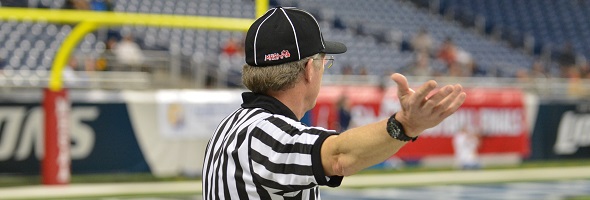
This week, MHSAA assistant director Brent Rice explains why seven-person crews are used at the Semifinals and Finals rounds of the 11-Player Football Playoffs.
Be The Referee is a series of short messages designed to help educate people on the rules of different sports, to help them better understand the art of officiating, and to recruit officials.
Below is this week's segment – 7-Person Football Crews - Listen
Since 2015, the MHSAA has used seven-person football officiating crews at the Semifinal and Final levels of our 11-player tournament. These larger crews replaced the traditional five-person crews in the 24 most important games of the football season.
Seven-person crews, which for many years were the size of NCAA and NFL crews, provide for much better coverage in the passing and running games with all of the spread offenses and wide-open attacks that have become commonplace in recent years in high school football.
By adding the two extra officials on each deep sideline, coaches have now two officials to communicate with on each sideline to answer questions and address concerns.
Past editions
November 1: Overtime Differences - Listen
October 25: Trickery & Communication - Listen
October 18: Punts & Missed Field Goals - Listen
October 11: What Officials Don't Do - Listen
October 4: Always 1st-and-Goal - Listen
September 27: Unique Kickoff Option - Listen
September 20: Uncatchable Pass - Listen
September 13: Soccer Rules Change - Listen
September 6: You Make the Call: Face Guarding - Listen
August 30: 40-Second Play Clock - Listen
August 23: Football Rules Changes - Listen