


Be the Referee: Free Throw Change
January 12, 2017
This week, MHSAA assistant director Mark Uyl discusses one of the most significant rules changes of this winter season, regarding basketball free throws.
Be The Referee is a series of short messages designed to help educate people on the rules of different sports, to help them better understand the art of officiating, and to recruit officials.
Below is this week's segment – Free Throw Change - Listen
One of the big changes in basketball this year deals with the free throw and movement along the lane.
Players who are in the lane in marked spaces can enter the lane as soon as the free throw is released by the shooter. The big change for this year is that no player – defensive or offensive – can enter the semicircle where the shooter has shot the ball from until the ball either hits the rim or the free throw ends.
In recent years, we’ve seen players move into the semi-circle, making early contact with the shooter before the ball has hit the rim.
Past editions
Jan. 5: Ratings - Listen
Dec. 22: Video Review - Part 2 - Listen
Dec. 15: Video Review - Part 1 - Listen
Dec. 8: Registration - Part 2 - Listen
Dec. 1: Registration - Part 1 - Listen
Nov. 24: You Make the Call - Sleeper Play - Listen
Nov. 17: Automatic 1st Downs - Listen
Nov. 10: Uncatchable Pass - Listen
Nov. 3: The Goal Line - Listen
Oct. 27: Help Us Retain Officials - Listen
Oct. 20: Point After Touchdown - Listen
Oct. 13: Untimed Down - Listen
Oct. 6: Soccer Penalty Kick Change - Listen
Sept. 29: Preparation for Officials - Listen
Sept 22: You Make the Call: Returning Kickoffs - Listen
Sept. 15: Concussions - Listen
Sept 8: Equipment Covering the Knees - Listen
Sept. 1: Play Clock Experiment - Listen
Aug. 25: Clipping in the Free Blocking Zone - Listen
Be the Referee: Sideline Management
December 5, 2014
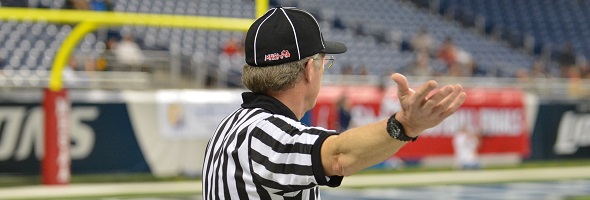
This week, MHSAA assistant director Mark Uyl dicusses how the sideline rule helps to keep the adults working in football, including coaches and officials, safe during football games.
"Be the Referee" is designed to help educate people on the rules of different sports, to help them better understand the art of officiating and to recruit officials. The segment can be heard on Mondays, Wednesdays and Fridays during the school year on The Drive With Jack Ebling on WVFN-AM, East Lansing.
Below is this week's segment - Sideline Management - Listen
The hottest topic right now in the sport of football deals with safety. We have talked a great deal over the fall about some new rules that have improved player safety. Today we’re going to focus on the adults - specifically coaches and officials that work at the sideline area just in front of the team box.
The rules require that from the time just before the snap until the end of the play, all coaches and team personnel must be completely out of the 6-foot safety zone located in front of the team box at each sideline. This then gives the official plenty of room to work unimpeded in either direction.
Now as soon as the play ends, coaches can move into this area to instruct their players or send in the next play and then move back prior to the next snap.
Past editions
Nov. 19 - 7-Person Mechanics - Listen
Nov. 12 - Blocking Below the Waist - Listen
Nov. 5 - Tournament Selection - Listen
Oct. 29 - Uncatchable Pass - Listen
Oct. 22 - Preparation for Officials - Listen
Oct. 15 - Automatic First Downs - Listen
Oct. 8 - Officials & Injuries - Listen
Oct. 1 - Overtime - Listen
Sept. 25 - Field Goals - Listen
Sept. 18 - Tackle Box - Listen
Sept. 11 - Pass Interference - Listen
Aug. 25 - Targeting - Listen