

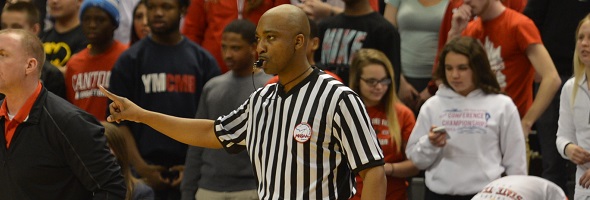
Be the Referee: Hockey Officials' Options
January 21, 2016
This week, MHSAA assistant director Mark Uyl explains how changes to hockey penalties are helping to keep athletes safe.
Be The Referee is a series of short messages designed to help educate people on the rules of different sports, to help them better understand the art of officiating, and to recruit officials.
Below is this week's segment - Hockey Officials' Options - Listen
Like all contact and collision sports, ice hockey is reviewing all playing rules with an emphasis and focus on increased player safety.
In the past, cross-checking, elbowing, goalkeeper contact, kneeing, slashing, tripping and roughing had options for a 2-minute minor or 5-minute major penalties. These violations now will include an option for game disqualification.
Fouls for grabbing the facemask and head butting had options for a 5-minute major penalty or game disqualification. These violations now include an option for a 5-minute major plus a 10-minute misconduct.
In addition, holding, hooking, interference/obstruction and bodychecking (girls teams) had the option of a 2-minute minor penalty. These fouls now will include the option for a 5-minute major penalty or game disqualification.
These changes are all ways to keep the game hockey as safe as possible for all high school athletes.
Past editions:
Jan. 14: Recruiting Officials - Listen
Jan. 7: Wrestling Weight Monitoring - Listen
Dec. 31: Respect for Referees - Listen
Dec. 24: Basketball Instant Replay - Listen
Dec. 17: Basketball Communication - Listen
Dec. 10: Basketball Excessive Contact - Listen
Nov. 26: Pregame Communication - Listen
Nov. 19: Trick Plays - Listen
Nov. 12: 7-Person Football Mechanics - Listen
Nov. 5: Make the Call: Personal Fouls - Listen
Oct. 29: Officials Demographics - Listen
Oct. 15: Make the Call: Intentional Grounding - Listen
Oct. 8: Playoff Selection - Listen
Oct. 1: Kick Returns - Listen
Sept. 24: Concussions - Listen
Sept. 17: Automatic First Downs - Listen
Sept. 10: Correcting a Down - Listen
Sept 3: Spearing - Listen
Aug. 27: Missed Field Goal - Listen
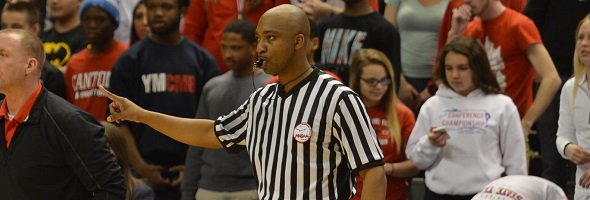
Be the Referee: Cheer Safety
February 11, 2015
This week, MHSAA assistant director Mark Uyl explains how a safe environment is created for Michigan's competitive cheerleaders.
Be The Referee is a series of short messages designed to help educate people on the rules of different sports, to help them better understand the art of officiating, and to recruit officials.
Below is this week's segment - Cheer Safety - Listen
Cheerleaders – usually at the college level - get in the sports headlines whenever an accident occurs causing a serious injury. In Michigan, the sport of Competitive Cheer doesn’t make the news in that regard.
Why? Because this sport, created by Michigan schools, has built-in safety guidelines for competition, including the proper matting, rules which prohibit dangerous stunts, and safety judges observing the routines, whose responsibility is to detect, record and report safety violations when they occur, and to penalize those who commit them.
This format is exclusive to Michigan and just another way that high school sports take the extra step to make the games our children play as safe as they can possibly be.
Past editions
Feb. 2 - Basketball PA Announcers - Listen
Jan. 26 - Wrestling Health Concerns - Listen
Jan. 19 - Basketball Physical Contact - Listen
Jan. 12 - Video Review Part 2 - Listen
Dec. 29 - Video Review Part 1 - Listen
Dec. 17 - Registration Part 2 - Listen
Dec. 10 - Registration Part 1 - Listen
Dec. 3 - Legacy Program - Listen
Nov. 26 - Sideline Management - Listen
Nov. 19 - 7-Person Mechanics - Listen
Nov. 12 - Blocking Below the Waist - Listen
Nov. 5 - Tournament Selection - Listen
Oct. 29 - Uncatchable Pass - Listen
Oct. 22 - Preparation for Officials - Listen
Oct. 15 - Automatic First Downs - Listen
Oct. 8 - Officials & Injuries - Listen
Oct. 1 - Overtime - Listen
Sept. 25 - Field Goals - Listen
Sept. 18 - Tackle Box - Listen
Sept. 11 - Pass Interference - Listen
Aug. 25 - Targeting - Listen