


Be the Referee: Hurdling
November 9, 2017
In this week's edition, assistant director Mark Uyl explains when hurdling a defender is and isn't allowed in football.
Be The Referee is a series of short messages designed to help educate people on the rules of different sports, to help them better understand the art of officiating, and to recruit officials.
Below is this week's segment – Hurdling - Listen
While we don’t see it very often, one of most unique football rules at the high school level deals with the prohibition about a runner hurdling over a defender.
Whenever a ball carrier is moving down the field and a defender is coming over to make that tackle, the only time that ball carrier can hurdle the defender – and by hurdle we mean trying to go over the top of the defender, leading with their foot first – the only time they can hurdle that defender is when the defender is contacting the ground with more than just their feet and hands.
So if that defender is lying on the ground, a hurdle is a legal move. However, if that defender is still on their feet, hurdling would result in a foul.
Past editions
November 2: The Survey Says - Listen
October 26: Helmet Comes Off - Listen
October 19: Goal Line Rules - Listen
October 12: No 1st-Year Fee - Listen
October 5: Athletic Empty Nesters - Listen
September 28: Misunderstood Football Rules: Kicking - Listen
September 21: Preparation for Officials - Listen
September 14: Always Stay Registered - Listen
September 7: Other Football Rules Changes - Listen
August 31: Pop-Up Onside Kicks - Listen
August 24: Blindside Blocks - Listen
In Memoriam: Paul Price (1950-2023)
By
Geoff Kimmerly
MHSAA.com senior editor
July 14, 2023
The MHSAA recently published its annual list of officials who have reached milestone years in their service to Michigan school sports. On the “40 Years” registration list was the name of Paul Price, a longtime official most recently from Republic who has been missed greatly especially in the Upper Peninsula officiating community since his death in January.
Price, who died Jan. 9 at the age of 72, began his officiating career with the MHSAA with basketball during the 1973-74 school year. Also an educator, he taught, directed, administrated and coached in Michigan, Colorado and Michigan again. He added softball and volleyball to his officiating in 1991-92, football in 1995-96, and over the last eight years was registered in football, basketball, volleyball, cross country and track & field while also taking an active roll in leadership and mentorship in those communities.
He was a mainstay at the Upper Peninsula Track & Field Finals and was missed there at this season’s championship event in June. He’ll be missed similarly in November at the 8-Player Football Finals at Northern Michigan University, where he’d coordinated the chain crew for the MHSAA’s two championship games at the Superior Dome.
Price was a graduate of East Lansing High School and Central Michigan University, and finished his educational career in 2011 as superintendent of Republic-Michigamme Schools. He previously had served as principal and athletic director at Fife Lake Forest Area among other stops, and he was recalled as a mentor to administrators as well during his many years in education.
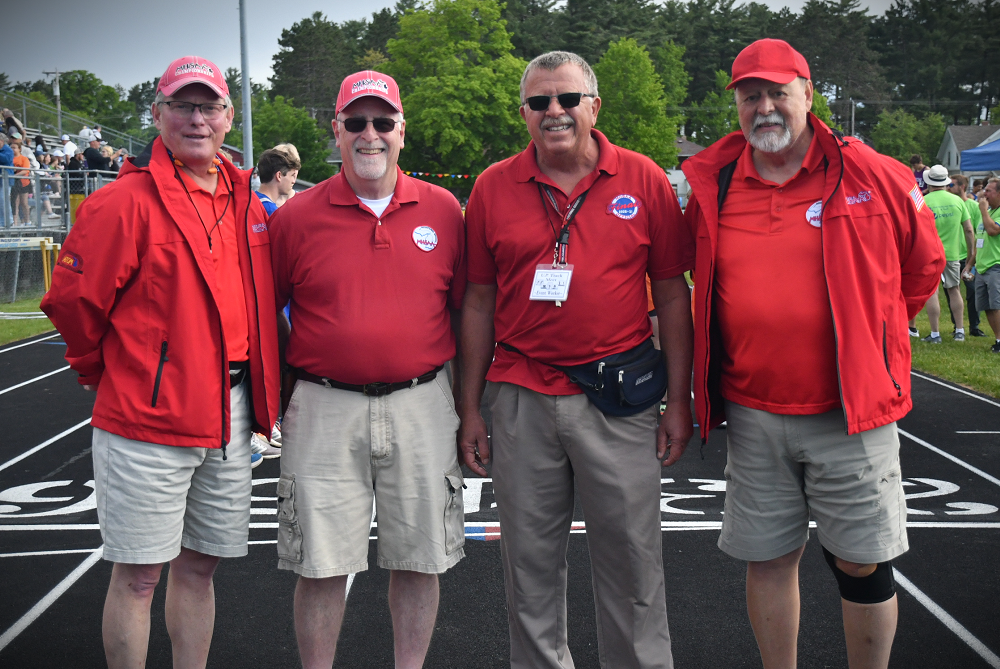
PHOTO Paul Price, second from left, takes a minute for an officials photo during the 2022 Upper Peninsula Track & Field Finals at Kingsford. (Photo by Cara Kamps.)