

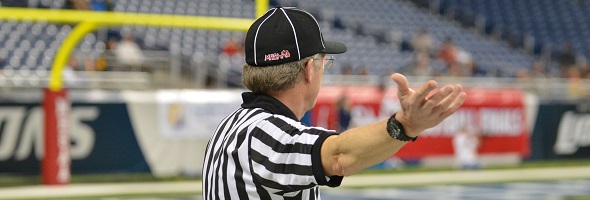
Be the Referee: Playoff Selection
October 7, 2015
This week, MHSAA assistant director Mark Uyl explains how officials are chosen to work football playoff games.
Be The Referee is a series of short messages designed to help educate people on the rules of different sports, to help them better understand the art of officiating, and to recruit officials.
Below is this week's segment - Playoff Selection - Listen
As the regular season reaches the halfway point, the MHSAA begins to look ahead to the five weeks of the football playoffs. Crews and officials are selected at mid-season for the tournament based on a number of factors.
Each official receives a rating from both schools following every game worked, and this rating average serves as the starting point for selection with the highest rated crews being considered first. The MHSAA also considers experience of the crew, recommendations for leagues and officials associations, football rule exam score (from a test) each official completes as well as the strength of the schedule the crew has worked during the season.
All of these factors are considered when selecting the very best officials to work the most important games of the season.

Be the Referee: Basket Interference
March 14, 2019
This week, MHSAA officials coordinator Sam Davis takes us through a basketball scenario where there is simultaneous basket interference by both teams.
Be The Referee is a series of short messages designed to help educate people on the rules of different sports, to help them better understand the art of officiating, and to recruit officials.
Below is this week's segment – Basket Interference - Listen
Let's see if you can make the call on this basketball play:
A player on the blue team drives toward the basket and attempts a shot. The ball banks off the backboard and heads towards the rim. While the ball is on the rim, another player from the blue team and a player from the red team hit it at the same time and it falls into the basket. You make the call: Does the basket count, or do you call basket interference, and on which team? And which team gets the ball?
If a player from each team touches the ball on the rim at the same time, you have simultaneous basket interference, and the ball is instantly dead. There is no basket, and you resume action with the ball being put into play by the team with the alternating possession arrow.
Past editions
March 7: Primary Areas - Listen
February 28: Under the Bus - Listen
February 21: You Make the Call - Listen
February 14: Because They Love It - Listen
February 7: Coach/Official Communication - Listen
January 31: Backcourt Violation? - Listen
January 24: Required Hockey Equipment - Listen
January 17: You Make the Call: 10-Second Clock - Listen
January 10: Tripping in Hockey - Listen
January 3: Sliding in Basketball - Listen
December 27: Stalling in Wrestling - Listen
December 20: Basketball: You Make the Call - Listen
December 13: Basketball Uniform Safety - Listen
December 6: Coaching Box Expansion - Listen
November 29: Video Review, Part 2 - Listen
November 22: Video Review, Part 1 - Listen
November 15: You Make the Call - Sleeper Play - Listen
November 8: 7-Person Football Crews - Listen
November 1: Overtime Differences - Listen
October 25: Trickery & Communication - Listen
October 18: Punts & Missed Field Goals - Listen
October 11: What Officials Don't Do - Listen
October 4: Always 1st-and-Goal - Listen
September 27: Unique Kickoff Option - Listen
September 20: Uncatchable Pass - Listen
September 13: Soccer Rules Change - Listen
September 6: You Make the Call: Face Guarding - Listen
August 30: 40-Second Play Clock - Listen
August 23: Football Rules Changes - Listen