

Be the Referee: Registration - Part 1
December 11, 2014
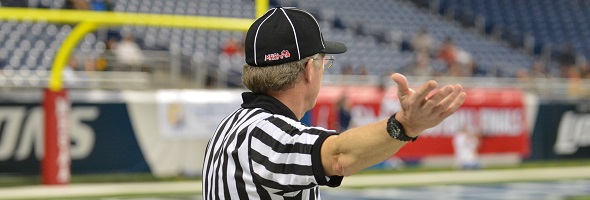
This week, MHSAA assistant director Mark Uyl dicusses the first step in becoming an MHSAA registered official.
"Be the Referee" is designed to help educate people on the rules of different sports, to help them better understand the art of officiating and to recruit officials. The segment can be heard on Mondays, Wednesdays and Fridays during the school year on The Drive With Jack Ebling on WVFN-AM, East Lansing.
Below is this week's segment - Registration Part 1 - Listen
Today we are going to talk about how a person becomes an MHSAA registered official. Depending on the sport, that could mean a referee, umpire or judge.
The first step in the process is to contact the MHSAA and identify the sport or sports in which a person wants to become an official. The next step is to complete the MHSAA Officials Guidebook Exam.
The Officials Guidebook covers some of the basic elements and procedures that are necessary in becoming a sports official. Things such as game assignments, payment of game fees, playing rules and ejection protocols are covered in this first step of the process.
Past editions
Dec. 3 - Legacy Program - Listen
Nov. 26 - Sideline Management - Listen
Nov. 19 - 7-Person Mechanics - Listen
Nov. 12 - Blocking Below the Waist - Listen
Nov. 5 - Tournament Selection - Listen
Oct. 29 - Uncatchable Pass - Listen
Oct. 22 - Preparation for Officials - Listen
Oct. 15 - Automatic First Downs - Listen
Oct. 8 - Officials & Injuries - Listen
Oct. 1 - Overtime - Listen
Sept. 25 - Field Goals - Listen
Sept. 18 - Tackle Box - Listen
Sept. 11 - Pass Interference - Listen
Aug. 25 - Targeting - Listen
Be the Referee: Always 1st-and-Goal
October 3, 2018
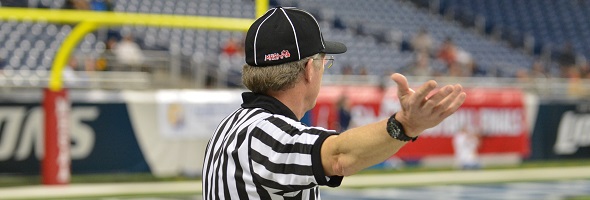
This week, MHSAA assistant director Brent Rice explains how every series of high school football overtime in Michigan begins with 1st-and-Goal.
Be The Referee is a series of short messages designed to help educate people on the rules of different sports, to help them better understand the art of officiating, and to recruit officials.
Below is this week's segment – Always 1st-and-Goal - Listen
In Michigan, football overtime for each team starts with 1st-and-goal at the 10-yard line. Other states which allow overtime to begin anywhere from the 10 to the 25-yard line, and in some of those states, you could actually pick up a first down while on offense.
But Michigan is always 1st-and-goal. Even in those situations where a dead ball foul from the end of the first team’s possession in an overtime may start the second team’s series at the 25 – it is still 1st-and-goal.
The only way a team on offense can pick up a first down in overtime is on a penalty providing yardage plus an automatic first down, and those are only the roughing calls – roughing the passer, the kicker, the holder and the long snapper.
Past editions
September 27: Unique Kickoff Option - Listen
September 20: Uncatchable Pass - Listen
September 13: Soccer Rules Change - Listen
September 6: You Make the Call: Face Guarding - Listen
August 30: 40-Second Play Clock - Listen
August 23: Football Rules Changes - Listen