

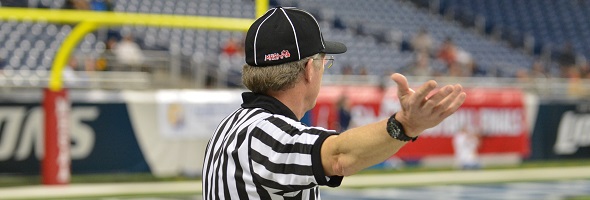
Be the Referee: The Survey Says
November 2, 2017
In this week's edition, assistant director Mark Uyl explains how a recently completed national survey will assist in the recruitment of officials.
Be The Referee is a series of short messages designed to help educate people on the rules of different sports, to help them better understand the art of officiating, and to recruit officials.
Below is this week's segment – The Survey Says - Listen
Over the years, the officiating industry has really struggled with the fact that there’s been very little data out there to really understand who officials are. This kind of data would be very helpful as the MHSAA continues to recruit, retain and train our officials.
The National Association of Sports Officials just conducted a national survey in which nearly 20,000 amateur sports officials responded about who they are, their education level and where they’re from. It’s some of this national data that will now allow us to make better decisions as we continue to recruit and keep the officiating ranks in Michigan strong.
Past editions
October 26: Helmet Comes Off - Listen
October 19: Goal Line Rules - Listen
October 12: No 1st-Year Fee - Listen
October 5: Athletic Empty Nesters - Listen
September 28: Misunderstood Football Rules: Kicking - Listen
September 21: Preparation for Officials - Listen
September 14: Always Stay Registered - Listen
September 7: Other Football Rules Changes - Listen
August 31: Pop-Up Onside Kicks - Listen
August 24: Blindside Blocks - Listen

2015-16 Officials Registration Underway
June 15, 2015
By Geoff Kimmerly
Second Half editor
The Michigan High School Athletic Association is accepting registrations by mail and online for game officials for the 2015-16 school year.
The MHSAA annually receives registration by more than 10,000 officials, and had 10,305 during the 2014-15 school year. The highest total of officials registered for basketball, 4,469, with football, baseball and softball all with more than 2,000 registered officials during this school year.
For all new and returning officials, those who register online again will receive a $5 discount off their processing fees. A $12 fee is charged for each sport in which an official wishes to register, and the online processing fee is $30. Officials submitting registration forms by mail or on a walk-up basis will incur a $35 processing fee. Officials registered in 2014-15 will be assessed a late fee of $30 for registration after Aug. 3. The processing fee includes liability insurance coverage up to $1 million for officials while working contests involving MHSAA schools.
Click to learn more about online registration on the MHSAA Website. Forms also are available online that can be printed and submitted by traditional mail or hand delivery to the MHSAA Office. More information about officials registration may be obtained by contacting the MHSAA at 1661 Ramblewood Drive, East Lansing, MI, 48823, by phone at (517) 332-5046 or by e-mail at [email protected].
There is an officials' registration test for first-time officials and officials who were not registered during the past school year. The test consists of 45 questions derived from the MHSAA Officials Guidebook, which also is available on the Officials page of the MHSAA Website. Additional 50-question exams must be taken by those registering for football or basketball for the first time or those who were not registered for those sports during the previous school year. Manuals for both sports also are available on the Officials page.
The MHSAA is a private, not-for-profit corporation of voluntary membership by more than 1,400 public and private senior high schools and junior high/middle schools which exists to develop common rules for athletic eligibility and competition. No government funds or tax dollars support the MHSAA, which was the first such association nationally to not accept membership dues or tournament entry fees from schools. Member schools which enforce these rules are permitted to participate in MHSAA tournaments, which attract more than 1.4 million spectators each year.