

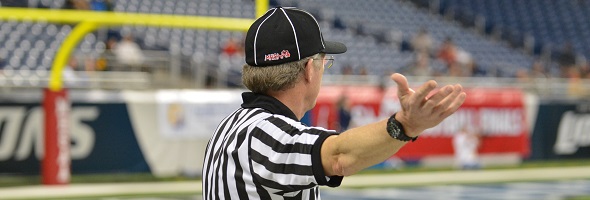
Be the Referee: Trick Plays
November 19, 2015
This week, MHSAA assistant director Mark Uyl explains which trick plays in football are allowed, and not allowed, under high school rules.
Be The Referee is a series of short messages designed to help educate people on the rules of different sports, to help them better understand the art of officiating, and to recruit officials.
Below is this week's segment - Trick Plays - Listen
In some of the biggest football games of the year, often times a trick play can be the difference between winning and losing.
Many types of these trick plays are perfectly legal – the halfback pass, the hook and ladder, or the double pass with the first pass being backward behind the line of scrimmage and the second pass going forward. There are several types of trick plays, however, that are prohibited by rule.
One is the old fumblerooski play, where a team intentionally fumbles near the center and a lineman picks up the ball and advances. A second type that is illegal is whenever you’re using substitutions or pretended substitutions to free up a receiver or player standing out along the sidelines.
Past editions:
Nov. 12: 7-Person Football Mechanics - Listen
Nov. 5: Make the Call: Personal Fouls - Listen
Oct. 29: Officials Demographics - Listen
Oct. 15: Make the Call: Intentional Grounding - Listen
Oct. 8: Playoff Selection - Listen
Oct. 1: Kick Returns - Listen
Sept. 24: Concussions - Listen
Sept. 17: Automatic First Downs - Listen
Sept. 10: Correcting a Down - Listen
Sept 3: Spearing - Listen
Aug. 27: Missed Field Goal - Listen
What's My Why: Official Mike VanLaan
May 20, 2026
Mike VanLaan, Alto
VanLaan is completing his eighth year as an MHSAA-registered official. He began with football in 2018-19 and added boys lacrosse the following year.
So in 2018 I decided to get started in officiating. I started with football because that was the sport that gave me the most opportunity when I was younger. I played a lot of football and just wanted to give back to the game.
I loved it so much that I decided I also wanted to add a spring sport. So a couple of years later I added boys lacrosse, and now I officiate high school football and high school boys lacrosse.
Things that drove me to add another sport – just fell in love with the camaraderie, working with other officials, good people. And then also, just realizing how important it is to stay active physically and mentally, and this allows me to do that.
“What’s My Why” is a weekly feature telling the stories of MHSAA-registered officials in their own words. If you’re an MHSAA official and would like to share your reason why, please submit a 15 to 45-second video, taken horizontally, to director of officials Sam Davis at [email protected].
Don't miss Officiate Michigan Day 2026, July 25 in Grand Rapids! Check out MHSAA.com/OMD to register and learn more.
What's My Why
May 20: Clint Abbott, Newaygo - Watch