

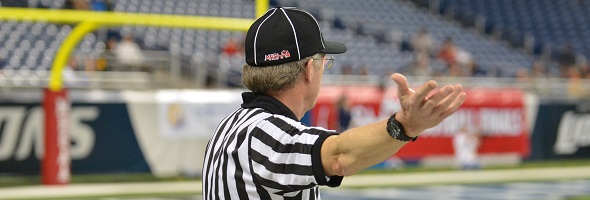
Be the Referee: Uncatchable Pass
October 30, 2014
This week, MHSAA assistant director Mark Uyl explains the differences between high school and college and pro rules when it comes to an uncatachable pass.
"Be the Referee" is designed to help educate people on the rules of different sports, to help them better understand the art of officiating and to recruit officials. The segment can be heard on Mondays, Wednesdays and Fridays during the school year on The Drive With Jack Ebling on WVFN-AM, East Lansing.
Below is this week's segment - Uncatchable Pass - Listen
Today we’re going to talk about one of the most misunderstood rules at the high school level, and that deals with the uncatchable pass.
All of us have sat in front of our televisions on Saturday or Sunday and seen the long pass get thrown, followed immediately by the throwing of the flag. As the officials discuss what happened, the referee invariably clicks on the microphone and announces that there is no foul for pass interference because the pass was uncatchable.
At the high school level, that is not a factor in deciding whether or not pass interference has occurred. The ball does not have to be catchable, and if the contact is ruled as pass interference, that foul stands, regardless of the quality of the pass.
Past editions
Oct. 22 - Preparation for Officials - Listen
Oct. 15 - Automatic First Downs - Listen
Oct. 8 - Officials & Injuries - Listen
Oct. 1 - Overtime - Listen
Sept. 25 - Field Goals - Listen
Sept. 18 - Tackle Box - Listen
Sept. 11 - Pass Interference - Listen
Aug. 25 - Targeting - Listen

Be the Referee: You Make the Call
February 21, 2019
This week, MHSAA officials coordinator Sam Davis takes us through a "You Make the Call" scenario in basketball.
Be The Referee is a series of short messages designed to help educate people on the rules of different sports, to help them better understand the art of officiating, and to recruit officials.
Below is this week's segment – You Make the Call - Listen
Let’s test your rules knowledge with this basketball “you make the call.”
A player on the red team drives for the basket, and as he leaps into the air, a defender from the green team knocks the ball loose prior to the release of the shot. The red team player, still airborne, regains control of the loose ball, returns to the floor, starts to dribble again and scores.
You Make The Call – Do we have a traveling violation, a double dribble violation, or does play continue?
If you said play continues – you’re right. Under Rule 9-5 in the National Federation Basketball Rules Book, the loose ball created by the defender’s actions allows the offensive player to basically start a new possession. There is no violation, and the basket counts.
Past editions
February 14: Because They Love It - Listen
February 7: Coach/Official Communication - Listen
January 31: Backcourt Violation? - Listen
January 24: Required Hockey Equipment - Listen
January 17: You Make the Call: 10-Second Clock - Listen
January 10: Tripping in Hockey - Listen
January 3: Sliding in Basketball - Listen
December 27: Stalling in Wrestling - Listen
December 20: Basketball: You Make the Call - Listen
December 13: Basketball Uniform Safety - Listen
December 6: Coaching Box Expansion - Listen
November 29: Video Review, Part 2 - Listen
November 22: Video Review, Part 1 - Listen
November 15: You Make the Call - Sleeper Play - Listen
November 8: 7-Person Football Crews - Listen
November 1: Overtime Differences - Listen
October 25: Trickery & Communication - Listen
October 18: Punts & Missed Field Goals - Listen
October 11: What Officials Don't Do - Listen
October 4: Always 1st-and-Goal - Listen
September 27: Unique Kickoff Option - Listen
September 20: Uncatchable Pass - Listen
September 13: Soccer Rules Change - Listen
September 6: You Make the Call: Face Guarding - Listen
August 30: 40-Second Play Clock - Listen
August 23: Football Rules Changes - Listen