

Become an Official: HS Sports Need You
January 24, 2018
By Bob Gardner, Executive Director of the National Federation of State High School Associations
and Mark Uyl, Assistant Director of the Michigan High School Athletic Association
They don’t make the headlines, their names are not in the box scores and they don’t make the all-star teams. But perhaps the most important individuals in high school sports are the contest officials.
These individuals are so important that, in fact, there would be no organized competitive sports at the high school level without the men and women who officiate these contests every day across the country. Subtract the dedicated men and women who officiate high school sports, and competitive sports would no longer be organized; they would be chaotic.
In some areas of our country, high school officials are retiring faster than new ones are being added. And junior varsity, freshmen and middle school games are being postponed – or even cancelled – because there are not enough men and women to officiate them.
Anyone looking for a unique way to contribute to the local community should consider becoming a registered high school official. For individuals who played sports in high school, officiating is a great way to stay close to the sport after their playing days have ended. Officiating helps people stay in shape, expands their social and professional networks and offers part-time work that is flexible, yet pays. In fact, officiating is a form of community service, but with compensation.
Another benefit of officiating is that individuals become role models so that teenagers in the community can learn the life lessons that high school sports teach. Students learn to respect their opponents and the rules of the game and the importance of practicing good sportsmanship thanks, in part, to those men and women who officiate. And the objectivity and integrity that high school officials display is an example that every young person needs to observe firsthand. In short, communities around the country will be stronger because of the life lessons that high school officials help teach the next generation.
Officiating is a great way to stay connected to sports and to give back to the local high school and community. We need dedicated men and women to become involved so that high school sports can continue to prosper for years to come.
Individuals interested in learning more about becoming a high school official, and even beginning the application process, can do so at www.HighSchoolOfficials.com.
Norris Honoree Continues Setting Standards on Track, as Mentor
By
Geoff Kimmerly
MHSAA.com senior editor
May 19, 2021
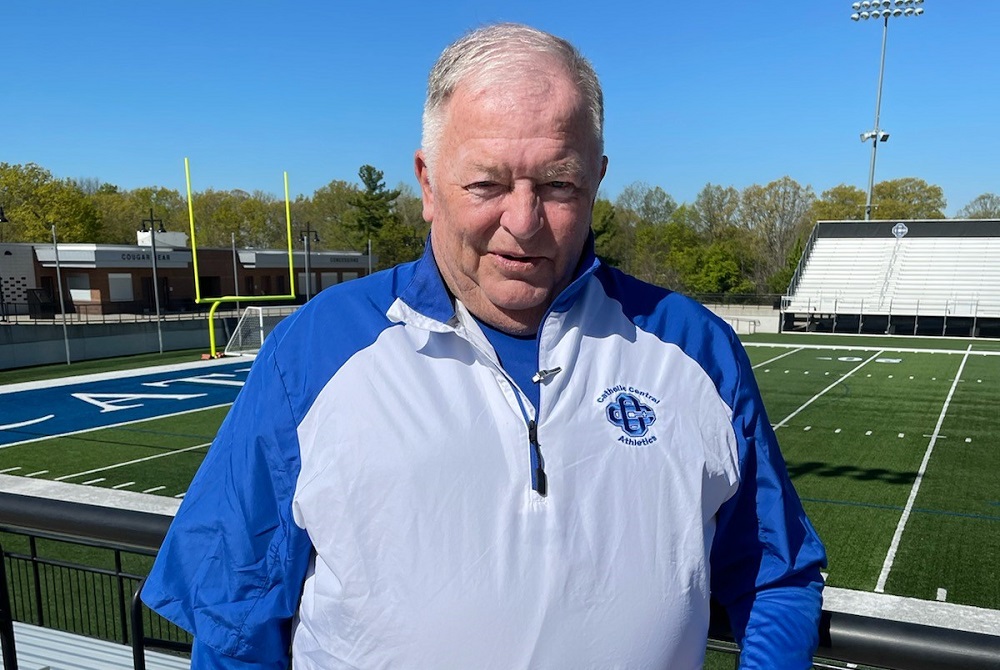
A staple of Michigan High School Athletic Association postseason track & field events for more than three decades, Grand Rapids’ Lewis Clingman continues to serve as an easily-recognizable host of Regionals and Finals in that sport for teams from all over the Lower Peninsula each spring.
But his tireless service to school sports stretches across the entire school year and is rooted in 53 years as an MHSAA-registered game official, and those contributions are being celebrated with his selection for this year’s MHSAA Vern L. Norris Award.
The Norris Award is presented annually to a veteran official who has been active in a local officials association, has mentored other officials, and has been involved in officials’ education. It is named for Vern L. Norris, who served as executive director of the MHSAA from 1978-86 and was well-respected by officials on the state and national levels.
Clingman was to be honored with his Norris Award this month at the MHSAA’s 41st Officials’ Awards & Alumni Banquet. However, the banquet was canceled for the second-straight year due to safety concerns because of COVID-19. He instead will accept his award as part of a virtual banquet to be published on the MHSAA Website and social media feeds later this spring.
Clingman first registered as an MHSAA official for the 1968-69 school year, to work track & field, basketball, baseball and softball. He has registered for track & field throughout his 53-year officiating tenure, and added cross country during the 2009-10 school year. He has officiated nine cross country and four track & field MHSAA Finals.
But that just scratches the surface of his many contributions. He is noted by many as a mentor – 2018 Norris Award honoree Jill Baker-Cooley that year specifically recognized Clingman among those who assisted her in getting started in the avocation. He also has been a catalyst of the MHSAA Lower Peninsula Track & Field Finals’ two-decade run in the Grand Rapids area, where as a meet manager he continues to schedule and organize officials for all four locations of the season-ending series.
“I love being with the kids. It’s for the kids. And that’s why we’re here,” Clingman said. “The camaraderie with the other professionals that I’m with, and just watching the successes that go on. … But I love being with the kids. My kids are all gone; they’re all over the country, my grandkids are around the country. This is a great way to substitute (by serving) the kids who are here.
“If you’re in this for ego, you’re in the wrong business. And if you’re in this to make a lot of money and retire, you’re in the wrong business. When you think about it, 50 years of officiating, there’s a lot of (officials) who don’t last that long – they don’t because they’re not in the right business. But there’s a lot of people in this area, that are officiating, have been officiating, who will be (longtime officials) because they do it for the right reason.”
Clingman is a longtime member of the Association of Track Officials of Michigan (ATOM) and has received its Bob Bloomer Award, Bernie Abrams President’s Leadership Award, Art Jevert/Bruce Jacobs Distinguished Service Award, and three times its Past President’s Service Award. He also is a member of the West Michigan Officials Association.
Clingman also has served more than 40 years as an administrator, teacher and coach. He began his career at Holy Trinity Catholic School in Comstock Park, serving as middle school athletic director and basketball coach while also coaching football and track at Comstock Park High School. He served as head boys basketball and track coach and football assistant at Grand Rapids Kenowa Hills during the second half of the 1970s and after also serving as head basketball coach for five seasons at St. Joseph’s Prep in Grand Rapids.
He moved on to serve as athletic director at East Grand Rapids High School, then after a brief stint in the business world began a 20-year tenure teaching middle school for Grand Rapids Public Schools before retiring from GRPS in 2011. During that time he became the spring event manager at Houseman Field, where at its peak he hosted on average a combined nine high school and college track meets per week. He also during his time at GRPS served as an assistant coach in football, basketball and track at Grand Rapids Catholic Central. He joined the staff at Catholic Central seven years ago and continues to serve as event manager and assistant to the athletic director.
Clingman was added to the Grand Rapids Catholic Central Wall of Honor in 2016 and has received a GRPS service award.
“Lew has been someone who has given tirelessly, most of all of his time, over the years to really benefit not just officiating but school sports as a whole,” MHSAA Executive Director Mark Uyl said. “The work Lew has done, specifically recruiting and training track & field officials – providing for a sport we don’t think of very often as having those needs – and the work he’s done with ATOM has just been incredible. There’s been nobody more important to the track & field and cross country officiating community than Lew Clingman.”
Clingman graduated from Grand Rapids Catholic Central in 1965 and with bachelor’s degrees in history, physical education and English from Aquinas College in 1969. He earned a master’s in secondary administration from Michigan State University in 1978.
In addition to his continued service to Catholic Central, Clingman serves on the Aquinas Hall of Fame Committee and Alumni Association board, and on the Grand Rapids Public Schools committee for Houseman Field renovation. He also serves as an official for local Special Olympics events.
Clingman and his wife Cindy have been married 52 years. They have four children, 13 grandchildren and one great-grandchild.
Previous recipients of the Norris Award:
1992 – Ted Wilson, East Detroit
1993 – Fred Briggs, Burton
1994 – Joe Brodie, Flat Rock
1995 – Jim Massar, Flint
1996 – Jim Lamoreaux, St. Ignace
1997 – Ken Myllyla, Escanaba
1998 – Blake Hagman, Kalamazoo
1999 – Richard Kalahar, Jackson
2000 – Barb Beckett, Traverse City; Karl Newingham, Bay City
2001 – Herb Lipschultz, Kalamazoo
2002 – Robert Scholie, Hancock
2003 – Ron Nagy, Hazel Park
2004 – Carl Van Heck, Grand Rapids
2005 – Bruce Moss, Alma
2006 – Jeanne Skinner, Grand Rapids
2007 – Terry Wakeley, Grayling
2008 – Will Lynch, Honor
2009 – James Danhoff, Richland
2010 – John Juday Sr., Petoskey
2011 – Robert Williams, Redford
2012 – Lyle Berry, Rockford
2013 – Tom Minter, Okemos
2014 – Hugh R. Jewell, West Bloomfield
2015 – Sam Davis, Lansing
2016 – Linda Hoover, Marshall
2017 – Michael Gentry, Shelby Township
2018 – Jill Baker-Cooley, Big Rapids
2019 – David Buck, St. Joseph
2020 – Hugh Matson, Saginaw
High school game officials with 20, 30, 40, 45 and 50 years of service also are being honored with service awards. Twenty-three officials with 50 years of service are being honored, along with 49 officials with 45 years. A 40-year award is being presented to 40 officials. In addition, 98 officials with 30 years and 181 officials with 20 years of experience are being honored.
MICHIGAN HIGH SCHOOL ATHLETIC ASSOCIATION
20, 30, 40, 45 & 50-YEAR OFFICIALS
The officials on this list are receiving their 20, 30, 40, 45 or 50-year service awards.
20-YEAR OFFICIALS
Ada - Carl J. Cress
Alto - Joseph E. Geroux
Alto - Jeff A. Harp
Ann Arbor - Dana P. Fuller
Ann Arbor - Thomas R. Sumner
Armada - David R. Coenen
Battle Creek - Douglas R. Jones
Battle Creek - Steven C. Peine
Battle Creek - Ronald D. Stewart
Battle Creek - Pete A. Zapata
Bay City - Robert A. Bluhm Jr.
Bay City - Brad G. Champagne
Bay City - William R. Walter
Belleville - Rodney M. Sullens
Belmont - Duncan Powell
Berkley - Tony A. Beaulieu
Breckenridge - Gerald W. Saunders
Brighton - Melissa M. Flores
Brockway - Dennis L. Gerlach
Brownstown - Larry D. Pierce
Brownstown - Michael V. Roach
Brownstown Township - Joseph P. Ciaravino
Brownstown Township - Franco Gonzalez Jr.
Bruce Township - Nicholas G. Nowakowski
Burt - William J. Carstens
Burt - Ryan D. Galloway
Cadillac - Steve W. Fuhst
Caledonia - Daniel A. Stockel
Canton - Robert L. Altizer
Canton - Steve Nesovski
Cheboygan - Gail N. Scharffe III
Chesaning - Leonard L. Strait Jr.
Clinton Township - Arthur D. Jones
Clinton Township - Rachel M. Krone
Clinton Township - David T. Ryall
Coldwater - Scott D. Galloway
Crystal Falls - Thomas P. Courchaine
Davison - Joseph Whitman
Dearborn - Joseph D. Corso
Dearborn Heights - Stan M. Karchefske
Deford - Larry R. Barrons
Detroit - Michael G. Byrd
Detroit - Brian K. Smith
Detroit - Gaylon B. Williams
DeWitt - Quentin V. Alverson
Dexter - Robert J. Leadley
Dowagiac - Jim R. Nate
Drummond Island - Jack K. Miles
Empire - Charles M. Leduc
Essexville - Gary P. Schulz
Flint - Matt S. Kateman
Flushing - Todd J. Willis
Frankenmuth - Mark C. Jarlock
Freeland - Jerry J. Haines
Fremont - John H. Pell
Garden City - Lawrence P. Mills
Grand Haven - John F. Jakubiec
Grand Rapids - Steven E. Hedke
Grand Rapids - Michael James
Grand Rapids - Kevin B. Krauss
Grand Rapids - Timothy J. Likens
Grand Rapids - Megan J. Pell
Grand Rapids - Thomas D. Siver
Grand Rapids - Ronald D. Masters
Grandville - Richard J. Funk
Grandville - Troy A. Ungrey
Grawn - Kenneth C. Koehler
Grayling - Timothy J. Swope
Greenville - Martin A. Taylor
Grosse Ile - Raymond D. Geist
Grosse Pointe Farms - William C. Cunningham
Hastings - Andrew L. Discher
Hastings - Pattrick M. Jansens
Hillsdale - Keven D. Wolcott
Holland - Jeffrey A. Carper
Holland - George W. Kantz Jr.
Holland - Michael B. Torrey
Holt - Troy Gladstone
Hubbard Lake - Gary A. Medland
Hudsonville - John D. Wiercinski
Iron Mountain - William D. Edberg
Iron River - Robert P. Busakowski
Ironwood - Don J. Cvengros
Jackson - Nathan A. Gross
Jackson - Scott S. Maurer
Kalamazoo - Timothy J. Eastman
Kalamazoo - Janelle B. Holland
Kalamazoo - Robert A. King
Kalamazoo - Deborah L. Noble
Kalamazoo - Robert V. Wagley
Kalamazoo - Keith Williams
Kaleva - James K. Frizzell Sr.
Kent City - Rick D. Stockhill
Kentwood - Jermaine C. Jennings
Kentwoood - Donell R. Jones
Kingsford - Nicholas L. Gayan
Lake Orion - Michael J. Ley
Lansing - Gary N. Simpson
Lansing - Anthony D. Winston
Lenox Township - John J. Essenmacher
Leslie - Robert V. Barrett
Leslie - Jerry E. Miller
Linwood - Brad T. Wehner
Livonia - Ken Lauer
Lowell - Mark T. Bradburn
Lowell - Paul P. Durkee
Lowell - Chris T. German
Macomb - Gordon Machleit
Macomb Township - Ronald K. Jacobs
Madison Heights - Amy Bessler
Madison Heights - David B. McPhail
Manistee - Curtis J. Mathieu
Marcellus - Wade L. Bent
Marinette - Robert Deschaine Jr.
Marysville - Kevin T. Leeman
Metamora - Noelle R. Cole
Monroe - Kevin J. Holden
Montrose - Mark A. Emmendorfer
Mount Pleasant - Roger L. Lintemuth
Mt. Morris - Robert P. Emery
Mullett Lake - Alan J. Granger
Muskegon Heights - Ronald S. Jenkins
Nashville - Keith H. Jones
Negaunee - Christopher O. Sholander
New Baltimore - Mark W. Masters
North Muskegon - Michael J. Belmonte
Northville - Mark J. Parrinello
Oak Park - Mario Blocton
Oakland - Robert L. Zbytowski
Ontonagon - Jeffery M. Rule
Owosso - Brian L. Mendyk
Paw Paw - Alton J. Laupp
Paw Paw - Rick Jay Mitchell
Perrinton - Dan L. Sweet
Pontiac - John Cantu
Pontiac - Vance L. Hardiman
Portland - Adam J. Schrauben
Portland - Anthony J. Costello
Ravenna - Ted F. May
Remus - John S. Mayer
Rochester - Barbara Gemellaro
Rockford - Michael C. VanDyke
Rockford - John A. Woods
Roscommon - David E. Hansen
Royal Oak - Perry A. Brunetti
Saginaw - Patrick A. Campbell
Saginaw - Felipe Echeverria
Saginaw - Thomas A. Lewis
Saginaw - Daniel A. McIntyre
Saginaw - Barb A. Streeter
Saginaw - Jason R. Wildey
Sebewaing - Cheri L. Nitz
Sebewaing - Holly A. Roth-Guza
Sheridan - James Forton
South Lyon - Christopher R. Duprey
South Lyon - John C. Lindeman
Southfield - Eric V. Lee
St. Helen - Donald W. Clements
St. Johns - Chris H. Hyzer
St. Johns - Penny L. Keener
St. Joseph - Ronald L. Scudder
Stanton - Frank P. Marinello
Sturgis - Jean E. LaClair
Swartz Creek - Bill A. Dean
Swartz Creek - Dennis D. Simnitch
Swartz Creek - Derick R. Woodworth
Temperance - Kevin V. Brown
Three Rivers - Rebecca M. Neff
Three Rivers - Ed M. Smith
Traverse City - Dave R. Jones
Trenton - Eric J. Hoerle
Troy - Darrin Millar
Wakefield - Paul E. Harley
Warren - Roman R. Jablonski
Washington - Douglas H. Lutkenhoff Sr.
Waterford - Dwayne E. Little
Westland - Sharvon M. McNab
White Lake - David J. Schoenegge
White Lake - Keith M. Verellen
Williamston - Aaron L. Porter
Woodland - Kevin J. Duits
30-YEAR OFFICIALS
Adrian - Michael K. Stevenson Jr.
Allegan - Kevin Lawrence Gilligan
Allen Park - James C. Marker
Ann Arbor - Edward J. Mcconnell
Battle Creek - Cary P. Grant
Battle Creek - Roger L. Steele
Battle Creek - Chad D. Jackson
Bay City - Laurence E. Jacobs III
Belding - Francis Mason
Bellevue - Candice J. Whitney
Benton Harbor - Robert A. Edelberg Sr.
Benton Harbor - Larry Edwards
Bessemer - Sandra J. Muzzy
Beulah - Tammy A. Sedlar-Wing
Bridgman - Paul J. Pantaleo
Cadillac - Penny L. McDonald
Caledonia - David J. Driscoll
Cass City - David W. Hoard
Charlevoix - Dennis A. Phelps
Charlevoix - Randy K. Tarzwell
Clark Lake - Mike J. Jordon
Clinton Township - Robert M. Cichowski
Concord - Michael G. Ogden
Dansville - Charles H. Barrett
Detroit - Darlene J. Barber
Detroit - Kathleen S. Bridge
Detroit - Michael J. Dobson
Dowagiac - Randall G. Gross Sr.
East Jordan - Norman J. Vogt
Eastpointe - Jerry VandeVyver
Flat Rock - Theodore M. Wegienka
Flint - Michael D. Moreau
Freeland - Thomas E. Behmlander
Gaylord - David M. Becker
Grand Haven - Scott A. Vanderberg
Grand Rapids - Gene S. Debbaudt
Grand Rapids - Thomas M. Farley
Grand Rapids - Chris LaMange
Grand Rapids - Scott L. Smith
Grand Rapids - Mark D. Swets
Grosse Pointe Farms - Robert B. Conway
Hartford - Jason D. Meachum
Hastings - Stephen J. Laubaugh
Hillsdale - Scott E. Chase
Holland - Steven S. Bredeweg
Holland - William L. Lawton
Holland - Raymond G. Thomas Jr.
Holland - Mark A. Volkers
Holt - John D. Greathouse
Iron Mountain - Edward D. St. Arnauld
Iron River - Curtis J. Olexa
Jenison - Laurie A. DeWitt
Kalamazoo - Chris L. Grimes
Kaleva - Dixie L. Hoeh
Kalkaska - Diane L. Buttermore
Laurium - Matthew Vertin
Lincoln - Tim Paul Somers
Livonia - John P. Morris
Macomb - Douglas J. Rizzi
Mattawan - Michael W. Walters
Midland - John W. Day
Monroe - Douglas Boylan
Mount Pleasant - Brian J. Gould
Mount Pleasant - John Straight
Muskegon - Clinton A. Todd Jr.
Northville - Clinton C. Lawrence
Northville - Aaron M. Woodbury
Norton Shores - Jim P. Adrian
Ottawa Lake - Richard L. Deisler
Plainwell - Pete J. Boyd
Portage - Kevin L. Haun
Portland - Brian D. Russell
Redford - Anthony Johnson
Reed City - Earl G. Kage
Rock - Robert J. VanDamme
Rockford - Brooks McIntyre
Rogers City - Mary E. Fairbanks
Roscommon - Brian W. Reicks
Roseville - Glenn A. Jablonowski
Royal Oak - Raymond L. Smith
Saginaw - Cornelius Walker Jr.
Sault Ste. Marie - Murray J. Meehan
Shelby Township - John M. Rakowski
Southfield - Wallace L. Whitfield
St. Joseph - Kenneth R. Nolte
St. Joseph - Michael J. Petlick
Sterling Heights - Robert M. Iwasko
Stevensville - Howard L. Jackson
Swartz Creek - Richard E. Hunt
Warren - Steve C. Miller
Waterford - Michael Blom
Wayland - Robert J. Wolf
Webberville - Troy B. Perkins
West Branch - Douglas B. Grezeszak
White Lake - Charles E. Johnson Sr.
Wyandotte - Robert C. Wolsek
Wyoming - Carol L. Ross
Zeeland - Gretchen J. Galloway
40-YEAR OFFICIALS
Allen Park - James C. Bales
Battle Creek - David L. Eubank
Battle Creek - Edward B. Smith
Canton - Jeanne L. Martin
Canton - John O. Wright Jr.
Constantine - Marge Caid
Davison - Mitchell J. Olejniczak
Deerfield - William P. Gomoluch
Detroit - Robert W. Kirkland
DeWitt - Mark A. Robinson
Evart - Tom W. Adams
Flushing - Gerald Marenkewicz
Grand Blanc - Curtis L. Williams
Grand Rapids - Michael J. Duffy
Grand Rapids - Thomas D. Shearer
Grand Rapids - Jeffrey A. Wierzbicki
Grosse Pointe Park - Kelvin W. Wise
Grosse Pointe Shores - James L. Valliere
Holt - Lee Rodgers
Howell - Jim A. Murray
Ionia - Michael S. Antonides
Ionia - Mike A. Fuller
Iron Mountain - John N. Meyer
Kentwood - Rick S. Hazel
Lansing - Mark S. Ditsworth
Lapeer - Gordon L. Bade
Livonia - Brian R. Dinsmore
Ludington - John F. Shears
Madison Heights - Wilford J. Laveirge
Maple City - Joseph F. Dechow
Mayville - Clare L. Kreger
Muskegon - Onesiphorus B. Burrel Sr.
Muskegon - Melville B. Foster
Muskegon - Todd R. Geerlings
New Hudson - Dennis E. Evans
Norton Shores - Randall S. Martinus
Okemos - Michael J. Maisner
Plymouth - William R. Baumgart
Portage - Jerry A. Mais
Quincy - Robert C. Coward
Rogers City - Roger M. Wenzel
Roscommon - William A. Root
Smiths Creek - James D. Evans
Spring Lake - Robert L. Mol
Sterling Heights - Philip J. Lieblang
Traverse City - Dennis W. Hall
Troy - Jerald J. Sosnowski
West Branch - Matt Emerick
Wixom - Patrick L. Beagle
Zeeland - Linda S. Schmidt
45-YEAR OFFICIALS
Baraga - James L. Holm
Bloomfield Hills - Dennis F. King
Bloomfield Hills - W. Jack Morris
Bowling Green - Thomas L. Ford
Cadillac - William J. Allen
Caledonia - George B. Watterson
Clarkston - Dale A. Kutchey
Clinton Township - Dennis G. Clark
Essexville - William L. Post
Fairgrove - Jerry L. Lasceski
Flat Rock - Robert J. Brodie
Fort Gratiot - Julius A. Traub
Freeland - Kim D. Heisler
Gaylord - George-Tom T. Johnson
Gaylord - Kevin M. Leary
Gladstone - Wayne W. Marshall
Gladwin - Michael E. Steinkraus
Grand Rapids - Patricia A. Treman
Hancock - John D. Vaara
Hermansville - Robert J. Maule
Highland - Evan H. Lehto
Holland - Mary F. Colenbrander
Holland - Thomas J. Kruithoff
Holland - Barbara A. Shelley
Holland - David W. Smits
Iron Mountain - Jerry Reddinger
Jackson - Ardis Jill Conat
Kaleva - David K. Hoeh
Lansing - Karen L. Yanna
Livonia - Laura J. Alves
Manitou Beach - Allen L. Schuch
McMillan - Cliff J. Fossitt
Michigan Center - Daniel C. Bentschneider
Newberry - Thomas J. Rahilly
Northville - Edward K. Gabrys
Norton Shores - Duane A. VandenHeuvel
Oconto - Peter C. Pericolosi
Pontiac - Jerome C. Chaumley
Portage - Frank S. Gawkowski
Portage - Timothy J. Osterman
Posen - Kenneth Wozniak
Saginaw - John C. Flukes
Saginaw - John E. Oczepek
Sturgis - Raymond Martin
Swartz Creek - David J. Sutton
Three Rivers - Kim D. Losik
Traverse City - Michael J. Muldowney
Troy - James J. Stone
Wyoming - Sandra K. Noto
50-YEAR OFFICIALS
Battle Creek - Richard L. Randle
Bessemer - Henry E. Aapala
Caro - John H. Amend
Comstock Park - Riley S. Swinehart
Delton - Gregory W. Nikitas
Detroit - Richard L. Miller
Grand Rapids - James J. Aalderink
Grand Rapids - George H. Kniola
Holt - John S. Malatinsky
Howell - John S. Hardy
Jackson - Ozzie L. Hashley
Macomb - Chet W. Boss
Marcellus - Deborah L. Schug
Mesick - Paul G. Williams
Owosso - Paul A. Chaffee
Owosso - Edwin L. Rappuhn
Plymouth - Don A. Vogt
Prudenville - Robert J. Studer
Spring Lake - Joseph G. Popiel
Tecumseh - Nancy A. Hebert
Troy - Mike Luttenberger
Warren - Collette C. Hallberg
Warren - William Upina